


Veterans may live with severe pain, frequent headaches, limited mobility, or mental health symptoms that disrupt work, relationships, and everyday activities. However, the intensity of those symptoms does not automatically lead to an approved claim or a higher disability rating. Why Strong Symptoms Alone May Not Win a VA Disability Claim explains why veterans need more than personal accounts of suffering—they also need clear medical evidence showing what the condition is, how it relates to military service, and how severely it affects daily functioning.
When reviewing a VA disability claim, the Department of Veterans Affairs considers whether the evidence supports a current condition, service connection, and the appropriate level of impairment. Even credible symptoms may not be enough when medical records are incomplete, the service-related link is unclear, or the evidence does not document the condition’s frequency and severity. This guide examines the key requirements VA raters evaluate and explains how stronger documentation can help connect a veteran’s symptoms to a well-supported disability claim.

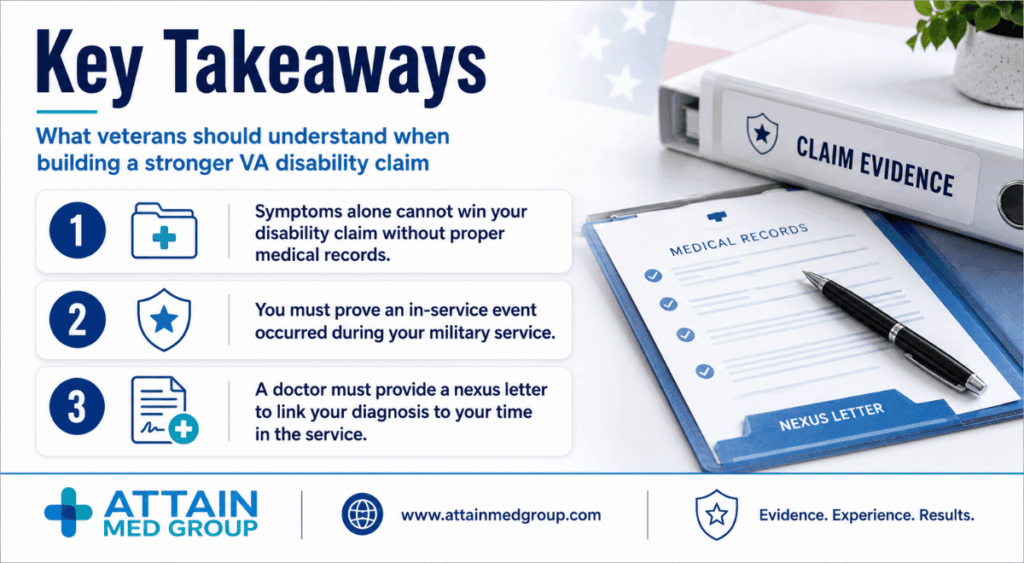
Many service members believe that an obvious injury automatically leads to a high disability rating. The reality of disability law demands far more than just demonstrating a current health condition. You must satisfy three specific legal elements to get your disability claim approved by the government. These pillars form the foundation of every successful application for va disability and are often referred to as the “Caluza Triangle” by legal professionals.
First, you need a current diagnosis from a qualified medical professional for your specific mental health or physical issue. Second, you must provide service records showing an in-service event, injury, or illness occurred during your military service. Finally, you need a medical nexus linking that in-service event to your current diagnosis. This direct service connection is the bridge that many veterans fail to build correctly. Establishing a direct service connection requires more than just a timeline; it requires a logical medical explanation that ties the past to the present.
If you miss any of these three requirements, the government will deny your request for va disability benefits. Strong symptoms satisfy the diagnosis requirement, but they ignore the other crucial components of service connection. A proper va disability claim requires strong medical evidence for all three pillars simultaneously to withstand the scrutiny of a VA rater. Without the in-service event or the nexus, the severity of your current pain is legally irrelevant to the VA’s decision-making process.
VA Claims: Why Medical Evidence and Medical Records Outweigh Personal Suffering
The VA operates on a “paper-trail” system where medical records serve as the primary currency for validation. While your daily life may be significantly impacted by pain, the va doesn’t simply take your word for it. They require a clear medical history that documents the progression of your service-connected condition over time. Without these records, your va disability application lacks the necessary weight to move forward through the adjudication process.
Consistency in your medical evidence is vital for a successful disability claim. If you have gaps in treatment lasting several years, the VA may argue that your condition is not related to your military service. Maintaining regular appointments and ensuring your doctors record your symptoms accurately will strengthen your va disability claim. These records provide the objective data needed to justify a specific disability rating, which is based on the severity and frequency of symptoms documented by professionals.
Furthermore, the VA often prioritizes objective findings, such as X-rays, MRIs, or blood tests, over subjective reports of pain. While your personal testimony is important, it must be supported by clinical findings that a rater can quantify. If you claim a back injury but have no imaging showing degenerative changes, the VA may grant a lower rating or deny the claim entirely. Building a robust medical file is the most effective way to ensure your suffering is recognized by the system.
VA Claim: The Challenge of Establishing Service Connection for Disability Claims
Establishing service connection is often the most difficult hurdle for veterans seeking va benefits. You must demonstrate a causal link between your current health condition and a specific event from your military service. This can be achieved through direct service connection, where the injury happened on duty, or through secondary service connection. In a secondary service scenario, a new condition is caused or aggravated by an existing service-connected disability.
For example, a veteran might have a service-connected condition like a knee injury that eventually leads to back problems due to an altered gait. Proving this secondary service connection requires detailed medical records and a persuasive medical opinion. The VA will look for evidence that the secondary issue would not have occurred but for the original service-connected disability. Navigating these complexities is why many disability claims are initially denied, as veterans often fail to explain the physiological link between the two conditions.
Aggravation is another path to service connection that many veterans overlook. If you had a pre-existing condition before joining the military, but your service made it worse, you may be eligible for benefits. However, you must prove that the worsening was beyond the natural progression of the disease. This requires a high level of medical detail and a clear comparison between your health status at entry and your health status at discharge.
Examining Specific Health Conditions like Sleep Apnea and Mental Health
Certain conditions are notoriously difficult to link to service, such as sleep apnea. While sleep apnea can be life-altering, the va disability system often requires a sleep study conducted during or immediately after service. If you are filing for sleep apnea years later, you may need to pursue it as a secondary condition related to weight gain from a physical injury or mental health issues. This strategy is common in many va disability claims involving respiratory issues that develop long after discharge.
Similarly, mental health condition issues like PTSD or depression require specific evidence of a stressor or event. A mental health condition can be invisible, making the medical evidence and lay evidence from family members even more important. The VA evaluates mental health based on social and industrial impairment, so your medical records must reflect how the condition affects your ability to work and maintain relationships. Successfully claiming a mental health issue often hinges on a strong nexus opinion from a psychiatrist who can articulate the impact of service on your psychological well-being.
Veterans should also be aware of how the VA rates these conditions. For instance, mental health ratings are not based on the diagnosis itself but on the level of occupational and social impairment. You could have a diagnosis of severe PTSD, but if your records show you are working full-time and have stable relationships, your rating may be lower than expected. This is another reason why symptoms alone, without documented functional loss, may not result in a high rating.

How to Prove Your Disability Claim with Proper Evidence
To prove your disability claim, you should gather a comprehensive file of medical records from both the VA and private providers. In addition to professional medical evidence, you can submit lay evidence, such as statements from friends or fellow service members. These “buddy letters” can help establish the occurrence of an event in your military service that might not be fully documented in your official service records. This combination of evidence is crucial for a va disability claim.
You should also keep a daily journal of your symptoms to show how they impact your daily life. While this isn’t a substitute for a medical opinion, it provides context for the VA rater during the va disability evaluation process. Showing a consistent history of treatment and symptom reporting makes it much harder for the VA to deny your service connection. Every piece of evidence should point toward the same conclusion: your condition is a result of your service and has a measurable impact on your functionality.
Photographic evidence can also be helpful in certain cases, such as skin conditions or visible scarring. If you have photos from your time in service showing the onset of a condition, include them in your package. The goal is to create a “preponderance of evidence” that makes it more likely than not that your claim is valid. The VA is legally required to give you the “benefit of the doubt” if the evidence is in equipoise, but you must first provide enough evidence to reach that point.
Special Circumstances: Gulf War and Agent Orange Presumptive Conditions
In some cases, the VA acknowledges that certain environments are inherently toxic, leading to presumptive service connection. Veterans who served in the Gulf War or were exposed to Agent Orange in Vietnam may not need to prove a specific in-service event. For these veterans, the VA presumes that certain health conditions are related to their military service. This simplifies the va disability claim process significantly for those eligible, especially under the recent PACT Act expansions.
However, even with presumptive conditions like those from the Gulf War, you still need a current diagnosis. You must also prove that you served in the specific locations and timeframes covered by the law. If you have a condition not on the presumptive list, you will still need a nexus letter to establish service connection. Understanding these special rules is vital for maximizing your va disability benefits and ensuring you are not doing more work than the law requires.
The PACT Act has added dozens of new presumptive conditions related to burn pits and other toxic exposures. If you were previously denied for a respiratory condition or certain cancers, you should look into whether your condition is now considered presumptive. This change in the law allows many veterans to bypass the difficult “nexus” requirement, provided they have the qualifying service and a current diagnosis.
Handling Denials with a Supplemental Claim

If your va disability claim is denied, do not lose hope, as this is one of the common reasons veterans eventually seek professional help. You have the right to file a supplemental claim if you have new and relevant medical evidence to present. A supplemental claim allows the VA to review your case again with the added information, such as a new medical opinion or updated medical records. This is a standard part of the va disability appeals process.
Many veterans find success on their second or third attempt by addressing the specific reasons for the initial denial. The VA’s decision letter will outline exactly why they denied service connection or gave a lower va rating than expected. Use this feedback to target your medical evidence collection. Whether it’s a missing nexus letter or incomplete service records, a supplemental claim is your chance to fix the errors in your original disability claim and provide the missing link.
It is important to note the one-year deadline for appeals. If you do not file a supplemental claim, a higher-level review, or a board appeal within one year of your denial, your claim will become final. This means you could lose out on months or years of back pay. Keeping your claim “active” through the appeal process is the best way to preserve your effective date and maximize your eventual payout.
Maximizing Your Chances of Success for VA Disability Benefits
To maximize your chances of receiving va disability benefits, you must be proactive and organized. Start by requesting a complete copy of your service records and medical records to identify any gaps. Ensure that every mental health condition or physical ailment is documented by a professional. The goal is to leave no doubt in the rater’s mind regarding the validity of your va disability claim and its connection to your time in uniform.
Working with a doctor who understands the va disability system can also be a major advantage. They can provide a nexus letter that uses the specific language required by disability law. By focusing on the “three pillars” and providing clear medical proof, you position yourself for a favorable va rating. Remember, the VA is looking for a legal and medical justification to award disability benefits, not just a description of pain or a list of symptoms.
Another tip is to be extremely specific about your functional limitations. Instead of saying “my back hurts,” explain that “I cannot stand for more than 15 minutes without needing to sit down due to sharp pain in my lower lumbar region.” This type of descriptive evidence helps the rater apply the correct diagnostic code to your condition. The more specific you are, the less room there is for the VA to underestimate the severity of your disability.
The Impact of Multiple Service-Connected Conditions and Secondary Service Connection
Many veterans suffer from multiple issues that are intertwined, which can lead to secondary service connection. If your primary service-connected disability causes a secondary condition, you are entitled to additional va disability benefits. For example, chronic pain from a back injury often leads to mental health conditions like depression or anxiety. Proving this secondary service link is a common way to increase your overall disability rating and get a more accurate reflection of your health.
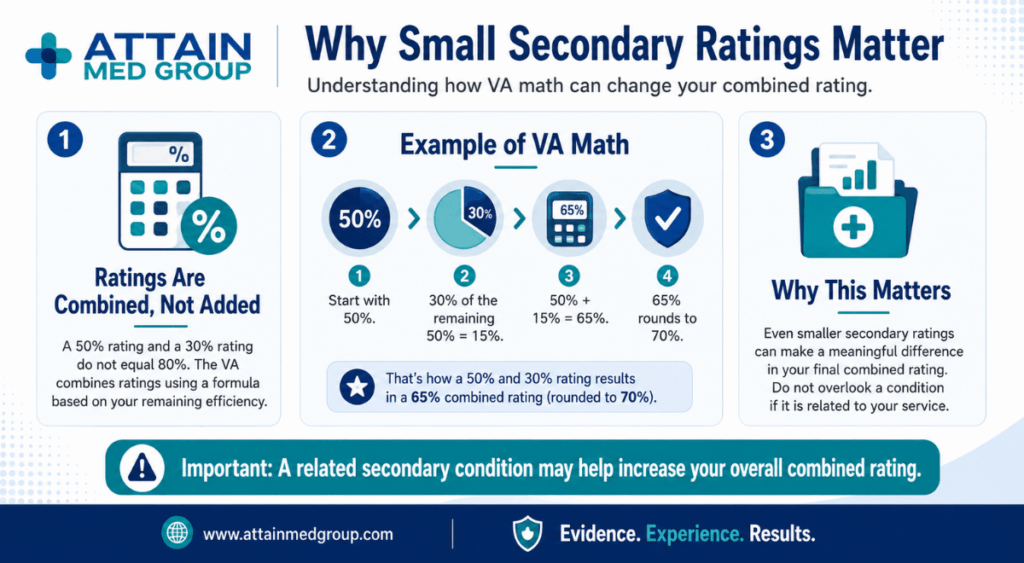
The VA uses a complex formula to combine ratings for multiple service-connected conditions. It is not a simple addition; instead, they use “VA math” to determine your total va rating. By identifying every secondary service connection, you ensure that the full impact on your life is recognized. This comprehensive approach to your disability claim is essential for receiving the maximum support available under disability law, as it accounts for the “whole veteran” rather than just isolated injuries.
Common Reasons Why Strong Symptoms Alone May Not Win a VA Disability Claim
One of the common reasons for a denied va disability claim is the “missing link” between symptoms and service. Veterans often focus so much on their current pain that they forget to document the military service event that started it. Another mistake is failing to provide a nexus letter, assuming the connection is “obvious.” In the world of va disability, nothing is obvious unless it is written in your medical records by a qualified professional.
Additionally, many veterans wait too long to file their disability claims, leading to massive gaps in medical evidence. If you haven’t seen a doctor for your health condition in ten years, the VA will likely question the service connection. Consistency in treatment and documentation is the key to overcoming these common reasons for denial. Your va disability claim depends on a continuous chain of evidence from service to the present day, showing that the condition never truly went away.
Another common error is failing to attend scheduled C&P exams. If you miss an exam without a valid reason, the VA can deny your claim immediately. Even if you feel the exam is unnecessary because you have already provided private medical records, you must attend. Use the exam as an opportunity to reinforce your evidence rather than viewing it as a hurdle. Being uncooperative or defensive during the process can also negatively impact the examiner’s final report.
Working with Professionals for Your VA Disability Claim
Navigating disability law can be overwhelming, which is why many veterans work with Veterans Service Organizations (VSOs) or attorneys. These professionals can help you organize your medical records and identify the best strategy for your va disability claim. They understand what the VA is looking for in a nexus letter and can help you avoid common reasons for a denial. Their expertise in va disability benefits can be life-changing for those struggling with the paperwork.
A professional can also assist in filing a supplemental claim or higher-level review if your initial disability claim is unsuccessful. They can help gather lay evidence and ensure your service records are complete. While you can file on your own, having an expert who knows the nuances of service connection can significantly increase your chances of a successful va rating. Investing in professional help is often the best way to secure your va benefits without the stress of doing it alone.
VSOs are typically free of charge and are a great starting point for most veterans. However, if your case is particularly complex or involves multiple appeals, a specialized VA disability attorney might be necessary. Attorneys often work on a contingency basis, meaning they only get paid if you win your appeal. This alignment of interests ensures they are motivated to build the strongest case possible for your specific situation.
Preparing for Compensation and Pension Exams to Secure a VA Rating
The Compensation and Pension (C&P) exam is a critical step in the va disability claim process. During this exam, a VA-contracted doctor will evaluate your health condition to determine your va rating. It is vital to be honest and descriptive about your worst days, not just how you feel at that moment. The examiner will review your medical records and medical evidence to confirm the severity of your symptoms and how they align with the rating schedule.
Many veterans make the mistake of trying to “tough it out” during the exam, which can lead to a lower disability rating than they deserve. You should explain how your service-connected disability affects your daily life and ability to work. If the C&P examiner’s medical opinion contradicts your private nexus letter, you may need to file a supplemental claim to challenge the findings. Preparation for this exam is key to a successful va disability outcome and should involve reviewing your own medical history beforehand.
During the exam, if the doctor asks you to perform a physical movement, stop as soon as you feel pain. The VA rates many physical conditions based on “painful motion.” If you push through the pain to show how “strong” you are, the examiner may record a greater range of motion than you actually have on a normal day. This can result in a significantly lower rating. Be vocal about when and where it hurts during the evaluation.
The Timeline for VA Disability Decisions

The timeline for a va disability claim can vary significantly depending on the complexity of the case and the current backlog. On average, it can take several months for the VA to review your medical records and service records before making a decision. If you have multiple service-connected conditions or are claiming secondary service connection, the process may take longer. Patience is required when dealing with the va disability benefits system, as rushing the process can lead to mistakes.
You can track the status of your disability claim through the VA’s online portal. If the VA requests more medical evidence or another medical opinion, respond as quickly as possible to avoid further delays. While the wait can be frustrating, a well-documented va disability claim is more likely to result in a favorable va rating. Once approved, your disability benefits are often backdated to the day you filed your intent to file, providing a significant lump sum payment.
If your claim is taking an unusually long time (over a year), you may want to contact your local VSO or even your congressional representative. Sometimes, claims get stuck in the system due to administrative errors. However, for most veterans, the best course of action is to ensure the VA has everything they need so there is no reason for them to pause the review. A complete and organized file is the fastest route to a decision.
Final Thoughts on Securing Your Future and Disability Law
Securing va disability benefits is a marathon, not a sprint. While your symptoms are real and debilitating, the legal requirement for medical evidence and service connection cannot be ignored. By focusing on the “three pillars”—diagnosis, in-service event, and nexus letter—you can build a va claim that stands up to scrutiny. Don’t let common reasons for denial stop you from getting the support you earned through your military service.
Whether you are dealing with sleep apnea, mental health conditions, or injuries from the Gulf War, the key is documentation. Keep your medical records organized, seek a professional medical opinion, and don’t be afraid to file a supplemental claim if needed. Understanding disability law and the importance of medical evidence will help you navigate the system and secure the va rating you deserve for your service-connected condition. Your health and financial future depend on your ability to prove your case within the VA’s specific legal framework.