


Diabetes can cause nerve pain, eye problems, kidney issues, and more. Learn how to document secondary conditions and increase your VA rating.
If you’re a veteran with service‑connected diabetes, you may already know that high blood sugar doesn’t just affect your glucose levels—it can lead to a host of other medical problems over time. These are called secondary conditions, and they can qualify for additional VA disability benefits, on top of your diabetes rating.
At Attain Med Group, we specialize in helping veterans just like you document and connect these complications. Through expert medical evidence—nexus letters, DBQs, and record reviews—we help you clearly establish the link between your diabetes and its downstream effects. In this article, you’ll learn:
- What secondary conditions are commonly associated with diabetes
- How the VA evaluates and rates them
- What medical evidence you need to support secondary‑condition claims
- Tips for gathering, documenting, and presenting your case
1. What Does “Secondary Condition” Mean in a VA Disability Context?
A secondary condition is a disease or disability that either results from or is aggravated by a primary, service-connected condition. For veterans with diabetes, that means many of the complications of uncontrolled or long-standing diabetes may be compensable.
The National Academies’ review of VA rating policy confirms: many complications of diabetes—like peripheral neuropathy, vascular disease, and eye disorders—are treated as secondary manifestations for VA rating purposes.
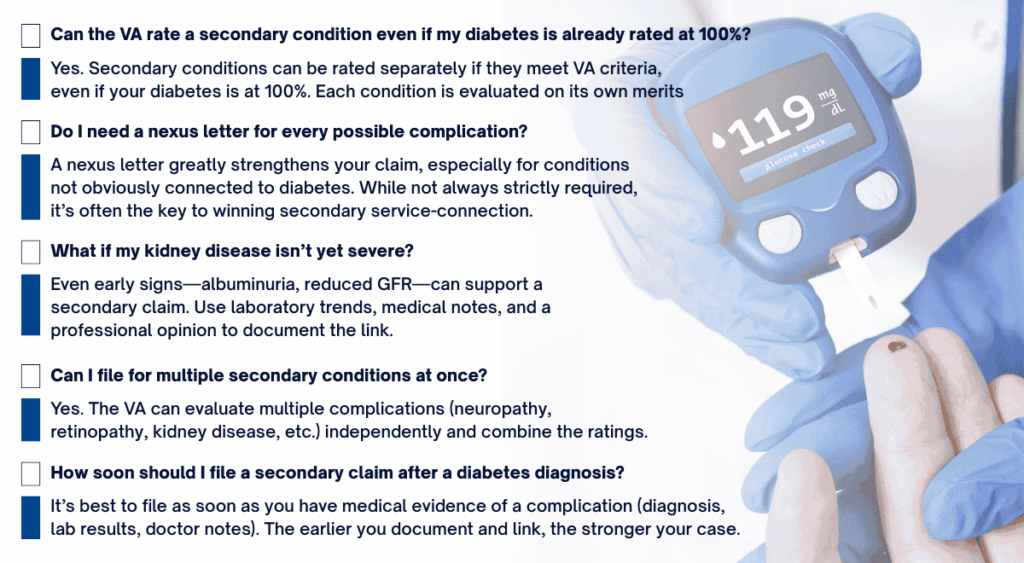
In practice: VA evaluates each secondary condition separately. If your complication is “proximately due to” (caused by) diabetes, you can file a secondary service‑connection claim.
2. Key Secondary Conditions Linked to Diabetes
Here are some of the most common—and most clinically significant—secondary conditions to diabetes that veterans should be aware of:
- Diabetic Neuropathy (Nerve Damage)
- High blood sugar can damage peripheral nerves, leading to symptoms like tingling, numbness, burning, or pain.
- VA may rate neuropathy under peripheral nerve disability codes, considering which nerves are affected (feet, hands, etc.).
- In some cases, VA recognizes diabetic neuropathy as secondary to service-connected diabetes.
- High blood sugar can damage peripheral nerves, leading to symptoms like tingling, numbness, burning, or pain.
- Diabetic Nephropathy (Kidney Disease)
- Diabetes is one of the leading causes of chronic kidney damage due to microvascular changes.
- The VA rates renal (kidney) dysfunction under its Genitourinary System schedule (38 CFR § 4.115a).
- If you have albuminuria, reduced GFR, or other signs of kidney disease, these may be rated separately as secondary to your diabetes.
- Diabetes is one of the leading causes of chronic kidney damage due to microvascular changes.
- Diabetic Retinopathy (Eye Disease)
- Elevated blood sugar damages retinal blood vessels, potentially leading to bleeding, vision loss, or other complications.
- The VA provides a rating for retinopathy based on frequency of incapacitating episodes (e.g., hospital or eye‑doctor visits) or the degree of visual impairment.
- A nexus (medical opinion) linking your retinopathy to your service-connected diabetes is often crucial.
- Elevated blood sugar damages retinal blood vessels, potentially leading to bleeding, vision loss, or other complications.
- Cardiovascular Disease & Peripheral Vascular Disease
- Diabetes contributes to macrovascular disease (atherosclerosis), increasing risk for heart disease, peripheral artery disease (PAD), and stroke.
- The VA may rate these separately as secondary conditions, depending on medical evidence and lower‑limb circulation or coronary issues.
- Diabetes contributes to macrovascular disease (atherosclerosis), increasing risk for heart disease, peripheral artery disease (PAD), and stroke.
- Hypertension (High Blood Pressure)
- High blood sugar can also damage blood vessel walls, contributing to hypertension, which VA may consider secondary to diabetic renal disease.
- If hypertension is linked to diabetic kidney damage, a medical opinion or DBQ may help support this secondary claim.
- High blood sugar can also damage blood vessel walls, contributing to hypertension, which VA may consider secondary to diabetic renal disease.
- Skin Conditions and Circulatory Complications
- Diabetes can impair wound healing, lead to diabetic foot ulcers, and contribute to poor circulation (angiopathy).
- These conditions may also support a secondary-rated claim, depending on severity and functional impact.
- Diabetes can impair wound healing, lead to diabetic foot ulcers, and contribute to poor circulation (angiopathy).

3. Why Documenting Secondary Conditions Matters
A. Increase Your VA Rating
By proving a secondary disability, you can often raise your total combined VA disability rating, which can lead to significantly greater monthly compensation.
B. Access Better Medical Care
Recognizing and rating secondary conditions can also help prioritize your access to the right VA medical care, referrals, and management (e.g., kidney specialists, ophthalmologists, podiatrists).
C. Strengthen the Service Connection
Secondary claims show that your diabetes isn’t just under control — it’s causing real, measurable damage. This kind of medical narrative strengthens your overall VA case
4. What Evidence the VA Needs to Award a Secondary Condition
To successfully claim a secondary condition to diabetes, you’ll need strong medical evidence, including:
- Current Diagnosis
- Medical records showing diagnosis of neuropathy, retinopathy, kidney disease, etc.
- Laboratory tests: for kidney disease, this may include GFR, creatinine, albuminuria.
- Ophthalmology/optometry reports for eye disease.
- Medical Nexus / Expert Opinion
- A nexus letter from a qualified provider that states it is “at least as likely as not” (50% chance or greater) that your secondary condition is caused (or aggravated) by your service-connected diabetes.
- The provider should explain the medical mechanism (e.g., hyperglycemia → microvascular damage → nephropathy).
- Functional Impact / Severity
- For kidneys: lab trends over time, dialysis notes, edema, blood pressure issues.
- For neuropathy: nerve conduction studies, C&P exam findings, physical exam.
- For the eyes: records of treatment visits, hospitalizations (“incapacitating episodes”) for visual problems.
- Continuity of Evidence
- Evidence showing how your secondary condition evolved or worsened after your diabetes diagnosis.
- Service treatment records (if applicable), especially if complications began soon after service or diagnosis.
- VA or Non-VA Medical Records
- All relevant medical documentation, from VA and civilian providers, should be compiled.
- Use DBQs (Disability Benefits Questionnaires) for the relevant organ systems (kidney, nerve, eye) to structure the information in a way VA raters understand.

5. Tips for Making a Successful Secondary Service-Connection Claim
- Request Specialized Examinations: Ask for nerve conduction studies or ophthalmology evaluations if not already documented.
- Talk to Your Provider: Ensure your doctor or specialist is aware that you’re building a VA disability case — they may tailor their language to support a nexus.
- Be Thorough: Don’t just document the diagnosis — show how it limits you (mobility, vision, daily life).
- Work with Experts: Attain Med Group can help you connect with medical professionals who know how to write effective nexus letters and complete DBQs.
- Organize Your Evidence: Create a “secondary‑conditions dossier” containing all medical records (lab results, notes), nexus letters, DBQs, C&P reports, and personal statements.
7. Why Attain Med Group Is Your Partner in Secondary Diabetes Claims
Navigating secondary-condition claims can be complex: it’s not just about proving diabetes, but showing how diabetes is causing or worsening other serious disabilities. Here’s how Attain Med Group can help:
- Veteran-Centered Expertise: We understand how diabetes complications uniquely affect veterans.
- Experienced Providers: We work with endocrinologists, nephrologists, neurologists, and ophthalmologists familiar with VA standards.
- Nexus Letter Support: Our clinicians know how to articulate connection in VA‑friendly medical probability language.
- Comprehensive Evidence Review: We review your full medical and VA record, identify gaps, and help you obtain needed tests.
- Appeals & Claims Strategy: Whether filing a new secondary, increasing a rating, or appealing a denial — we guide you every step.
Conclusion & Call to Action
Diabetes is more than a blood sugar issue—it’s a powerful disease that can damage nerves, kidneys, eyes, blood vessels, and more. These secondary conditions may significantly worsen your health and, importantly, your VA disability rating.
If you’re a veteran living with diabetes and experiencing complications, don’t wait: document them, connect them, and let the VA recognize their true impact.
At Attain Med Group, we help you turn your medical reality into a strong, evidence-backed claim. Contact us today to schedule a free consultation and build your secondary‑condition dossier with nexus letters, DBQs, and expert support.
→ Book Your Consultation
→ Download Our Secondary Conditions Claim Checklist