


An OTH discharge can feel like a heavy burden after completing your military service. It may also leave veterans feeling disconnected from the community they once served. Many veterans believe this discharge permanently prevents them from accessing important VA benefits and support.
However, an OTH discharge does not always end your options. Proven Ways to Appeal OTH Discharge for VA Benefits can help you understand the paths available. You may be able to appeal your discharge status by presenting strong documentation and supporting evidence. Understanding what review boards consider can also help you prepare a clearer and more organized case.
The Discharge Review Board or the Board for Correction of Military Records may handle your appeal. Each board follows different requirements, so understanding the process is an important first step. A successful discharge upgrade can officially change the characterization of your military service. It may also affect your eligibility for certain VA benefits and other veteran programs.
Start by gathering your military records, supporting statements, and other relevant evidence. These records can help explain the circumstances surrounding your discharge. Strong documentation can also provide important context about your service and post-service history.

Appealing an OTH discharge can take time, preparation, and persistence. Knowing your options can help you move forward with greater confidence. This guide explains the appeal process, important evidence, and possible paths for pursuing VA benefits.
An OTH discharge is an administrative separation that falls below honorable conditions. It may result from disciplinary infractions, misconduct, rule violations, or other circumstances. In previous eras, some service members also received OTH discharges for issues related to sexual orientation. Unlike a dishonorable discharge, an OTH discharge is administrative rather than the result of a general court-martial. Understanding your discharge status is the first step toward determining which VA benefits may be available.
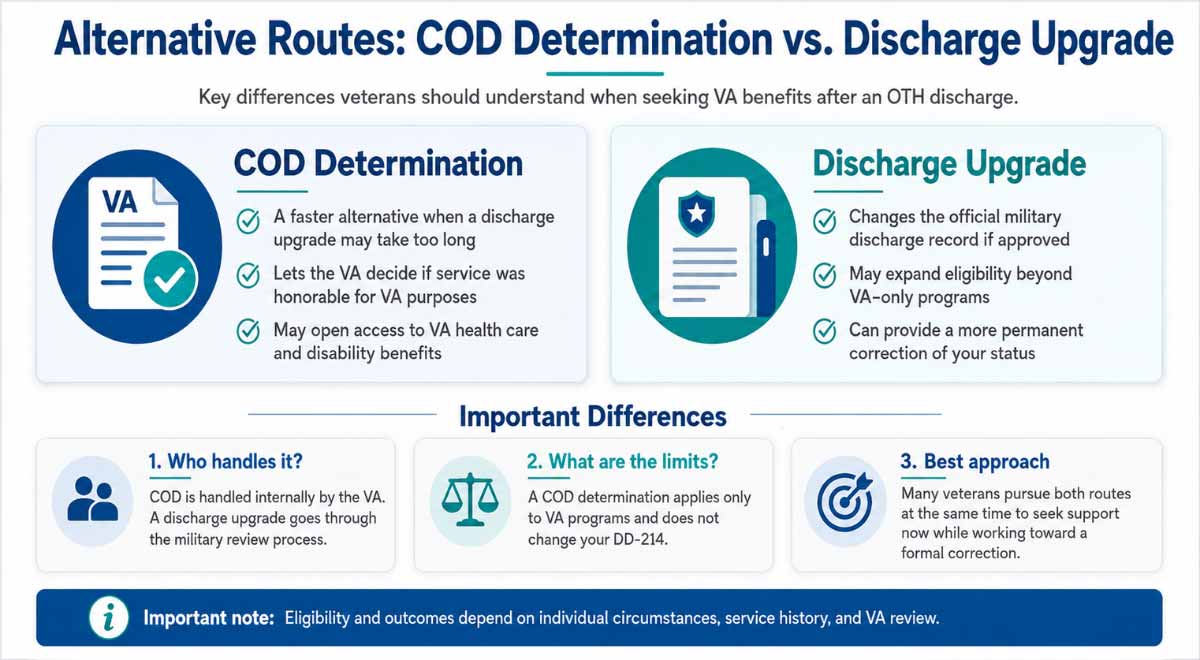
The Department of Veterans Affairs does not automatically deny every VA benefit because of an OTH discharge. You can request a character of discharge determination to establish eligibility for certain VA programs. A COD determination reviews whether your service was honorable for VA purposes. This review may affect access to VA benefits while a formal discharge upgrade remains pending.
A favorable determination may open access to health care or disability compensation. Some veterans also pursue corrections to their military discharge records later in life. You can apply for a military record correction through the appropriate official channels. A formal discharge upgrade may expand your eligibility for additional VA benefits and veteran programs.
An upgraded discharge changes your official military record and may remove barriers to certain veteran programs. You may still have options even if many years have passed since separation. Post-service conduct and the circumstances surrounding your discharge can help support your case. A successful upgrade may also provide a sense of closure and pride in your military service.
💡 Pro Tip: Always request your complete military records before starting your appeal. This documentation forms the foundation of your case and prevents processing delays when applying for a va benefit.
Appealing an OTH Discharge for VA Benefits Here’s how to apply and win your VA claim.

Pursuing a discharge upgrade requires patience and a clear understanding of the Discharge Review Board (DRB) process. Each military branch, including the Coast Guard, maintains its own discharge review board. These boards review requests to change a veteran’s discharge characterization. They may grant an upgrade if the original decision was inequitable or improper. A successful upgrade can also affect your eligibility for VA benefits.
The review board examines whether your separation was equitable and proper under the applicable military regulations. Your evidence plays an important role in the discharge review process. This may include medical records, service records, witness statements, and other supporting documents. You may also present evidence showing that the original separation was unjust or incorrect. An undiagnosed mental health condition may be relevant when supported by appropriate evidence.
The review board also considers your overall military record and conduct. It may compare your achievements with the incidents that resulted in your OTH discharge. A discharge upgrade may affect eligibility for certain VA benefits and other veteran programs. Veterans should also understand that the processing timeline can vary. The article notes that some reviews may take 12 to 18 months, depending on the branch and backlog.
Submitting a complete application package may help prevent unnecessary processing delays. Organize your records and supporting evidence before you submit your request. The board will review the circumstances surrounding your discharge before issuing a decision. If the board upgrades your discharge, you can then determine which VA benefits may be available.

Legal Standards: Understanding Inequity and Impropriety
To strengthen your appeal, frame your argument around the legal standards of “inequity” or “impropriety.” Impropriety occurs when the military failed to follow applicable regulations or laws during your discharge process. For example, you may have been denied the right to legal counsel. The evidence used against you may also have been factually incorrect. These circumstances may support an argument that your discharge was improper.
Identifying procedural errors requires a careful review of your official military personnel file. You should also review the regulations in effect when you separated from service.
Inequity focuses on whether the military fairly characterized your discharge when considering your overall service record. You may argue that an isolated incident of misconduct made your OTH characterization inequitable. Your awards, decorations, and performance evaluations can provide important context about your overall service. The board reviews this evidence when deciding whether your discharge characterization fairly reflects your service.
Veterans may also argue that changes in military policies or societal standards make an OTH discharge inequitable. Current military policies may handle conduct differently than policies in place when you served. Highlighting these changes can provide additional context for your discharge characterization.
Your post-service conduct may also support your argument. A clean record, steady employment, and community involvement can provide evidence of positive conduct after military service.
Compelling Circumstances for an Honorable Discharge
Many successful appeals are based on compelling circumstances that were not fully considered during the original discharge. For example, some service members were discharged for misconduct linked to an undiagnosed mental health condition. PTSD or a traumatic brain injury may have influenced the behavior that led to an OTH discharge. The board may consider these circumstances when deciding whether the discharge was inequitable. Highlighting these factors can be important when appealing an OTH discharge for VA benefits.
Policies such as the Hagel and Kurta memos require review boards to give “liberal consideration” to certain mental health conditions. This can include cases involving military sexual trauma (MST) or other trauma that occurred during service. If misconduct was connected to military sexual trauma, that evidence may support a discharge upgrade request. These protections address cases where trauma may have contributed to the behavior behind an OTH discharge.
The boards may also consider “clemency” based on your post-service conduct and contributions to society. A clean record, steady employment, and community service may help support your case. These details can show how your conduct has changed since leaving military service. They may also help the board better understand your overall character and circumstances. Positive post-service conduct can become an important part of your request for an honorable discharge.
The Power of Liberal Consideration for Mental Health

“Liberal consideration” can be important for veterans seeking to upgrade an OTH discharge. This policy directs review boards to give significant weight to evidence of mental health conditions. This can apply even when the condition was not diagnosed during service.
PTSD, TBI, or another condition may have contributed to the behavior behind your discharge. If you can show that connection, the board may consider it during the review process. This policy recognizes that some service members struggled with conditions that were not identified or treated at the time.
To use liberal consideration effectively, you should provide a clear link between your condition and the misconduct. This may include a “nexus” statement from a medical professional. The statement can explain how your symptoms may have contributed to disciplinary problems.
For example, a veteran with undiagnosed PTSD may have struggled with anger or substance use. Explaining these connections can provide important context for the board. It may also help explain why a different discharge characterization should be considered.
The Wilkie Memo also expanded protections for veterans discharged because of conduct related to sexual orientation. These policies address cases involving past discriminatory military practices. Liberal consideration does not guarantee a successful discharge upgrade. However, it can provide an important path for veterans facing these circumstances.
For veterans appealing an OTH discharge for VA benefits, this policy may become an important part of the case.
Steps to Appeal Your Separation Status
- Request Your Official Military Personnel File (OMPF) You must obtain a complete copy of your records to identify the exact reasons for your OTH discharge and find errors.
- Draft a Detailed Personal Statement Write a personal statement explaining the circumstances of your service and any mitigating factors like mental health conditions.
- Submit Form DD-293 or DD-149 Choose the correct form based on how long it has been since your discharge to initiate the va benefit review process.

Using a Personal Statement for Your VA Benefits
A strong personal statement is often the most influential part of your application for a discharge upgrade. This is your opportunity to speak directly to the board and explain the “why” behind the events in your military record. You should describe any mental health conditions, such as depression or anxiety, that affected your performance but were not diagnosed at the time. By providing context, you help the board understand that your OTH discharge does not define your entire period of service.
In addition to your statement, you should gather letters of support from people who knew you during and after your service. These can include fellow service members, employers, or medical professionals who can attest to your character and any health condition you face. Evidence of military sexual trauma or other traumatic events is particularly powerful when supported by buddy statements or contemporaneous reports. This collective evidence builds a narrative that supports your eligibility for a va benefit and a higher va rating.
Medical evidence is also crucial, especially if you are seeking a va benefit related to a service-connected disability. If you have a diagnosis from a private doctor or the VA, include those records to show a link between your service and your current health. The board needs to see that your mental health or physical injuries played a role in the conduct that led to your OTH. This connection is vital for winning your disability claim and securing the financial support you need for long-term care.
Gathering Medical Evidence and Nexus Letters
One of the most critical components of a successful appeal is the inclusion of strong medical evidence. If you are claiming that a mental health condition or physical injury led to your OTH, you need a professional diagnosis. A “Nexus Letter” from a qualified physician or psychologist is particularly valuable, as it explicitly links your current condition to your time in service. This letter should explain how your symptoms were present during your military tenure and how they influenced the behavior that resulted in your administrative separation.
When gathering medical records, don’t limit yourself to VA documents; private medical records can be just as influential. If you sought treatment immediately after discharge, those early records can provide a “snapshot” of your health at the time of separation. These documents help overcome the “presumption of regularity,” which is the board’s tendency to assume the original discharge decision was correct. By providing objective medical data, you make it much harder for the board to dismiss your claims of inequity or impropriety.
Furthermore, you should include any evidence of “self-medication” if substance abuse was a factor in your OTH. Many veterans with undiagnosed PTSD turned to alcohol or drugs to cope with their symptoms, leading to disciplinary issues. If you have since completed rehabilitation or maintained sobriety, this post-service conduct serves as powerful evidence of your true character. Combining medical proof with a narrative of recovery creates a compelling case for an honorable discharge and full access to every va benefit.
Securing Professional Help and Free Resources
Navigating the complexities of military law and VA regulations can be overwhelming for any veteran. Fortunately, there are many free resources available to help you with your discharge upgrade and va benefit applications. You should reach out to a veterans service organization (VSO) like the American Legion or DAV for expert assistance. These organizations have trained representatives who can help you gather evidence and file your paperwork correctly at no cost to you.
In some cases, you may also want to consult with a legal clinic or a private attorney who specializes in veterans law. Many law schools offer pro bono clinics that focus specifically on discharge upgrades for low-income veterans. These legal experts can help you frame your arguments in a way that resonates with the review board’s legal standards. They can also assist with related issues, such as applying for social security disability if your military injuries prevent you from working in the civilian sector.
Remember that you are not alone in this process, and seeking help is a sign of strength, not weakness. Thousands of service members have successfully navigated these challenges with the help of a dedicated veterans service representative. By leveraging these resources, you increase your chances of securing every va benefit you are entitled to under the law. Whether it’s help with a personal statement or finding medical experts, professional assistance is a game-changer for your case.
Veterans Disability and Your Discharge Status
Applying for va disability compensation is one of the most important steps you can take after securing a discharge upgrade or a positive COD. This va benefit provides monthly tax-free payments to veterans who got sick or injured while serving in the military. To win your disability claim, you must prove that your condition is “service-connected,” meaning it was caused or aggravated by your time in uniform. Your discharge status plays a major role in whether the VA will even process your claim in the first place.
Once your status is corrected, you can seek a va rating that reflects the severity of your disability. A higher va rating results in more significant financial support and better access to specialized va health services. For veterans with an OTH, getting that first foot in the door is the hardest part, but an upgrade makes the rest of the process much smoother. You can also apply for secondary conditions that have developed as a result of your primary service-connected injury.
The VA also offers disability benefits for “presumptive” conditions, which are illnesses that the VA assumes were caused by your service in certain locations. For example, if you served in a location with toxic exposure, you may be eligible for benefits even without a direct link in your medical records. However, these benefits are generally only available to those with a discharge under honorable conditions. This is why the discharge upgrade is so essential for long-term health and financial security for those seeking va disability payments.

How Mental Health and Trauma Impact Your Case
Mental health conditions are at the heart of many OTH discharge cases, and the VA is increasingly recognizing this reality. If you are struggling with a mental health condition like PTSD, it is essential to get a formal diagnosis and link it to your service. The boards are now required to consider how mental health issues may have contributed to the behavior that led to your separation. This shift in policy has opened the door for thousands of veterans to finally receive an honorable discharge and access their va benefits.
Cases involving military sexual trauma (MST) are handled with particular sensitivity by the review boards today. If you experienced sexual assault or harassment during your service, this sexual trauma can be a powerful mitigating factor in your appeal. The VA provides specialized va health services for MST survivors, regardless of their discharge status in many instances. Highlighting military sexual trauma in your application can help the board understand the extreme stress you were under during your service.
It is also important to note that sexual orientation was once a common reason for OTH discharges under “Don’t Ask, Don’t Tell.” If you were discharged for your orientation, you are now eligible for an automatic upgrade to an honorable discharge in most cases. This correction allows you to reclaim your dignity and access the va benefits that were unfairly taken from you. Addressing these mental health conditions and past injustices is a core part of the modern discharge review process.
Final Steps to Maintain Your VA Benefits
Once you have successfully upgraded your status and secured your va benefits, it is important to stay proactive in maintaining them. Keep copies of all your new discharge paperwork and VA decision letters in a safe place. You should also continue to seek health care through the VA to ensure your medical records are up to date. Regular check-ups help document the ongoing nature of your disabilities, which is important if you ever need to file for an increased va rating.
Stay informed about changes in VA laws and policies, as new va benefits are often added by Congress. For example, the PACT Act recently expanded eligibility for millions of veterans exposed to toxic substances. By staying connected with your veterans service organization, you can ensure you are always taking advantage of the latest programs. Maintaining your va benefits is a lifelong process that requires staying engaged with the veteran community and the VA system.
Finally, consider helping other service members who are in the same position you once were. Sharing your story of Appealing an OTH Discharge for VA Benefits can inspire others to take action. Your experience is valuable, and by mentoring others, you help strengthen the entire veteran community. Together, we can ensure that every veteran receives the respect and support they earned through their service to the nation.
Conclusion
Appealing an OTH discharge is a challenging but deeply rewarding journey that can change the trajectory of your life. By understanding the rules, gathering strong evidence, and seeking professional help, you can win your va claim and secure your future. Whether you pursue a full discharge upgrade or a COD determination, the goal is to access the va benefits you need to thrive. Don’t let a past mistake or an unfair discharge status define your future; take the first step toward your honorable discharge today.
The path to reclaiming your va benefit is paved with persistence and the right information. With the support of a veterans service organization and a clear personal statement, you can overcome the hurdles of the review board. Your service to this country matters, and you deserve the health care and disability benefits that come with an honorable status. Start your application today and join the thousands of veterans who have successfully restored their honor and secured their va benefits.