

Understand what the executive order requires, what remains unconfirmed, and how to keep relevant medical evidence organized as changes progress.
Military medical records sharing can affect how readily VA accesses information about your service and health history. For veterans preparing a claim, seeking a rating increase, or responding to a denial, accessible records may help present a clearer picture of their circumstances.
On September 8, 2026, President Donald Trump signed Executive Order 14426, Accelerating Access to Veterans’ Benefits and Employment Opportunities. It directs the Department of War and Department of Veterans Affairs to improve records sharing and digital access to VA Benefits.
The order sets agency responsibilities. Veterans and their families can continue organizing relevant evidence while implementation progresses.

What the executive order directs
The order establishes three distinct implementation timelines, measured from its signing date.
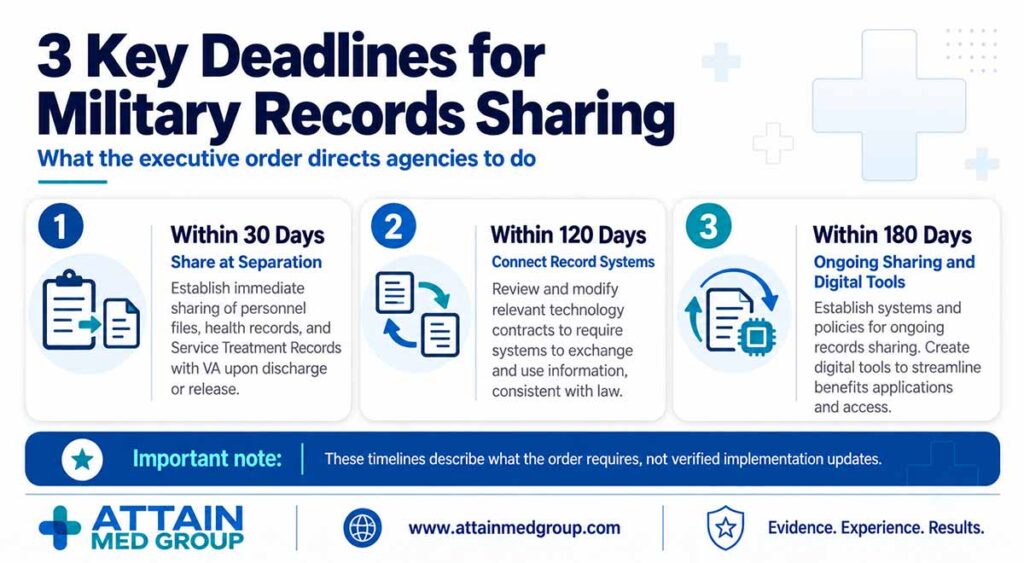
Within 30 days: immediate sharing at separation
The Secretary of War and Secretary of Veterans Affairs must ensure that current service members’ Official Military Personnel Files, health records, and Service Treatment Records are shared with VA immediately upon discharge or release from the Armed Forces.
This requirement must be established within 30 days and continue thereafter. Personnel files document service history; Service Treatment Records document medical care during service.
Within 120 days: interoperable technology contracts
The two secretaries must review and modify relevant existing technology contracts, consistent with law and federal procurement policy, to require interoperability. This means different records systems can exchange and use information.
The review involves consultation with the Department of Health and Human Services, including its Office of the National Coordinator for Health Information Technology, and the Office of Management and Budget, including its federal technology and procurement officials. Future medical and personnel technology contracts must include the interoperability requirement.
Within 180 days: ongoing sharing and digital tools
The agencies must establish updated technology systems, policy guidance, and memoranda supporting permanent, prospective, ongoing sharing of all Official Military Personnel Files and Service Treatment Records. The required sharing spans entry into military service through the period when VA Benefits are needed, consistent with applicable law.
They must also create and deploy digital tools using artificial intelligence and other emerging capabilities to streamline benefits applications and access through a comprehensive single source that includes Department of Labor training and job opportunities.
Separately, the order requires updates to the Transition Assistance Program and other workforce programs within 180 days. These provisions address connections to employment or optional training and appropriate government veterans’ representatives, to the maximum extent practicable and applicable.
Why military medical records sharing matters
Service and treatment records can help document when an injury occurred, what care was provided, and how a condition developed. Improved access could reduce some administrative barriers and support coordination between military and VA systems.
However, a transferred record may not answer every medical question. An older treatment note may document an injury without describing current symptoms or limitations.
VA’s evidence guidance explains that evidence needs depend on the claim. An initial claim generally involves a current condition, an in-service event or illness, and a connection between them, with exceptions such as qualifying presumptive conditions. A rating increase concerns worsening of an already service-connected condition. A Supplemental Claim following a denial generally requires new and relevant evidence.
What is confirmed and what remains unconfirmed
The signed order and VA’s September 8 announcement confirm the policy direction and describe anticipated improvements in access and processing.
As of October 7, 2026, no later official announcement confirming completion of these specific requirements was located in the government sources reviewed. This does not establish that agencies have made no progress; it means completed implementation could not be verified publicly. A deadline passing would not, by itself, prove completion.
VA’s announcement also discusses processing improvements achieved before the order. Those earlier results should not be attributed to this newly signed directive, and projected benefits should not be presented as measured outcomes.
The order does not automatically approve claims, increase ratings, or remove existing evidence requirements. It does not guarantee that every historical record has been found or transferred, or automatically include every private provider’s records. It also does not eliminate examinations; VA may request a claim examination when more information is needed.

Why accessible records may still need clinical interpretation
Records transfer makes information available. A clinical evaluation assesses a condition, while a reasoned medical opinion explains a provider’s conclusions using the available evidence and medical reasoning.
For example, records may show an earlier injury, while a clinician evaluates current limitations or addresses a possible relationship to today’s diagnosis. These functions serve different purposes.
A nexus letter addresses a medical connection. A Disability Benefits Questionnaire, or DBQ, records condition-specific medical findings in a standardized format. VA’s public DBQ guidance explains that these forms collect medical information and that additional examinations may still be required.
Not every veteran needs a nexus letter, DBQ, or independent examination. The order does not require purchasing independent medical evidence.
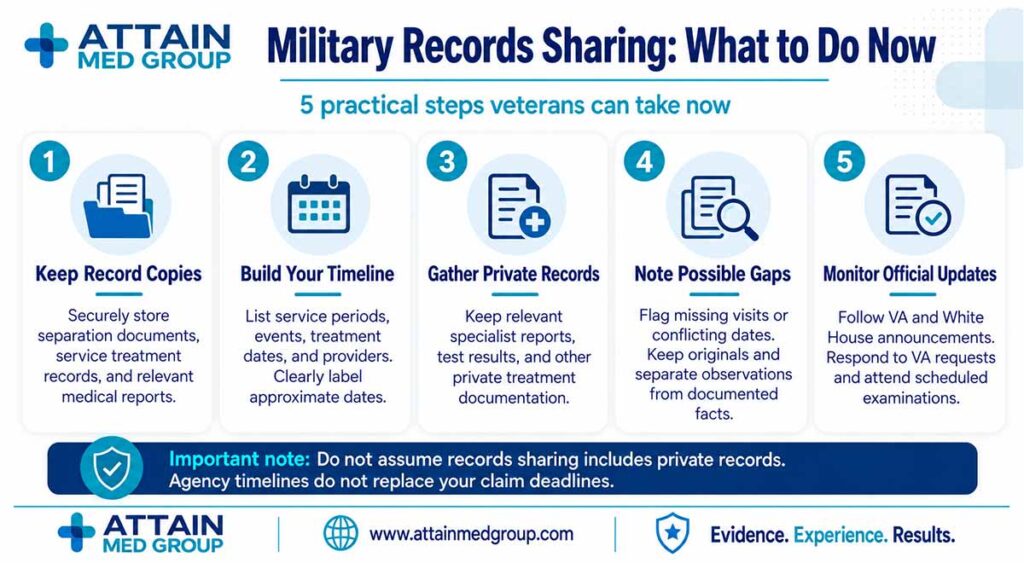
Practical steps veterans can take now
- Keep copies of available records. Store separation documents, service treatment records, and relevant medical reports securely. VA’s military records request guidance explains available routes, including the National Archives and, for eligible veterans, milConnect.
- Build a service and treatment timeline. List service periods, relevant events, treatment dates, and providers. Label approximate dates clearly.
- Gather relevant private treatment records. Keep specialist reports, test results, and other documentation related to the claimed condition. VA’s evidence guidance for fully developed claims specifically addresses private records; do not assume interagency sharing includes them.
- Note possible gaps or discrepancies. Identify missing visits or conflicting dates. Keep original documents and separate your observations from documented facts.
- Monitor official updates. Follow VA and White House announcements, and continue responding to VA requests and scheduled examinations. Agency implementation timelines do not replace deadlines stated in your claim correspondence.
Families and caregivers can help organize documents with the veteran’s permission.
How Attain Med Group may help
Attain Med Group is a veteran-owned and operated organization supporting veterans with medical evidence through its network of medical professionals.
Relevant services confirmed on AMG’s Services page include medical records reviews, nexus letters, DBQs, and independent psychological examinations. Depending on the medical question, these services may help review documentation, explain a supported medical relationship, or assess and document a condition.
Medical conclusions must reflect the provider’s independent assessment. A service cannot promise a favorable opinion, approval, higher rating, or faster decision. The order does not give AMG direct access to government records systems.
Improved sharing could make relevant information easier to access. Keeping your evidence organized remains a practical step while changes progress.
This article provides general education, not individualized medical or legal advice. VA determines eligibility and ratings.
To learn about medical evidence services that may be relevant to your needs, visit Attain Med Group.