


Veterans frequently face significant hurdles while pursuing rightful compensation for service-connected mental health conditions. A VA independent psychological exam offers a powerful alternative to standard government evaluations by providing a formal independent medical opinion (IMO) regarding your diagnosis and its connection to military service. Securing this outside evaluation allows veterans to present a substantially stronger case for their mental health disability claim and overall benefits.

VA Independent Medical Opinion (IMO): Understanding the VA Independent Psychological Exam for Service Connection
The Department of Veterans Affairs typically schedules a Compensation and Pension (C&P) evaluation to assess mental health claims. However, veterans have the legal right to submit medical evidence from private healthcare providers to support their case. A VA independent psychological exam is a comprehensive mental health assessment conducted by a non-VA clinical psychologist or psychiatrist to establish a clear service connection.
Comparing Private Evaluations to a Standard VA C&P Exam for Mental Health
Government contractors perform standard evaluations under strict time constraints that often limit thorough clinical investigation. In contrast, an independent examiner spends several hours reviewing your complete medical history and conducting extensive psychological testing. This extended timeframe allows the private practitioner to develop a highly detailed clinical picture of your current occupational and social impairment for your mental health disability claim.
The independent provider works directly for the veteran rather than the federal government. This arrangement removes any potential conflict of interest that might exist within the standard claims processing system. Your private examiner focuses entirely on reaching an accurate clinical diagnosis based on established medical science and your specific service records.
💡 Key Takeaways
- Independent exams provide a private alternative to standard VA government evaluations.
- Private psychologists spend significantly more time reviewing your complete medical history.
- Veterans have the legal right to submit outside medical evidence for their claims.

Why Veterans Pursue a VA Independent Psychological Exam for Mental Health Disability Claims
Why do so many veterans seek private psychological assessments after receiving a denial letter from the Veterans Benefits Administration? The standard claims process sometimes results in inaccurate diagnoses or completely misses the connection between current symptoms and military service. An independent psychological exam provides the necessary medical evidence to appeal these unfavorable decisions effectively.
Using Medical Evidence and Independent Medical Opinions to Challenge Unfavorable VA Decisions
A common reason for denial involves a government examiner concluding that a mental health condition existed prior to service. Private psychologists can thoroughly review your pre-enlistment records and service treatment notes to refute this presumption. They apply objective psychological assessment tools to demonstrate how specific military events directly caused or aggravated your current symptoms, supporting a higher PTSD rating.

Establishing a Strong Medical Nexus Letter for Service Connection
Winning a mental health disability claim requires a clear medical nexus linking your current diagnosis to an in-service event. Independent examiners specialize in writing comprehensive nexus letters that meet the strict legal requirements established by federal regulations. These detailed reports cite relevant peer-reviewed medical literature to substantiate the connection between your military service and psychological condition.
💡 Pro Tip
Always provide your independent examiner with your complete claims file (C-File) before the evaluation. The VA gives more weight to medical opinions that reference a thorough review of your entire military and medical history.
Finding a Licensed Clinical Psychologist for Your VA Independent Psychological Exam
How does selecting an appropriate mental health professional impact the potential success of your disability claim? You must identify a licensed clinical psychologist or board-certified psychiatrist who possesses extensive experience with veteran populations. Finding an expert who understands the specific terminology and legal standards required by federal adjudicators makes a substantial difference in your case.
Essential Qualifications for a Mental Health Disability Claim and Psychiatric Evaluation Expert
The Veterans Benefits Administration assigns different weight to medical opinions based on the examiner’s professional credentials. A clinical psychologist holding a doctoral degree generally carries more authority than a licensed clinical social worker for a VA independent psychological exam. You should verify that your chosen provider actively maintains an unrestricted license to practice psychology in their respective state.
Additionally, the ideal examiner will demonstrate a proven track record of completing Disability Benefits Questionnaires (DBQ) accurately. They must understand how to translate complex psychological symptoms into the specific rating criteria used by government raters. Providers who regularly testify as expert witnesses in federal court often produce the most compelling and legally sound medical reports.

How to Prepare for Your Private VA Independent Psychological Exam and C&P Evaluation
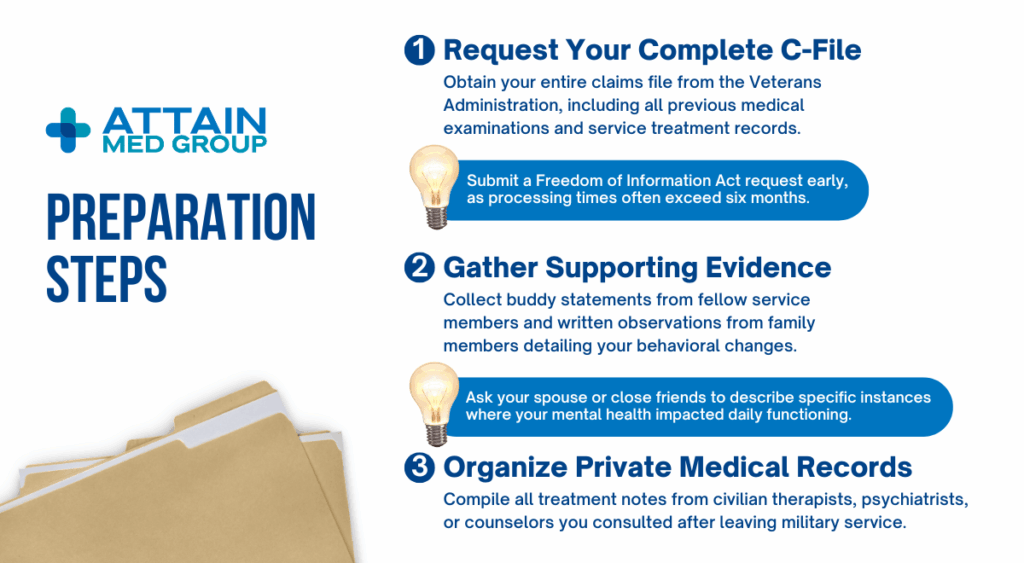
Proper preparation directly influences the quality and accuracy of your final psychological evaluation report. Gathering the right documentation beforehand allows the examiner to form a comprehensive understanding of your military history. The following steps outline the most effective approach for getting ready for your upcoming clinical appointment and psychiatric evaluation.
The Evaluation Process for a Mental Health Disability Claim and PTSD Rating
A comprehensive VA independent psychological exam typically spans several hours across one or two separate clinical sessions. The examiner will conduct a multifaceted assessment to evaluate your cognitive functioning, emotional state, and behavioral patterns. This thorough approach confirms that the final report accurately reflects your true level of occupational and social impairment for your VA claim.
The Clinical Interview and Comprehensive Psychiatric Evaluation
The assessment begins with an extensive clinical interview covering your childhood, military service, and current life circumstances. Your psychologist will ask detailed questions about specific traumatic events, combat exposure, or other significant incidents during active duty. You must answer these questions honestly while fully describing your worst days rather than minimizing your daily struggles during the psychiatric evaluation.

Standardized Psychological Testing Methods for VA Mental Health Claims
After the interview, the provider will administer standardized psychological tests to measure specific aspects of your mental health. Common instruments include the Minnesota Multiphasic Personality Inventory and the Clinician-Administered PTSD Scale. These objective measurements provide empirical data that strongly supports the clinician’s final diagnostic conclusions and severity ratings for your PTSD rating.
The testing phase helps rule out malingering while clearly documenting the legitimate severity of your psychiatric condition. Government raters find objective test scores highly persuasive because they reduce the subjective nature of mental health diagnoses. Your examiner will interpret these results alongside your clinical interview to formulate a highly accurate medical opinion for your mental health disability claim.
💡 Key Takeaways
- The clinical interview covers your complete history from childhood through current daily functioning.
- Standardized tests provide objective empirical data to support your mental health claim.
- You must describe your symptoms honestly without minimizing the negative impact on your life.
The Final Report, Disability Benefits Questionnaire (DBQ), and Nexus Letter Requirements
Following your evaluation, the psychologist compiles all findings into a comprehensive medical report and nexus letter. This document explicitly states whether it is at least as likely as not that your condition stems from military service. The examiner will detail exactly how your specific symptoms align with the diagnostic criteria outlined in the DSM-5 for your mental health disability claim.
A strong independent report will also include a completed psychological Disability Benefits Questionnaire (DBQ). This specific form directly maps your functional impairments to the standard rating schedule used by claims adjudicators. Submitting this fully developed medical evidence makes it significantly easier for raters to grant an appropriate disability percentage.
You should review the finalized documents carefully with your legal representative before submitting them to the government. Check that the examiner referenced specific pages from your service treatment records to support their medical rationale. A well-documented report practically forces the rating board to assign adequate weight to the independent medical opinion (IMO).
📝 Note
The “at least as likely as not” standard means there is a 50% or greater probability that your military service caused your psychological condition. This is the exact legal threshold required to win a service connection claim.
Resolving Conflicting Medical Opinions and Establishing Service Connection
When you submit an outside evaluation, government adjudicators must weigh it against their own internal medical reports. Federal regulations dictate that when evidence is equally balanced, the rating board must resolve reasonable doubt in favor of the veteran. A VA independent psychological exam often creates this exact balance of evidence during the appeals process.
Your private examiner can directly review and refute the flaws found within a previous negative compensation assessment. They might highlight instances where the government contractor ignored crucial service records or misapplied diagnostic criteria. Pointing out these specific errors forces the rating board to assign greater evidentiary weight to your private evaluation and independent medical opinion.
Sometimes the government will request a second internal examination after receiving your private psychological report. You must attend this follow-up appointment to maintain compliance with federal claims processing requirements. However, your independent medical opinion remains a permanent part of your file to support your case during higher-level reviews.
Costs of a Private VA Independent Psychological Exam for Disability Benefits
Veterans must pay for an independent psychological exam out of pocket because the government does not cover private evaluations. These comprehensive assessments typically cost between $303,000 depending on the provider’s experience level. You should view this upfront expense as an investment in securing your long-term monthly disability compensation and service connection.
Many legal representatives will advance the cost of these medical evaluations if they represent you during an appeal. The law firm then recovers the examination fee from your retroactive backpay once you successfully win the claim. Discuss these financial arrangements clearly with your veterans disability attorney prior to scheduling any private medical appointments.

Conclusion
Securing a VA independent psychological exam represents a strategic decision for veterans fighting for fair disability compensation. This private evaluation provides the comprehensive medical evidence necessary to overcome unfavorable government assessments and denied claims. By presenting an objective, well-documented nexus letter, you significantly increase your chances of receiving an accurate disability rating.
Take the time to find a qualified clinical psychologist who deeply understands the federal claims process. Gather all pertinent medical records and approach the clinical interview with complete honesty about your daily struggles. A thoroughly prepared independent evaluation serves as the strongest possible foundation for your mental health disability claim.