


Many veterans feel discouraged after receiving a VA claim denial, especially when they know their condition began during military service. The message behind Trying to Win a VA Disability Claim Start by Finding the Missing Evidence is simple: strong symptoms alone may not be enough. Your claim must include evidence showing a current condition, an in-service event or injury, and a clear medical connection between the two.
VA adjudicators can only decide a claim based on the records and supporting documents available in your file. When service treatment records, private medical records, lay statements, or a medical nexus opinion are missing, the VA may determine that the requirements for service connection have not been met. By reviewing your denial letter, identifying the specific evidence your claim lacks, and submitting documents that directly address that gap, you can build a stronger VA disability claim and improve your chances of a favorable decision.
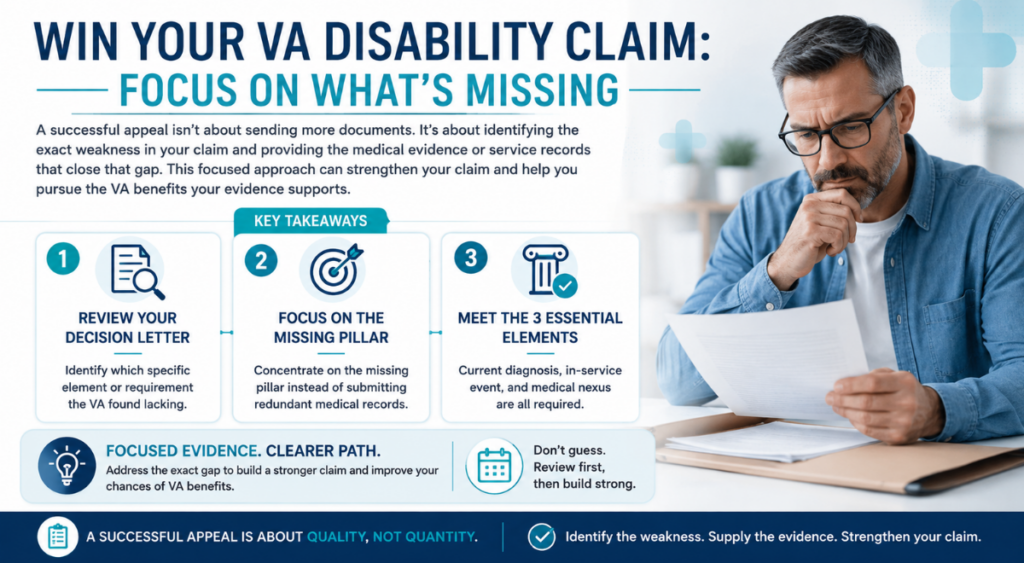
To understand what evidence you lack, you first must understand what the VA requires for approval. Every successful service-connected disability claim rests on three foundational pillars known as the Caluza Triangle, established by the Court of Appeals for Veterans Claims. You must prove a current medical diagnosis, an in-service event or injury, and a medical link between the two.
Did the VA deny your claim because they could not find a current medical diagnosis? If the VA denies your claim, they usually found one of these three pillars lacking in your file. The burden of proof rests primarily on the veteran to provide this specific information to the adjudicator to secure VA disability benefits.
While the VA has a duty to assist veterans in gathering records, this federal assistance has hard limits. You cannot rely entirely on a government agency to build a strong, winning case on your behalf. Taking a proactive approach to evidence collection drastically improves your chances of securing a favorable disability rating.
Analyzing Your VA Rating Decision Letter to Overturn a Denial

Your VA rating decision letter is one of the most important documents in the VA claim process because it explains why the Department of Veterans Affairs approved or denied each condition. Begin with the “Reasons for Decision” section, which outlines the evidence the VA reviewed, the requirements for service connection, and the specific element your disability claim failed to establish. This section may show that your medical records confirm a current diagnosis but that your service treatment records do not document an injury, illness, or symptoms during military service.
For example, the decision may acknowledge that you currently have a diagnosed knee condition while stating that your service records contain no report of knee pain or an in-service injury. In that situation, submitting additional treatment records about your current symptoms may not resolve the denial because the VA has already accepted that your condition exists. The missing claim evidence relates to the in-service event, so you may need to submit evidence such as service treatment records, personnel records, incident reports, deployment records, or lay evidence from service members who witnessed the injury.
You should also review the “Favorable Findings” section carefully. Favorable findings identify facts the VA has already accepted, such as a current diagnosis, qualifying military service, or exposure to a specific event. These accepted facts generally do not need to be proven again. Instead, focus on the missing requirement, whether it is evidence of an in-service event, a medical nexus, or treatment records showing that your symptoms continued after discharge.
Understanding this distinction can prevent you from overwhelming your VA claim with repetitive medical records that do not address the actual reason for denial. If the VA accepts the in-service event but denies service connection because there is no medical link, you may need a nexus letter or another qualified medical opinion. If the VA accepts the nexus but cannot confirm the original event, service records, buddy statements, or other supporting documents may be more valuable.
Trying to Win a VA Disability Claim Start by Finding the Missing Evidence in Service Records
Many veterans discover that their service treatment records are incomplete, heavily redacted, or missing from their VA claims file. This is especially common among service members who deployed to combat zones, received treatment in the field, changed duty stations frequently, or served decades ago. When official service medical records do not document an injury, illness, or exposure, establishing the required in-service event can become more difficult.
Missing records do not always mean that your VA disability claim cannot succeed. You may be able to reconstruct your military service history using personnel records, deployment orders, unit logs, line-of-duty reports, performance evaluations, or other supporting documents. These records can confirm where you served, what duties you performed, and whether you were present when the reported incident occurred.
Begin by reviewing your claims file to determine which service records the VA already considered. You can then request missing documents from the appropriate military records repository or government agency. If the records remain unavailable, lay statements from fellow service members may provide additional evidence supporting your account of the injury or event.
The goal is not simply to submit more paperwork. Focus on finding records that directly address the reason your claim was denied. Evidence confirming the in-service event can help complete the timeline between your military service, your current condition, and any medical opinion used to establish service connection.

Securing a Strong Medical Nexus for VA Disability Benefits
Sometimes your service records clearly show an injury, and your current medical records show a disabling condition. The missing piece is the medical nexus connecting those two distinct points in time together for the adjudicator. The VA relies on medical professionals to establish this link through compensation and pension examinations, often called a C&P exam.
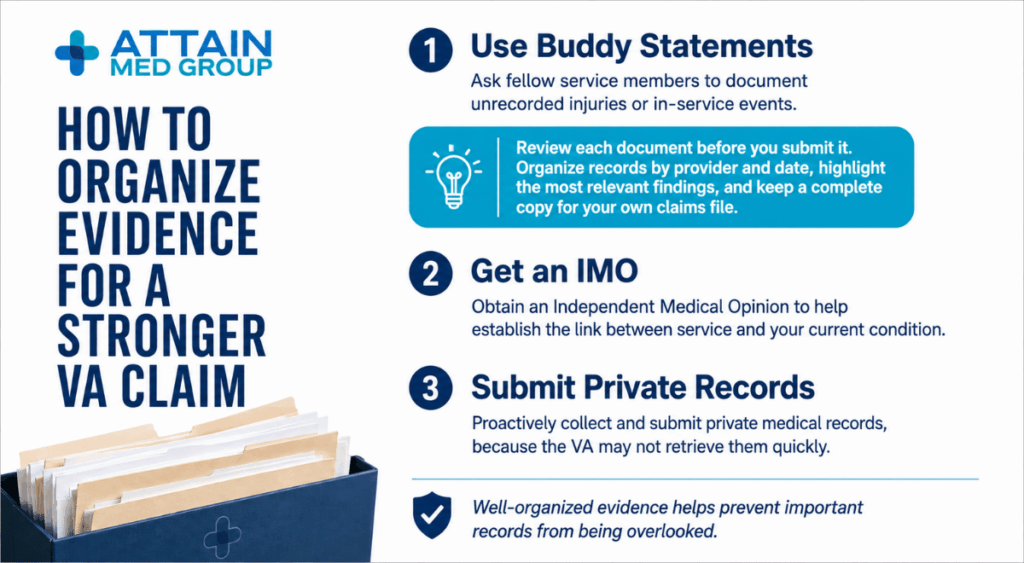
If a VA examiner provides a negative opinion, you must counter it with private medical evidence. A private physician can provide this missing evidence through a document called an Independent Medical Opinion or nexus letter. Many private doctors hesitate to write these letters because they misunderstand the legal standard required for veterans.
The VA does not require absolute scientific certainty to grant service connection for a veteran’s disability. The standard of proof is simply “as likely as not,” meaning a 50 percent probability that service caused the injury. You must educate your doctor about this specific legal standard before they write your nexus letter to support your VA disability benefits.
PRO TIP: Ask your private doctor to explicitly state “it is as likely as not that the veteran’s condition was caused by military service” and include their detailed medical rationale.
Utilizing Lay Evidence and Buddy Statements for Your VA Claim

Medical records do not document every injury, illness, or stressful event that occurs during military service. Some veterans avoid sick call, receive informal treatment in the field, or discover that their service treatment records are incomplete. When official records do not confirm an in-service event, credible lay evidence and buddy statements may provide important claim evidence that helps explain what happened.
Lay statements can come from fellow service members who witnessed the incident or observed changes in your health afterward. A buddy statement may describe when and where the event occurred, what the writer personally saw, and how your symptoms affected your duties. Veterans can submit this supporting evidence using VA Form 21-10210, Lay/Witness Statement, as part of the VA claim process.
Statements from spouses, relatives, friends, and former coworkers can also support your disability claim. These individuals may describe visible symptoms, missed work, changes in daily activities, the need for assistance, or the use of adaptive equipment. Employment records may further support these observations by documenting absences, reduced responsibilities, or other limitations connected to your condition.
Strong lay statements should remain factual and specific. The writer should explain how they know you, identify what they personally witnessed, and include approximate dates whenever possible. They should not offer medical opinions or diagnose a condition unless they are qualified health care professionals. Instead, their role is to describe observable facts that may fill gaps left by service records, VA medical records, or private treatment documents.
Lay evidence does not replace a current diagnosis or a qualified medical opinion when one is needed to establish service connection. However, it can strengthen the claims process by showing that an event occurred, symptoms began during service, or limitations continued after discharge. When combined with medical evidence and other supporting documents, credible witness statements can help the VA understand the complete history of your condition and make a more informed VA rating decision.
Tracking Down Private Medical Records for Your VA Disability Benefits Case
Trying to Win a VA Disability Claim Start by Finding the Missing Evidence means looking beyond the records already held by the VA. Many veterans receive treatment from private doctors, specialists, physical therapists, or mental health professionals outside the VA health care system. These treatment records may contain important medical evidence showing when your condition began, how it progressed, and how it continues to affect your daily life.
The VA will not always have access to your private medical records unless you identify the provider and authorize the release of those documents. Although the VA may assist with requesting records, obtaining them directly from your health care providers can give you greater control over the VA claim process. Contact every private provider who treated the condition involved in your disability claim and request a complete copy of your file.
Ask for more than a basic visit summary. Your records should include clinical notes, diagnostic imaging, laboratory results, specialist evaluations, medication histories, mental health treatment records, physical therapy reports, and long-term treatment plans. These documents may help establish a current diagnosis, support service connection, and show that your symptoms have continued over time.
For example, a private medical record showing that you reported chronic knee pain shortly after leaving military service may help connect your current condition to an earlier in-service event. Records documenting ongoing treatment can also help the VA understand the severity of your symptoms when assigning a disability rating. Without this timeline, the adjudicator may not have enough evidence to determine when the condition began or whether it is connected to service.
Organizing and Submitting Your New Evidence for a VA Appeal
Finding the missing evidence represents only half the battle in this complex administrative appeals process. You must present that evidence to the VA in a clear, highly organized manner for the adjudicator. Disorganized files frustrate adjudicators and drastically increase the chances they will miss critical information hidden in the pages.
Create a simple index or table of contents for the new documents you submit with your appeal. Highlight specific paragraphs or dates in your medical records that directly support your service-connected disability claim. Write a brief cover letter explaining exactly how this new evidence fulfills the missing requirement identified previously.
Under the Appeals Modernization Act, you have specific paths to submit this new information to the government. If you file a Supplemental Claim, you must use VA Form 20-0995 to submit your paperwork. This form specifically requires you to submit new and relevant evidence that the VA has not previously considered.
Conclusion
Carefully review why the VA denied your benefits claim and identify the exact requirement that remains unsupported. Under veterans law, a denial does not always mean that you are ineligible for benefits. It may simply mean that the evidence in your claims file did not clearly establish a current disability, an in-service event, or a medical connection between the two.
Focus on gathering documents that directly strengthen your service-connection claim. These may include service medical records, private treatment records, medical opinions, nexus letters, employment records, and statements from people who personally witnessed your symptoms. The right evidence can help establish service-connected disabilities, clarify the severity of your condition, and show whether you’re eligible for the VA rating supported by your medical history.
The evidence needed will depend on the type of claim you are pursuing. A claim involving Gulf War service or Camp Lejeune exposure may require records confirming where and when you served. Other cases may involve a temporary disability rating following qualifying treatment or recovery. Regardless of the condition, every document should help answer a specific question the VA previously found unresolved.
Veterans filing new claims may encounter standard claims procedures or the Fully Developed Claims Program. Fully developed claims generally require the claimant to submit all available supporting evidence when filing, while standard claims may require additional evidence development. A qualified veterans service organization or accredited representative may help you understand which process applies to your situation.
Do not submit unrelated paperwork simply to make your file larger. Build a focused record that explains what happened during service, how your condition developed, and how it affects your life today. With relevant evidence supporting every required element, you can move forward with a clearer, stronger, and better-organized VA disability claim.