


Are you struggling to get the compensation you deserve after your military service? The Department of Veterans Affairs processes hundreds of thousands of applications every single year. You might wonder, Can Better Medical Records Help You Win a VA Disability Claim for disability benefits?
Success often depends heavily on the overall quality of your submitted medical evidence. A comprehensive medical record can easily make the difference between a quick approval and a frustrating denial. We will examine exactly why detailed clinical files matter so much in this complicated administrative process. You will learn actionable steps to improve your chances of securing your va disability benefits.
Every successful va disability claim requires solid, undeniable proof of your current physical or mental health condition. Adjudicators at the department rely heavily on documented facts rather than basic assumptions to make their final rating decisions. Your medical record serves as the critical foundational document they review during this extensive evaluation process. Missing clinical pages or vague doctor notes can quickly derail your disability claim and delay your payments.
According to official VA guidelines on evidence needed, you must clearly prove three specific legal elements to win your va claim. First, you need documentation showing an in-service event, a physical injury, or a severe illness. Second, you must show a current disability diagnosis provided by a qualified medical professional. Finally, you need a clear medical nexus letter connecting your current symptoms to that original military service event.
Your medical records and personnel records tell the complete, chronological story of your health over an extended period. They establish the severity of your symptoms and detail exactly how they impact your normal daily life. Without clear documentation, the regional office cannot accurately evaluate your case or assign an appropriate disability rating. Proper clinical paperwork prevents raters from guessing about your actual physical limitations and daily pain levels.

Types of Medical Evidence Needed for a Strong VA Claim
Knowing exactly what evidence needed for approval can save you months of stressful waiting for disability claims. Different types of documents carry significantly different weights during the formal government review process. Your primary goal is to submit evidence that paints a comprehensive picture of your declining health. Comprehensive medical evidence speeds up the entire veteran claims process by eliminating unnecessary guesswork.
Gathering Military Service Records and Treatment Records
Your service treatment records and service medical files form the absolute baseline of your initial disability benefits application. These files show exactly what happened physically and mentally while you were on active duty. You must obtain your complete personnel records and service records to fully support your written statements. Keeping these historical files organized makes the review much easier for the assigned adjudicator at the regional office.
If you received care at a base clinic, those service treatment documents are highly critical for your va disability claim. They document the original injury or illness that started your long-term health issues. Missing service treatment records can make it incredibly difficult to prove the specific origin later. Always request complete copies of your military service files immediately upon your discharge from active duty.
Incorporating Private Medical Records and Health Care Information
Many veterans naturally seek health care outside the military system after they return home. If you use a civilian doctor, you must diligently gather your private medical records and documentation. The government does not automatically receive these files without your explicit, written permission. You have to take proactive, independent steps to gather these essential papers for your va claim.
You should fill out the proper va form to authorize the legal release of these documents. A private medical professional often provides detailed, specialized notes that greatly strengthen your case. An independent medical evaluation can also offer a helpful secondary perspective on your overall health. This outside insight often clarifies complex diagnostic issues that government doctors might miss.
WARNING: Do not assume the government will track down your civilian health care files automatically. You must actively request these documents and submit evidence yourself to build a winning case.
How to Prove Your Condition is a Service-Connected Disability

A well-documented medical record helps establish the fact that your illness is a service-connected disability. The department requires a clear medical opinion linking your current health to your past military service. This linkage is often the absolute hardest part of any disability claim you will file. You need overwhelming, undeniable proof to satisfy the strict legal requirements of the system.
Establishing the Medical Nexus with a Medical Opinion
A medical professional uses your medical records to write a strong, persuasive nexus letter for your file. This document explains exactly how your past military duties caused your current disability condition. The physician must explicitly state that your condition was “as likely as not” caused by service. Vague language in this important letter will likely result in a swift application denial.
Detailed va medical files and va health records show a continuous, unbroken history of treatment over the years. If you have large gaps in your medical record, a doctor might struggle to connect the dots. Consistent, regular visits prove that your condition never fully resolved after your formal discharge. This continuous timeline is highly vital for proving chronic illness cases to the rating board.
Using Lay Evidence and Buddy Statement Documentation
Sometimes, clinical files simply do not capture the entire negative impact of a service connected injury. You can successfully use alternative forms of proof, like lay evidence, to fill those gaps. A buddy statement from fellow service members provides crucial eyewitness context to your injury. These personal letters describe the specific incident exactly as it happened in the field.
Statements from family members can also vividly describe how your service-connected disabilities affect your life at home. This additional evidence supports your formal medical record during the comprehensive board evaluation. Personal accounts are especially helpful for proving mental health conditions like severe PTSD. They show the hidden emotional toll that standard clinical notes often completely miss.
How to Organize Your Medical Records for the VA Regional Office
The way you physically present your va disability claim and submit evidence matters significantly to the reviewers. Raters at the veterans affairs office systematically review hundreds of pages per individual file. A disorganized medical record makes it much harder for them to find crucial diagnostic information. Proper formatting prevents important diagnostic codes from getting lost in the massive administrative shuffle.
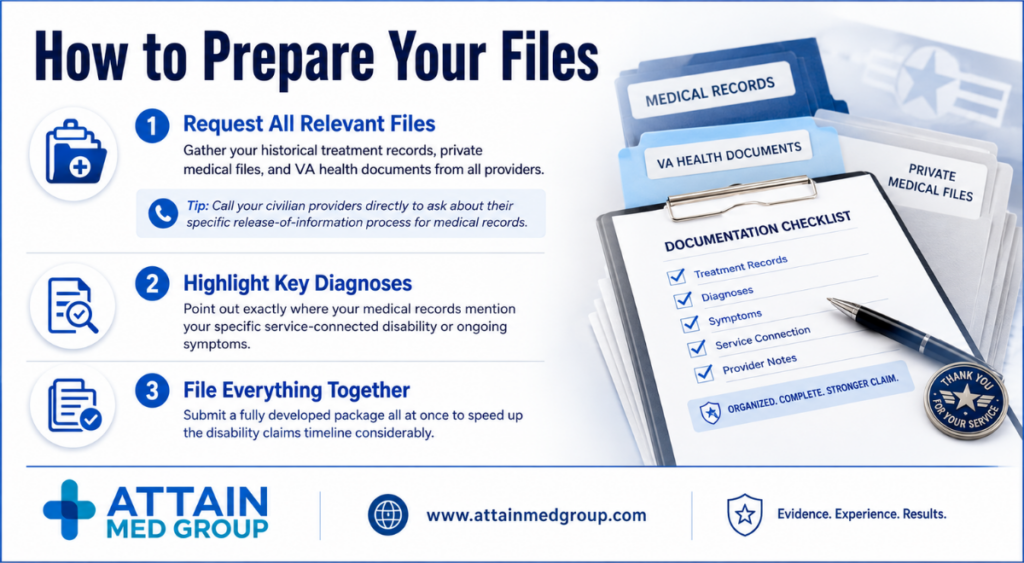
Working with an accredited claims agent can streamline this entire organization process for your veteran claims. They know exactly how to logically format a va claim for the highest chance of approval. Professionals understand precisely what the rating schedule requires for different service-connected disabilities. Their deep expertise helps you avoid common filing mistakes when winning a va disability appeal or initial application.
Maximizing Your VA Disability Rating and Disability Compensation
Your final disability rating directly determines your monthly disability compensation amount from veterans affairs. A highly thorough medical record helps you achieve the highest possible percentage for your condition. The raters carefully match your documented symptoms against the official criteria in the rating schedule. Better documentation generally leads to higher monthly payouts and better long-term financial security.
If your medical records show worsening symptoms over time, you can file for an increase in your disability rating. Regular medical evaluations provide the ongoing proof needed to legally justify a higher rating. Never stop going to the doctor just because you won your initial va disability case. Continuous medical care protects your current benefits from unexpected reductions during routine reevaluations.
VA Disability Claims for Specially Adapted Housing and Individual Unemployability
Severe physical conditions might qualify you for extra disability benefits like specially adapted housing. For example, veterans with severe mobility issues might need specially adapted housing to live safely. The specially adapted grant requires a highly specific medical record showing permanent physical limitations. You must prove you cannot move around your home safely without significant structural modifications.
If your condition prevents you from working entirely, you might qualify for individual unemployability benefits. This program pays you at the maximum rate even if your combined rating is technically lower. Your medical record must clearly demonstrate exactly how your symptoms make holding a job impossible. You must establish total occupational impairment through concrete clinical proof and doctor statements.
The adapted housing program also requires extensive architectural and clinical reviews before final approval. Having comprehensive medical evidence ready will make these secondary applications move much faster. Every set of medical records you add builds a stronger foundation for your future security.

Conclusion
Building a strong va disability claim argument requires significant patience and excellent organization of your medical records. Your medical record is the absolute foundation of your entire case from start to finish. Without consistent and clear medical evidence, securing your compensation becomes a massive, frustrating challenge. You must take control of your health documentation early in the process.
Take the time to gather every single piece of paper related to your ongoing health. Request your military service files and private records to ensure nothing is overlooked. By being proactive, you significantly increase your chances of a successful outcome for your hard-earned benefits.