


Many veterans wait months or even years to receive an official decision on their comprehensive disability claim. During this extended waiting period, the financial strain on your household often grows incredibly significant and stressful. VA backpay eligibility: the importance of medical evidence. Learn how the right documents can unlock compensation you already earned. The Department of Veterans Affairs provides generous retroactive pay to make up for that lost time spent in the queue. This powerful va benefits package covers the gap between your established effective date and the day your application gets approved. To secure this va backpay, you need strong documentation linking your current health condition directly to your military service. Without proper medical evidence, your va disability application might face unnecessary delays or outright denial.
Securing your rightful compensation requires a deep understanding of how the government evaluates your service history and clinical records. Many disabled veterans struggle to navigate the complex requirements for establishing a service-connected disability without professional guidance. By focusing on high-quality medical evidence, you can ensure that your va disability pay reflects the true severity of your condition. This article explores the nuances of retroactive payments and the specific documents required to maximize your monthly va disability benefit. We will examine how presumptive conditions and special monthly compensation can significantly increase your total lump sum payment. Understanding these rules is the first step toward achieving financial stability after your dedicated service to our nation.

The journey toward receiving your earned compensation often begins with a single, well-documented medical diagnosis from a qualified healthcare professional. Veterans must realize that the burden of proof lies with them to demonstrate a clear nexus between service and injury. This evidentiary standard ensures that federal resources are directed toward those who suffered legitimate harm during their military tenure. By meticulously organizing your clinical history, you create a roadmap that leads directly to a favorable rating decision. Professional medical opinions serve as the cornerstone of this process, providing the clinical authority needed to validate your personal testimony.
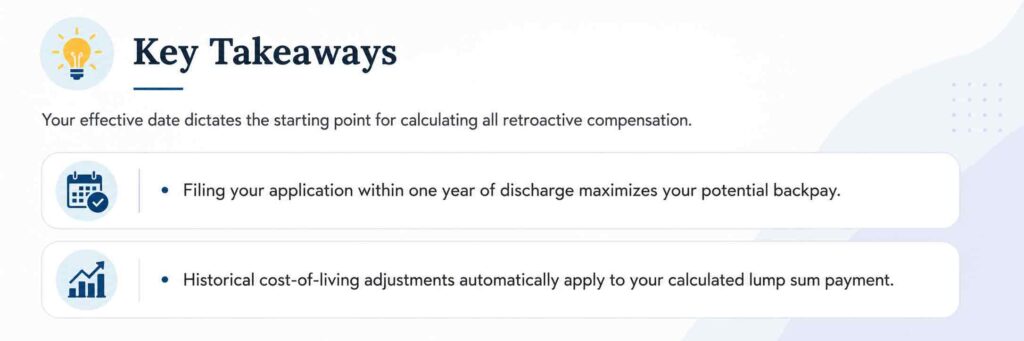
Your eligibility for a retroactive payment depends entirely on the effective date assigned to your specific file. The VA establishes this date based on when they received your application or when your condition first appeared. If you file a va form 21-526EZ within one year of leaving the military, your effective date becomes the day following your discharge. This rule ensures that veterans transitioning to civilian life receive continuous support for their service-connected disabilities. Missing this one-year window can result in a later effective date, potentially costing you thousands of dollars in lost disability pay.
For a va claim filed later, the effective date usually matches the exact day the government received your official paperwork. This standard rule applies to almost every service-connected disability benefit currently available to eligible former service members. Securing maximum retroactive pay requires you to submit your formal intent to file document as early as possible. Even if you are still gathering medical records, the intent to file preserves your effective date for up to one year. This proactive step is essential for protecting your right to va benefits during the lengthy review period.
The total amount of your lump sum depends on the exact va disability rates active during your waiting period. If general va disability rates increased due to annual cost-of-living adjustments, your retroactive payment will reflect those specific historical amounts. You can use a reputable online disability calculator to estimate your potential compensation before the final decision arrives. These calculators account for your disability rating, marital status, and number of dependents to provide a realistic financial outlook. Accurate estimations help you plan your finances while the VA processes your complex va disability benefits application.
The effective date is not merely a bureaucratic marker; it is the financial anchor for your entire retroactive claim. When the VA reviews your file, they look for the earliest possible date that the law allows for compensation. This often involves looking back at previous denied claims to see if a clear error was made by the rater. If you can prove a “clear and unmistakable error,” you might be able to push your effective date back by years. Such a discovery can lead to a massive retroactive payment that accounts for a decade or more of underpayment.
VA Disability Medical Evidence: The Critical Role of Medical Evidence

Proper documentation forms the absolute foundation of every successful va benefit application submitted to the government. The VA needs clear, undeniable proof that your current injury or illness directly connects to your active duty service. Comprehensive medical records provide this necessary clinical link and establish your official service connection. You should gather all relevant treatment notes, surgical reports, and diagnostic test results to support your claim. These documents serve as the primary evidence used by raters to determine your eligibility for va disability benefits.
A proper diagnosis from a qualified physician serves as the starting point for your formal benefits claim. You must also provide continuous treatment records showing the ongoing severity and progression of your physical or mental condition. This specific combination of current and historical data helps the VA assign an accurate disability rating. If your records are incomplete, the VA may schedule a Compensation and Pension (C&P) exam to fill the gaps. However, relying solely on the C&P exam can be risky, as the examiner may not capture the full extent of your daily struggles.
Without sufficient medical evidence, government reviewers cannot legally grant you a monthly va disability benefit. They rely heavily on clinical notes, diagnostic imaging, and expert medical opinions to justify the expenditure of federal funds. You must gather these comprehensive records from both military facilities and private health care providers. Including a nexus letter from a medical professional can also strengthen your case by explicitly linking your condition to your service. This expert opinion often bridges the gap between your military records and your current health status.
Medical evidence should also include Disability Benefits Questionnaires (DBQs) which are standardized forms used to evaluate the severity of conditions. These forms allow your private physician to speak the VA’s language by addressing specific criteria found in the rating schedule. When a doctor completes a DBQ, they provide the rater with the exact data points needed to assign a percentage. This proactive approach reduces the likelihood of the VA ordering a generic C&P exam that might undervalue your symptoms. High-quality clinical evidence is the most effective tool for overcoming the skepticism often found in the claims process.
Furthermore, you should ensure that your medical records reflect the frequency and duration of your symptoms over a long period. One-time visits rarely provide enough data for a high rating, as they only capture a snapshot of your health. Consistent treatment demonstrates that your condition is chronic and requires ongoing management by medical professionals. If you have gaps in your treatment history, be prepared to explain them, such as lack of insurance or physical inability to travel. Providing a complete picture of your medical journey helps the VA understand the true impact of your service-connected injuries.
VA Disability Benefits for Agent Orange Exposure and Presumptive Conditions

Veterans who served in specific locations during the Vietnam era often face unique health challenges related to toxic herbicides. The VA recognizes certain illnesses as a presumptive condition, meaning you do not need to prove a direct service connection. If you have documented agent orange exposure, you may qualify for significant retroactive benefits dating back to your initial filing. This presumption simplifies the claims process for thousands of veterans who were exposed to dangerous chemicals while serving overseas. Ensuring your medical records reflect a diagnosis on the presumptive list is vital for a successful outcome.
The list of conditions associated with orange exposure continues to expand as new medical research becomes available to the public. Common conditions include type 2 diabetes, Parkinson’s disease, and various forms of respiratory cancers linked to agent orange exposure. If you were previously denied for one of these conditions, you might be eligible to reopen your va claim under new regulations. This could lead to a substantial retroactive payment if the VA determines your effective date should have been earlier. Staying informed about legislative changes like the PACT Act is essential for all veterans seeking disability pay.
To qualify for these benefits, you must provide evidence of service in a location where agent orange was used or stored. This typically includes boots-on-the-ground service in Vietnam, certain Thai air bases, or the Korean Demilitarized Zone. Your military personnel records will serve as the primary proof of your location and duration of service. Once exposure is established, the focus shifts to your current medical diagnosis and how it impacts your daily life. Providing detailed health care records will help the VA assign the correct disability rating for your presumptive condition.
The PACT Act has significantly expanded the list of presumptive conditions for veterans of multiple eras, including those exposed to burn pits. This legislation represents the largest expansion of veteran healthcare and benefits in decades, affecting millions of former service members. If you served in Iraq or Afghanistan, you may now be eligible for compensation for respiratory issues and rare cancers. These new rules often allow for retroactive pay if you had a pending claim or were previously denied for these specific issues. It is imperative to review the updated list of conditions to see if your health struggles are now recognized as service-connected.
Presumptive service connection removes one of the most difficult hurdles in the entire va claims process. Instead of proving that “Event A” caused “Condition B,” you only need to prove you were at “Location X” and now have “Condition B.” This streamlined path is designed to honor the sacrifice of those who served in hazardous environments without requiring impossible levels of proof. However, you still need a formal diagnosis from a medical professional to trigger these presumptive benefits. Without that clinical diagnosis, the presumption of service connection cannot be applied to your specific case file.
VA Disability Claim for Individual Unemployability and Retroactive Payment

Individual unemployability, also known as TDIU, provides a pathway for veterans whose service-connected disabilities prevent them from maintaining gainful employment. This specific va benefit allows the government to pay you at the 100% rate even if your combined rating is lower. Securing this status requires extensive vocational evidence and medical documentation showing how your condition impacts your ability to work. If approved, your retroactive payment will reflect the difference between your previous rating and the 100% unemployability rate. This can result in a life-changing lump sum for veterans who have been unable to work for years.
To be eligible for individual unemployability, you generally need one service-connected disability rated at 60% or a combined rating of 70%. You must also demonstrate that your disabilities prevent you from securing or following a substantially gainful occupation. The VA will review your employment history, educational background, and medical limitations to make a final determination. Providing statements from former employers or vocational experts can significantly strengthen your disability claim for TDIU. These third-party perspectives offer valuable insight into the practical limitations caused by your service-connected disability.
The effective date for individual unemployability is often the date you first became unable to work due to your disabilities. However, you must have an active va claim or have filed for TDIU within a specific timeframe to secure this date. If the VA determines you were eligible for TDIU years ago, your retroactive payment could cover that entire period. This highlights the importance of maintaining thorough records of your employment attempts and medical consultations. Consistent documentation is the key to unlocking the full value of your va disability benefits.
Vocational evidence is just as important as medical evidence when applying for individual unemployability benefits. You should provide records of any workplace accommodations that were attempted but ultimately failed to keep you employed. If you were terminated from a position due to symptoms of your disability, that documentation is incredibly powerful. The VA needs to see that your inability to work is a direct result of your service-connected conditions rather than economic factors. A vocational expert’s report can bridge the gap between your medical limitations and the realities of the modern labor market.
It is also important to understand the concept of “marginal employment” when seeking TDIU status. If you are working but earning less than the federal poverty level, the VA may still consider you “unemployable” for benefit purposes. This exception allows veterans to maintain some level of social engagement or supplemental income without losing their 100% pay rate. However, you must be very careful to document these earnings and explain the sheltered nature of your work environment. Clear communication with the VA regarding your work status prevents future overpayment issues and protects your retroactive compensation.
VA Disability Compensation for Mental Health and Stress Disorders

Mental health conditions like post-traumatic stress disorder often require specialized documentation to establish a clear and undeniable service connection. A formal diagnosis of a stress disorder from a licensed psychologist or psychiatrist is essential for your disability claim. These records must detail the specific stressors encountered during your military service to justify your monthly va disability benefit. Because mental health symptoms can fluctuate, providing a long-term history of treatment is crucial for an accurate disability rating. The VA evaluates mental health based on social and industrial impairment, ranging from 0% to 100%.
Many veterans suffer from a stress disorder for years before seeking formal help from the VA or private doctors. If you can provide evidence that your symptoms began during service, you may be eligible for significant retroactive pay. Lay statements from family members or fellow service members can help document the onset of your mental health struggles. These “buddy letters” provide a personal perspective that clinical records might miss, especially for events that occurred decades ago. Combining these personal accounts with professional medical evidence creates a compelling narrative for the va claims process.
The VA also recognizes that mental health conditions can lead to secondary service-connected disabilities, such as sleep apnea or hypertension. If your mental health condition causes or worsens another physical ailment, you can claim it as a secondary condition. This approach can increase your overall disability rating and lead to higher monthly compensation for your sacrifices. It is important to discuss all your symptoms with your health care provider to ensure every issue is documented. Comprehensive reporting ensures that your va disability pay accurately reflects the total impact on your well-being.
When documenting mental health, you should focus on how your symptoms interfere with your ability to maintain relationships and perform work tasks. The VA rating schedule for mental health focuses heavily on “occupational and social impairment” rather than just a diagnosis. For example, a veteran who experiences occasional panic attacks might be rated at 30%, while someone with total social isolation might reach 100%. Providing specific examples of how your condition has led to job loss or divorce can help the rater understand the severity. These real-world consequences are often more persuasive than a simple list of symptoms in a medical chart.
Additionally, veterans should be aware of the rules regarding Military Sexual Trauma (MST) and its impact on mental health claims. The VA has established more sensitive procedures for handling these claims, recognizing the difficulty of reporting such events during active duty. If you are filing a claim based on MST, you can use “markers” in your personnel records to prove the event occurred. These markers might include sudden changes in performance, requests for transfer, or unexplained behavioral issues. Using these indirect forms of evidence allows survivors to access the va benefits they deserve without needing a formal police report from the time of the incident.
VA Disability Rating for Gulf War Veterans and Disability Benefits

Veterans who served in the gulf war often experience unexplained chronic symptoms known as Gulf War Syndrome or undiagnosed illnesses. The VA has established specific rules for these veterans, allowing for a presumptive service connection for certain chronic multi-symptom illnesses. These include fatigue, muscle pain, and gastrointestinal signs that cannot be linked to a specific diagnosis. If you served in the Southwest Asia theater, your disability rating may be based on these persistent and debilitating symptoms. Securing disability benefits for these conditions requires careful documentation of when the symptoms first appeared and their duration.
The va claims process for gulf war veterans can be complex due to the “undiagnosed” nature of many qualifying conditions. You must show that your symptoms have persisted for at least six months and resulted in a disability rating of 10% or more. Medical records showing frequent doctor visits for these symptoms are essential for proving the chronic nature of your illness. The VA will also consider environmental triggers, such as burn pit exposure, which are now covered under expanded presumptive rules. These updates have opened the door for many veterans to receive retroactive pay for conditions previously ignored.
Providing a detailed timeline of your health issues since returning from the gulf war is vital for your va claim. You should include any private health care records that document your search for answers regarding your mysterious symptoms. The more evidence you provide, the easier it is for the VA to grant a service-connected disability for your condition. This proactive approach helps ensure you receive the disability pay you earned through your service in a hazardous environment. Remember that your testimony about your daily limitations is a powerful form of evidence in these cases.
Gulf War veterans should also be aware of the “38 CFR 3.117” regulation, which governs claims for undiagnosed illnesses. This regulation is unique because it allows for compensation even when doctors cannot find a physical cause for your pain or fatigue. To succeed, you must demonstrate that your symptoms are not the result of a known clinical diagnosis like fibromyalgia or irritable bowel syndrome. However, those specific conditions are also presumptive for Gulf War veterans, so you are covered either way. The key is to ensure your medical records clearly state that your symptoms are chronic and began after your service in the region.
The VA often denies these claims by trying to attribute the symptoms to a known condition that is not on the presumptive list. You must work closely with your physician to rule out other causes and emphasize the “multi-symptom” nature of your illness. If you have multiple issues like joint pain, skin rashes, and memory loss, they should be evaluated as part of a single syndrome. This holistic view of your health is often the only way to reach the 100% disability rating level. By presenting a unified case, you increase your chances of securing a significant retroactive payment for your years of unexplained suffering.
VA Disability Pay: Special Monthly Compensation and Specially Adapted Housing

Special monthly compensation is an additional tax-free benefit paid to veterans with particularly severe disabilities or loss of limbs. This monthly compensation goes beyond the standard va disability rates to account for the increased cost of personal care and assistance. You might also be eligible for a specially adapted housing grant to modify your home for better accessibility and safety. These grants help disabled veterans live more independently by funding ramps, widened doorways, and adapted bathrooms. Understanding the criteria for special monthly benefits can significantly increase your total monthly va pay.
To qualify for a specially adapted housing grant, you must have a permanent and total service-connected disability. This often includes the loss of use of both lower extremities or blindness in both eyes due to service. The VA also offers the special monthly “Aid and Attendance” benefit for veterans who require the help of another person for daily activities. This could include help with bathing, dressing, or protecting yourself from the hazards of your daily environment. Documentation from your doctor regarding your need for daily assistance is required to secure this additional va benefits package.
Retroactive pay for special monthly compensation can be substantial if the VA determines you were eligible at an earlier date. For example, if your condition worsened years ago but you only recently applied for the increase, you might receive backpay. This is why it is critical to file a new va form whenever your health significantly declines. Keeping the VA informed of your changing needs ensures that your disability compensation remains aligned with your actual level of impairment. Don’t leave money on the table by failing to report the increased severity of your service-connected disabilities.
There are various levels of Special Monthly Compensation (SMC), ranging from SMC-K for the loss of a single organ to SMC-R for those requiring high-level daily care. Each level has its own specific medical requirements and corresponding pay rate that sits above the standard 100% disability amount. For instance, SMC-S is often granted to veterans who are “housebound” due to their service-connected conditions. Proving you are housebound requires medical evidence showing you are substantially confined to your premises. These nuances in the law allow the VA to provide extra support to those with the most significant physical and mental challenges.
When applying for SMC, you should ask your doctor to complete VA Form 21-2680, which is the “Examination for Housebound Status or Aid and Attendance.” This form provides the VA with the specific clinical data needed to approve the higher pay rate. It asks about your ability to feed yourself, manage your hygiene, and move around your home safely. If your spouse or a family member provides this care, their testimony can also be used to support the claim. Securing SMC can add thousands of dollars to your monthly check, providing the financial resources needed for professional home care services.
Navigating the VA Claims Process for Retroactive Pay
The va claims process involves several distinct stages, starting from the initial submission of your intent to file document. Throughout the claims process, you will likely undergo a Compensation and Pension examination to verify the severity of your symptoms. Understanding each step of the va claims process ensures that you provide the necessary evidence to avoid lengthy delays. You should regularly check the status of your va claim through the official portal to stay informed of any requests for more information. Promptly responding to VA inquiries is the best way to keep your application moving through the system.
During the va claims process, the government will gather your military service records and any medical evidence you have provided. They may also request records from your private health care providers to get a complete picture of your medical history. If the VA determines that more information is needed, they might schedule additional exams or ask for a formal statement. This is a critical time to ensure all your service-connected disabilities are clearly documented and explained. A well-organized file is much more likely to result in a favorable decision and a correct disability rating.
Once the VA reaches a decision, they will send you a rating decision letter explaining their findings and your effective date. If you are approved, your retroactive payment is usually processed within a few weeks of the decision date. This lump sum covers the entire period from your effective date to the start of your regular monthly payments. If you disagree with the decision, you have the right to appeal and seek a higher disability rating or an earlier effective date. Navigating the appeals portion of the va claims process requires patience and often additional medical evidence.
The “Intent to File” (ITF) is perhaps the most important tool for any veteran starting the claims process. By submitting an ITF, you effectively “bookmark” your effective date while you spend the next 12 months gathering evidence. This allows you to take the time needed to get a nexus letter or a private DBQ without losing months of backpay. Many veterans make the mistake of waiting until their file is “perfect” before contacting the VA, which can cost them thousands in lost compensation. Always submit your ITF the moment you decide to seek an increase or a new service connection.
During the C&P exam, you must be completely honest about your “worst days” rather than how you feel at that exact moment. Examiners often see veterans who try to “tough it out” during the exam, leading to an artificially low disability rating. You should describe your symptoms in detail, including how they limit your range of motion or your ability to concentrate. If the examiner does not use a goniometer to measure your joint movement, you should note that in your records. These small details can be the basis for a successful appeal if the initial decision is unfavorable.

VA Disability Documentation: Maximizing Your Disability Compensation
Maximizing your disability compensation requires a strategic approach to gathering and presenting your medical evidence to the VA. You should focus on establishing a clear “nexus” or link between your current diagnosis and a specific event in your military service. This often involves obtaining a formal medical opinion from a specialist who understands the VA’s unique evidentiary requirements. Including detailed journals of your symptoms and how they affect your daily life can also provide valuable context for the rater. These personal records help humanize your va claim and demonstrate the real-world impact of your service-connected disability.
Another way to increase your disability pay is to identify and claim all secondary conditions that result from your primary service-connected disability. For example, if a service-connected knee injury leads to back pain due to an altered gait, the back condition is also compensable. Many veterans overlook these secondary links, missing out on a higher combined disability rating and increased monthly compensation. Working with a veteran service officer or a qualified attorney can help you identify these often-missed opportunities for additional va benefits. Their expertise in the va claims process can be invaluable for securing the maximum possible retroactive pay.
Finally, ensure that your disability rating accurately reflects the frequency and severity of your “flare-ups” or bad days. The VA should rate you based on your condition’s impact during its worst periods, not just how you feel on the day of your exam. Providing evidence of missed work or the need for emergency medical care during flare-ups can help justify a higher rating. This comprehensive approach to documentation ensures that your va disability benefits provide the full support you need. By being thorough and persistent, you can unlock the compensation you have already earned through your service.
Lay evidence, often called “buddy statements,” can be the deciding factor in a close case where medical records are sparse. These statements from friends, family, or fellow service members describe the observable changes in your behavior or physical abilities. For example, a spouse can testify to your nightly struggles with sleep apnea or the frequency of your PTSD-related nightmares. While not medical evidence, these statements provide the “competent lay testimony” that the VA is legally required to consider. They fill in the gaps between doctor visits and provide a 24/7 view of your disability’s impact.
You should also consider the “combined rating table” when looking to maximize your monthly check. The VA uses “VA math,” which means that two 50% ratings do not equal a 100% rating; they actually equal 75%, which rounds to 80%. Understanding this system helps you realize that adding small 10% ratings for secondary conditions can eventually push you over the threshold to a higher bracket. Every small diagnosis counts toward your final goal of reaching the maximum compensation level. Persistence in documenting every service-related ailment is the only way to ensure the VA’s math works in your favor.
VA Disability Retroactive Pay: Managing the Appeals Process for Retroactive Pay

If your initial va claim is denied or you receive an unsatisfactory disability rating, the appeals process offers a chance for correction. You can choose from several appeal lanes, including a Higher-Level Review, a Supplemental Claim, or a Board Appeal. A Supplemental Claim is particularly useful if you have discovered new and relevant medical evidence since your last decision. This lane allows you to maintain your original effective date, preserving your right to a significant retroactive payment. Choosing the right appeal strategy is essential for correcting errors in your va disability benefits file.
During an appeal, the VA will re-examine your medical evidence and any new documentation you provide to support your case. If a Higher-Level Reviewer finds a “duty to assist” error, they may order new exams or gather more records on your behalf. This can lead to a revised decision that grants a higher disability rating or an earlier effective date for your benefits. It is important to remain patient, as the appeals portion of the va claims process can take several months or even years. However, the potential for a large retroactive payment makes the persistence well worth the effort for most veterans.
Successfully managing an appeal often requires a deeper dive into your health care history and military personnel records. You may need to seek additional expert opinions to counter a negative C&P exam or to clarify a complex medical issue. Every piece of evidence you add to your file strengthens your position and increases the likelihood of a favorable outcome. Once the appeal is won, the VA will calculate your retroactive pay based on the new, correct effective date. This final step ensures that you are fully compensated for the time you spent fighting for your rightful disability pay.
The Appeals Modernization Act (AMA) has streamlined the process, giving veterans more control over how their cases are reviewed. If you believe the rater simply missed a piece of evidence already in your file, a Higher-Level Review is the fastest option. However, if you need to submit a new nexus letter from a specialist, the Supplemental Claim lane is the correct choice. For the most complex cases involving legal interpretations, a Board Appeal before a Veterans Law Judge may be necessary. Each lane has its own pros and cons regarding speed and the ability to introduce new clinical data.
Finally, remember that an appeal is not just about the current rating, but also about the effective date of your benefits. If the VA grants your service connection but gives you a recent effective date, you should consider appealing that specific finding. Proving that you met the criteria for the disability years ago can result in a massive retroactive check. This requires showing that your medical records from that earlier period support the higher rating you eventually received. By fighting for the correct date, you ensure that the government fulfills its entire financial obligation to you as a veteran.