

What separates an approved VA disability compensation claim from an unexpected denial? In most cases, the deciding factor comes down to the quality, relevance, and depth of medical documentation submitted to adjudicators. Understanding the 7 ways medical evidence can strengthen a VA disability claim provides military veterans with an actionable blueprint to secure the monthly disability benefits they rightfully earned during active military service.
The encouraging reality is that veterans maintain substantial control over how their medical records are gathered, organized, and presented to the Department of Veterans Affairs. Developing a clear strategy around objective clinical documentation dramatically improves your odds of receiving a favorable decision and a proper disability rating. This comprehensive guide examines seven specific ways medical evidence strengthens a VA disability claim, outlines practical steps for obtaining supportive records, and highlights the procedural mistakes that quietly weaken otherwise valid cases.
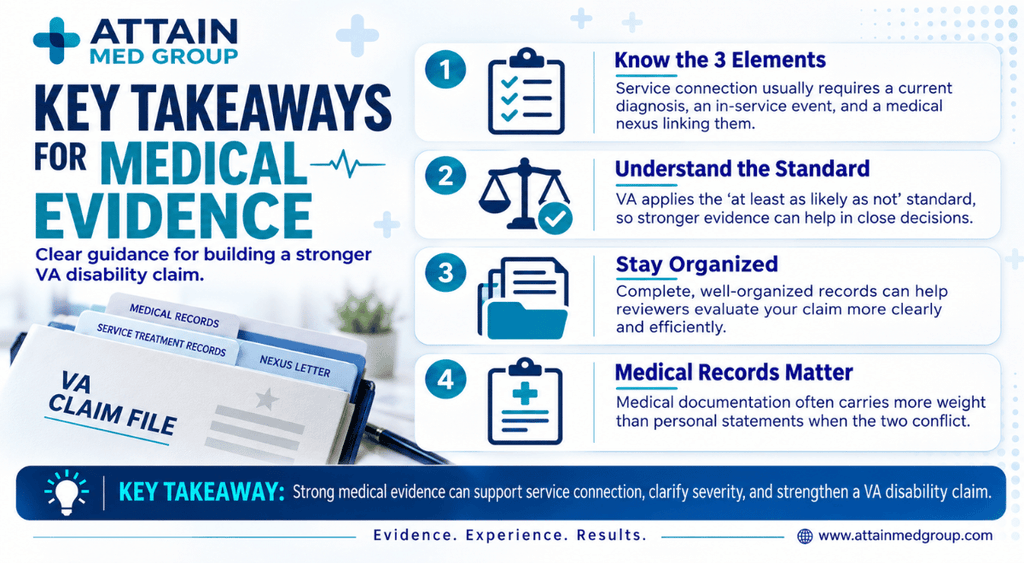
To establish service connection, veterans generally need evidence of three essential elements. These include a current physical or mental disability, an in-service event or injury, and a medical nexus. The medical nexus connects the current condition to military service. This framework comes from 38 CFR § 3.303 and relevant legal precedent. Medical evidence helps establish these elements in the official record.
The Department of Veterans Affairs reviews medical evidence, service treatment records, and credible lay evidence when evaluating VA disability claims. For medical opinions, at least as likely as not generally means a 50% or greater likelihood. Under 38 CFR § 3.102, VA must resolve reasonable doubt in the veteran’s favor. This rule applies when positive and negative evidence is in approximate balance. Strong medical records and well-supported opinions can help establish a connection to military service.
Millions of veterans navigate the VA disability claims process. Accurate and complete documentation helps build a well-supported claim. Medical evidence includes diagnostic reports, treatment records, and clinical evaluations. These records help VA reviewers understand a condition, its severity, and its potential connection to service. Thorough documentation does not guarantee approval or a higher VA disability rating. However, it can address unanswered questions and support a more informed decision.
7 Ways Medical Evidence Can Strengthen a VA Disability Claim
Every compensation claim proceeds through specific evidentiary checkpoints before an adjudicator assigns a rating percentage. The following analysis explores seven proven strategies where detailed medical evidence directly strengthens your file, ensuring regional office adjudicators have the legal and factual basis to approve your claim. Focusing on concrete clinical data eliminates ambiguity and protects your filing against premature denials.
1. Medical Evidence Confirms a Current, Compensable VA Disability Diagnosis
Establishing a current medical condition is an important step in building strong VA disability claims. For direct service connection, VA generally requires three elements. These include a current disability, an in-service event or injury, and a connection between them. A qualified medical professional can provide diagnostic findings, clinical evaluations, and opinions to support a disability benefits claim. For example, a veteran with persistent knee pain may submit records documenting arthritis, ligament damage, or functional limitations. Persistent pain that causes functional impairment may also qualify as a disability, even without a specific diagnosis.
A documented diagnosis helps VA reviewers understand the current condition and its possible relationship to military service. Veterans can gather medical evidence through VA healthcare facilities or private medical providers. This evidence may include diagnostic imaging, physical examinations, and treatment records. These findings can document symptom severity and help support an appropriate VA disability rating. A lengthy treatment history is not always required. However, consistent medical documentation can show how a condition develops over time.
Accurate medical records can show ongoing symptoms, functional limitations, and responses to treatment. Clinical notes may describe pain levels, mobility restrictions, medication use, and challenges with daily activities. Veterans can also submit credible personal statements or lay evidence alongside their medical records. These statements help explain how symptoms affect everyday life. Together, these records support VA’s evaluation of service connection, disability ratings, and the condition’s overall impact.
2. Clinical Documentation Proves the In-Service Event or Military Injury

Military service treatment records often provide key evidence for establishing direct service connection. These records may include sick call summaries following field exercises or medical profiles restricting physical activity. Emergency department records from deployments can also document injuries during military service. Without sufficient in-service evidence, VA reviewers may recognize a current condition but deny its connection to military service.
Missing military records do not automatically lead to a VA claim denial. The National Archives can help veterans locate or reconstruct missing military personnel files. Morning reports, hazardous duty orders, and post-discharge medical records may provide additional supporting evidence. Statements from fellow service members can also help confirm injuries or events that occurred during military service.
Veterans should compare their military occupational specialty (MOS) duties with documented physical injuries or toxic exposures. Combat reports, exposure records, and physical duty requirements can provide valuable supporting evidence. These records help establish the circumstances surrounding an injury or exposure during military service. When combined with post-service medical evaluations, they may strengthen the connection between military service and a current condition.
3. A Doctor’s Opinion Establishes the Medical Nexus Connecting Service to Disability
The nexus represents the indispensable medical bridge connecting an active, compensable disability back to an event during active duty service. A comprehensive nexus opinion prepared by a qualified physician provides adjudicators with the clinical rationale required to establish this essential link. Persuasive nexus evaluations conclude that the condition meets the at least as likely as not legal standard and articulate thorough pathological reasoning.
The distinction between an effective medical opinion and an unpersuasive letter lies in scientific analysis and claim file review. An opinion stating an injury might theoretically relate to service fails because the terminology remains entirely speculative under federal regulations. Conversely, a physician citing military parachuting logs, documented sick call visits, and modern magnetic resonance imaging establishes clear entitlement. Our detailed guide on getting a strong nexus letter outlines best practices for obtaining these crucial medical opinions.
Pro Tip: Ask your doctor to review your complete claims file before writing a nexus opinion. Opinions that cite specific records and explain the underlying medical reasoning carry far more weight than short, unsupported statements.
4. Objective Medical Evidence Proves Severity and Supports a Higher VA Rating
After VA grants service connection, medical evidence helps determine the appropriate disability rating. The VA Schedule for Rating Disabilities assigns percentages from 0% to 100% based on specific criteria. For cervical spine conditions, VA considers measured range of motion and functional limitations. During an examination, a goniometer measures joint movement in degrees.
Consistent medical records help show the severity of chronic conditions over time. Diagnostic imaging, laboratory results, physical therapy notes, and medication changes can provide supporting evidence. For example, regular treatment notes may document recurring prostrating migraines better than one isolated visit. Together, these records provide a clearer picture of symptom frequency and severity.
Objective testing can also document flare-ups, fatigue after repetitive movement, and additional functional loss. These findings matter under decisions such as DeLuca v. Brown, which addresses functional loss in musculoskeletal evaluations. Providers should document how pain affects movement, including additional range-of-motion loss when it can be determined. This helps reviewers consider limitations that may not appear during a brief examination.
5. Functional Medical Records Demonstrate How Your Condition Limits Ability to Work (TDIU)
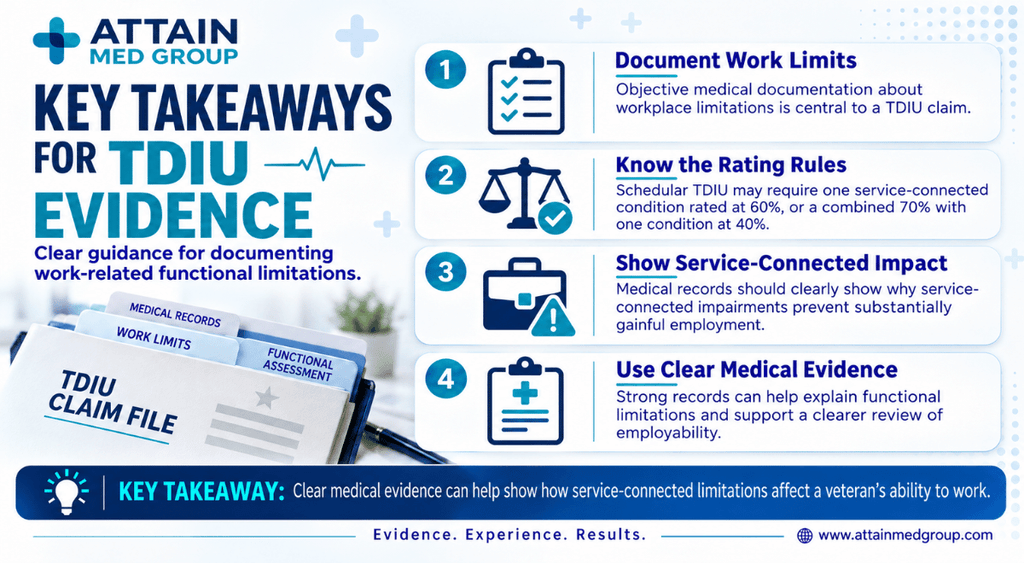
Functional capacity assessments from medical specialists carry substantial probative weight when evaluating occupational impairment under federal regulations. A treating psychologist documenting that severe post-traumatic stress disorder causes chronic decompensation, social avoidance, and impaired executive functioning provides definitive proof of total occupational impairment. Our comprehensive TDIU benefits guide explains eligibility standards, vocational factors, and relevant rating regulations in depth.
These clinical assessments should clearly distinguish between limitations caused by service-connected disabilities and those resulting from non-service-connected health factors. When treating doctors explicitly detail physical restrictions such as inability to stand for thirty minutes or sit without severe spinal spasms, raters cannot easily discount vocational claims. Robust medical evaluations ensure that adjudicators recognize the true occupational barriers confronting disabled claimants.
6. Diagnostic Evidence Builds the Strongest Case for Secondary Service Connection
Many veterans qualify for increased monthly compensation through conditions that developed as a direct consequence of an established primary disability. Detailed medical evidence clarifies the physiological mechanisms through which primary service-connected conditions aggravate or create secondary health problems. An altered antalgic gait caused by a service-connected knee impairment routinely generates progressive degenerative joint disease across the lumbar spine and hips.
Securing secondary service connection requires a formal diagnosis of the secondary condition and a medical opinion showing direct causation or aggravation. Medical providers can cite peer-reviewed clinical research confirming that service-connected diabetes mellitus accelerates bilateral peripheral neuropathy and ocular complications. Because establishing secondary conditions significantly increases a veteran’s combined disability rating, comprehensive medical evaluations remain vital for maximizing compensation.
Similarly, mental health disorders often stem directly from chronic, debilitating service-connected pain conditions. Clinical psychology notes that trace the onset of major depression or chronic anxiety to physical functional loss supply the necessary etiology. Backing these claims with continuous therapy notes and pharmacology histories creates an airtight medical argument that raters can approve without hesitation.
7. New Medical Evidence Rebuilds and Strengthens Your Claim on Appeal
Receiving an adverse rating decision or formal claim denial does not mean your path to disability compensation has reached an end. Under the Appeals Modernization Act, veterans filing a Supplemental Claim can submit new and relevant evidence, including private treatment records and independent medical opinions, as defined under 38 CFR § 3.2501. Many claimants prevail upon supplemental review simply by providing the definitive diagnostic imaging or clinical nexus that was missing from the initial file.
Independent medical evidence serves as an indispensable tool for countering inadequate Compensation and Pension examinations conducted by contract examiners. When an examiner rushes an evaluation or overlooks documented medical histories, an independent medical evaluation can effectively challenge those adverse findings. The Board of Veterans’ Appeals frequently remands decisions supported by deficient examinations, and our appeals process overview explains your appellate rights in detail.
Submitting focused medical rebuttals directly attacks errors in the initial C&P examiner’s rationale, such as misapplied diagnostic criteria or omitted historical records. An independent specialist who performs a comprehensive chart review can systematically point out where the VA contractor reached unsupportable medical conclusions. This higher tier of clinical scrutiny creates compelling reasonable doubt that appellate adjudicators must resolve in your favor.
How to Build Your Evidence File in Five Steps
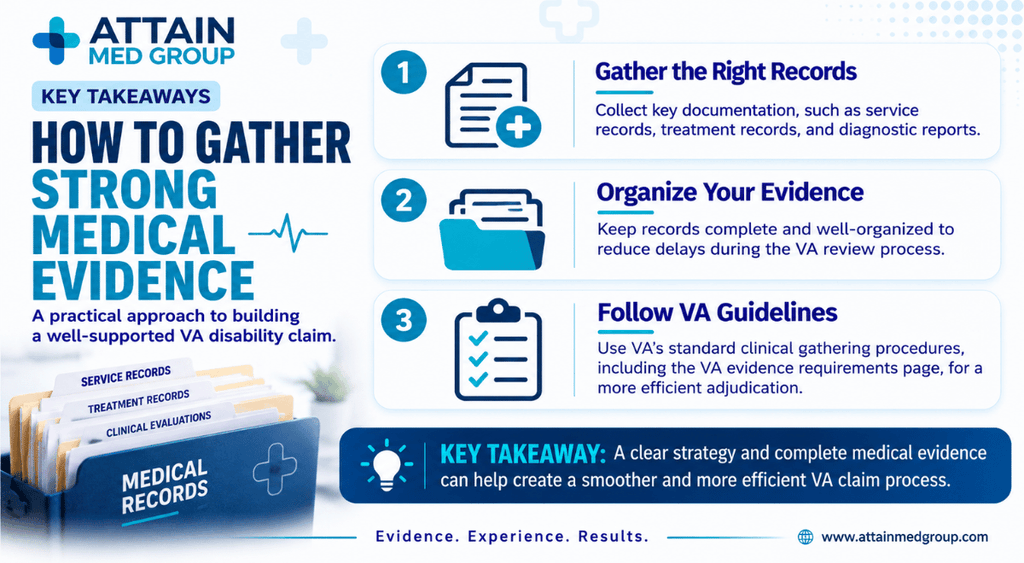
- Request Your Complete Service Treatment Records
Submit a formal request to the National Personnel Records Center using Standard Form 180, or authorize the agency to retrieve your military files directly. Be sure to request complete military personnel records alongside your clinical files, as administrative personnel files often confirm specific overseas assignments, combat badges, and hazardous duty environments.
Tip: Start early, because federal records requests can take several months to fulfill
- Gather All Private and VA Medical Records
Obtain electronic copies of your complete treatment history from every private physician, hospital network, and community care provider who treated your conditions. Execute VA Form 21-4142 and Form 21-4142a to authorize release of non-federal health records, ensuring that every diagnostic assessment, surgical summary, and progress note enters the claims folder.
Tip: Request unedited progress notes rather than billing summaries to provide raters with granular clinical data.
- Secure Objective Diagnostic Tests and Imaging
Schedule updated diagnostic imaging, such as magnetic resonance imaging scans, computed tomography scans, and electromyography studies, to substantiate the physiological presence of your condition. Objective diagnostic testing removes ambiguity by providing measurable radiological and neurological findings that raters and examiners cannot easily dismiss as subjective complaints.
Tip: Ensure diagnostic reports include full radiologist impressions along with precise anatomical descriptions of structural damage.
- Obtain a Comprehensive Medical Nexus Letter
Retain an independent medical practitioner or speak with your treating physician to draft a formal medical nexus opinion based upon a thorough review of your claims folder. The physician must state that they reviewed your military treatment records, outline your history of symptoms, and express their professional opinion utilizing proper legal terminology.
Tip: Confirm that the evaluating clinician cites peer-reviewed medical journals to reinforce the scientific plausibility of the nexus.
- Complete Disability Benefits Questionnaires (DBQs)
Have your treating provider complete publicly available Disability Benefits Questionnaires, commonly known as DBQs, matching the specific conditions listed in your formal application. Completed DBQs mirror the standardized examination templates used by agency examiners, ensuring your records capture the exact functional measurements required under federal rating codes.
Tip: Check that your doctor completes every measurement section, including flare-up severity and joint range-of-motion loss.
Common Medical Evidence Mistakes That Weaken VA Claims

Even genuine service-connected disabilities can face denial when files present avoidable documentation defects. One frequent error involves extended gaps in clinical care spanning several years after military discharge. When records show no documented treatment across significant timelines, adjudicators often infer that the condition resolved or resulted from an intervening non-service factor.
Another major mistake is relying entirely upon lay statements while neglecting competent medical proof. While statements in support of claim provide valuable descriptions of daily limitations, lay witnesses cannot legally diagnose complex illnesses or opine on medical etiology under federal law. Personal statements should always accompany objective diagnostic tests and clinical records rather than attempting to substitute for professional medical evaluations.
Finally, submitting nexus letters that contain vague, non-committal language represents a widespread reason for claim rejections. Form phrases asserting that a condition could possibly stem from service fail to establish the 50 percent probability threshold needed to award benefits. Clinicians must definitively state that the disability is at least as likely as not connected to service while supporting that statement with rigorous clinical rationale.
Additionally, skipping scheduled Compensation and Pension (C&P) examinations or showing up unprepared frequently leads to instant procedural denials. If an independent physician has already documented your limitations on a DBQ, bring copies directly to your exam to ensure the VA contract examiner reviews that crucial documentation. Leaving your claims folder open to speculation is the fastest way to derail a legitimate request for compensation.
The Bottom Line: Winning Your VA Disability Claim with Medical Evidence
The outcome of your VA disability claim ultimately rests on the depth, continuity, and clarity of your medical evidence. While the disability compensation framework can appear complex, understanding the rules empowers you to assemble a persuasive, bulletproof file for adjudicators. By following these 7 ways medical evidence can strengthen a VA disability claim, you establish a solid factual foundation that positions your case for long-term success.
Take proactive ownership of your claim by obtaining complete military records, securing definitive clinical diagnoses, and maintaining consistent treatment notes. If your claim was previously denied, remember that the Supplemental Claim framework gives you the opportunity to present new medical opinions and diagnostic proof. Thorough documentation bridges the gap between active duty service and your current disability, ensuring you obtain the comprehensive compensation you earned.