

VA Claims: Why Buddy Statements Need Medical Evidence
You’ve heard a buddy statement is a powerful tool for your VA claim. Someone who saw what happened or who sees how you live now can share their story. Their words are important, but there’s a catch that can stop a claim in its tracks.
A buddy statement for a VA claim helps but not without medical evidence. Learn why professional documentation is critical for getting the VA benefits you deserve. These personal accounts add critical context to your file, but they cannot stand on their own.
The VA needs concrete proof from a medical professional to approve your disability benefits claim. Understanding this distinction is often what separates a denied claim from an approved one. This knowledge is essential for building a successful case.
What Is a VA Buddy Statement?
A buddy statement is a written account from someone who knows you and can provide a firsthand perspective on your condition. This person essentially vouches for you and your claim. This type of evidence is officially called a “Statement in Support of Claim,” and the VA even provides a specific form for it, VA Form 21-10210.
These lay statements are not just random letters; they are a formal piece of evidence you can submit with your VA disability claim. A wide range of people can write one, including a spouse, close friend, other family members, or a fellow service member who was there during a service event. Their role is to fill in the personal gaps that your service treatment records might miss.
This person acts as a lay witness, offering testimony about what they have personally observed. They provide context that official documents often lack. This helps the VA understand the full scope of your condition.
The Human Element is Powerful
Your medical records show diagnoses and treatments in cold, clinical language. They present hard facts but fail to tell the complete story of your daily life. This is where a buddy statement, also known as a buddy letter, truly shines.
It brings the human side of your VA claim to life. Your friend can describe the person you were before your service-connected disability and detail the changes they have seen since. For instance, your spouse could write about your nightly struggles with sleep due to tinnitus, or a battle buddy could detail the explosion that caused your hearing loss.
These stories paint a vivid picture for the VA rater reviewing your file. They connect the medical jargon to a real human experience, showing how a diagnosis affects your ability to perform daily activities. This personal touch can make a significant difference in how your case is understood.
Why Medical Evidence is the Cornerstone of Your Claim

Here is a critical point that many veterans miss when gathering evidence. You can have the most moving and detailed buddy statements, but if you lack medical evidence, your claim will almost certainly be denied. The VA operates on a foundation of rules and regulations that require objective proof.
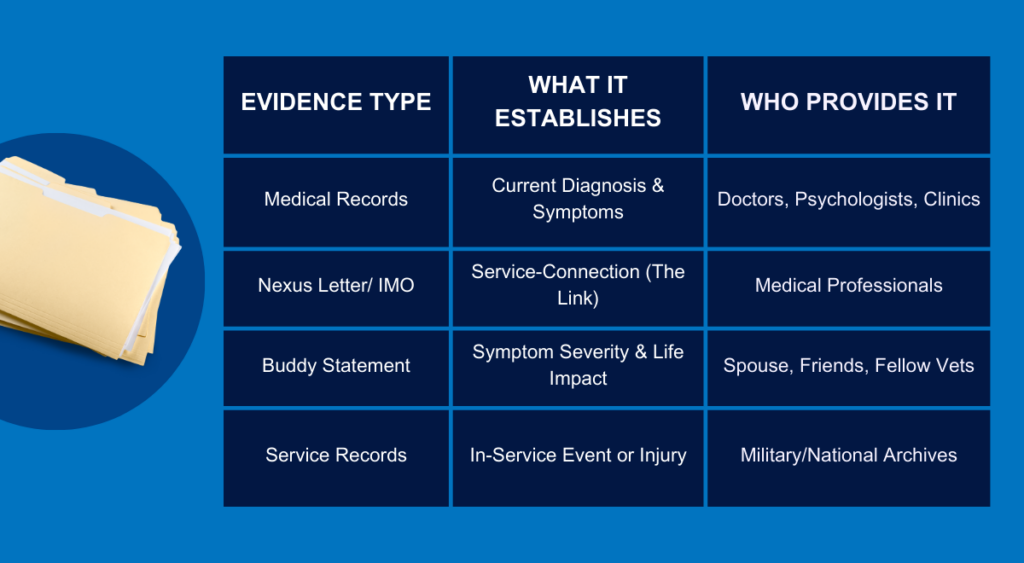
To approve disability claims, the VA looks for three key things. First, you need a current medical diagnosis of a disability from a qualified professional. Second, there must be proof of an event, injury, or illness that occurred during your active duty service.
Third, and most importantly, a medical nexus must connect the first two points. The nexus is a link established by a medical professional, stating that your current condition is related to your time in the military. This is the one piece of the puzzle that a buddy statement simply cannot provide.
Medical Nexus: The Golden Link
Think of the medical nexus as a bridge. On one side is your current disability, and on the other is the event that happened during your service. The bridge connecting them must be built by a medical expert with a credible medical opinion.
A friend or family member is not a medical professional. They cannot legally or credibly state that your knee pain today is the direct result of a parachute jump you did in 1998. They can only describe what they see, such as you limping and struggling to climb stairs.
Only a doctor can examine you, review your treatment records, and write a nexus letter. This letter must state that your condition is “at least as likely as not” related to your service. This specific language is what the VA requires to establish a service connection.
Lay Evidence vs. Medical Evidence
The VA classifies evidence into different categories. A buddy statement is considered “lay evidence” because it comes from a non-expert. Lay evidence is valuable for confirming certain details of a service connection claim.
For example, a buddy can confirm an event happened if it’s not in your service records. They can describe the severity and frequency of your symptoms or explain how posttraumatic stress disorder affects your ability to be in crowds. These lay statements can corroborate your personal account of your health conditions.
However, medical evidence comes from a qualified health professional. This includes doctor’s notes, lab results, X-rays, and psychological evaluations from VA medical centers or private physicians. The VA gives far more weight to medical evidence when establishing a diagnosis or a nexus because it is considered objective and authoritative.
How Buddy Letters and Medical Records Work Together
Don’t think of it as one type of evidence versus the other; think of them as a team. Your medical records build the foundation of your VA claim. The buddy statement then builds the house on top of that foundation, providing structure and detail.
Imagine you have a claim for a back condition. Your medical evidence would include an MRI showing a herniated disk and doctor’s notes describing your limited range of motion. A nexus letter from your doctor would connect this disc to a fall during a training exercise, making it a service-connected disability.
Then, your spouse’s buddy letter adds crucial detail. They could write about how you can no longer pick up your kids or had to give up your woodworking hobby. This additional evidence shows the real-world impact of the medically-diagnosed condition, which can influence your disability rating.

What Makes a Buddy Statement Effective?
A well-written buddy statement can significantly strengthen your case. To be effective, the statement needs to be credible, specific, and focused on personal observation. Vague letters will not provide much value to your disability benefits claim.
Credibility is Key
The person writing the statement should begin by identifying themselves and explaining their relationship to you. They should state how long they have known you and in what capacity (e.g., as a spouse, friend, or fellow service member). This establishes their credibility as a lay witness from the start.
Be Specific, Not General
General statements like “he has a bad back” are not helpful. The writer should provide specific examples of what they have observed. For instance, instead of saying you have trouble with your back, they could write, “I have seen him struggle to get out of a chair, and he often has to stop and rest after walking just one block.”
Contrast Before & After Active Duty
One of the most powerful techniques is to contrast your life before and after the in-service event that caused your disability. The writer can describe your personality, hobbies, and physical abilities before your service. Then, they can detail the changes they have witnessed since.
Focus on Observable Facts
It is very important that the writer avoids making medical diagnoses or speculations. Your friend should not write, “I think Jane has PTSD from military sexual trauma.” Instead, they should describe behaviors they’ve observed: “After her deployment, I noticed Jane stopped going out with friends, and she often calls me in the middle of the night because of nightmares.”
Using Buddy Statements for Specific Disability Claims
Buddy statements can be adapted to support various types of disability claims, from mental health conditions to claims for individual unemployability. The key is to tailor the information to the specific condition. This helps the VA understand the full extent of your limitations.
Claims for Mental Health Conditions
For mental health claims, such as those for posttraumatic stress disorder or anxiety, statements from family members are incredibly valuable. They can describe changes in your behavior, mood swings, social isolation, or panic attacks that they have witnessed firsthand. In sensitive cases involving military sexual trauma (MST), where official records may be scarce, buddy statements from those you confided in can be critical additional evidence.
Claims for Physical Health Conditions
When filing for physical disabilities, a buddy letter can detail how your condition impacts your physical abilities. A friend or spouse can describe how you need help with daily chores, your difficulty with mobility, or the visible pain you experience. This information can help support a higher VA disability rating or even claims for benefits like regular aid and attendance or housebound status.
Claims for Individual Unemployability (TDIU)
If you are filing for Total Disability based on Individual Unemployability (TDIU), buddy statements can come from former coworkers or employers. These individuals can attest to how your service-connected conditions affected your job performance. They might describe frequent absences, difficulty concentrating, or physical limitations that prevented you from performing your duties, strengthening your connection claim for unemployability.
Building a Claim That Can’t Be Ignored
So, what does a strong VA claim look like? It’s a balanced approach that uses every tool you have available. It presents a complete and undeniable picture of your disability to the VA.
First, you must have solid medical documentation. Get seen by a doctor for your condition and ensure it is well-documented in your health records. If you are filing a claim years after service, obtaining a clear diagnosis is your top priority.
Next, focus on the nexus. You may need to get an Independent Medical Opinion (IMO) or a nexus letter from a private physician. A medical expert explicitly connects your disability to your military service, and this is often the most important document when you submit evidence for your VA disability claims.
Once that foundation is set, start gathering your buddy statements. Ask people who have known you before, during, and after your service. Give them specific topics to write about, asking them to focus only on what they have personally seen or heard. This combination is what leads to success.
Common Mistakes Veterans Make
Many veterans focus too much on the buddy statement, thinking a powerful story is enough to win their VA rating. This is a primary reason why so many initial claims get denied. It’s crucial to understand their role as supportive, not primary, evidence.
Another common mistake is to submit lay statements that are too vague. A letter that simply says “John has a bad back” is useless. It needs specific details, including when the person observed the issue, what they saw, and how it affected your daily activities.
Finally, do not ask someone to speculate on medical matters. Your friend should describe symptoms, not name a diagnosis. Relying solely on a statement to prove an in-service event that isn’t in your service records is also difficult, so it’s best when it supports something that already has an official basis.
You Control Your Claim
Filing a VA claim can feel like you have no power. You submit your paperwork into a huge system and then wait for a decision. However, you have more control than you realize.
You control the quality and completeness of the evidence you submit. You can choose to build a claim that is solid from every angle, leaving no room for doubt. Start with the medical facts to build that strong, undeniable foundation for service connection.
Then, bring in the human story with well-written buddy statements. Show the VA rater not just what condition you have, but how it impacts who you are as a person. This complete package is your best shot at getting the disability benefits you earned through your service.
Conclusion
Your story and the words of those who have seen your struggles have a definite place in your VA claim. However, they cannot replace the objective proof the VA system requires to establish a service-connected disability. The best approach is to combine these powerful personal stories with solid medical proof.
Always remember, a buddy statement for a VA claim helps but not without medical evidence. Learn why professional documentation is critical to your success. By presenting a case that is not just emotionally compelling but also legally sound, you give yourself the highest chance of getting the VA disability benefits you rightly deserve.