

You are not crazy for being bothered by that loud jaw click every time you chew, talk, or yawn. If you are a veteran, that click, the pain, and the stiffness in your jaw might be worth real VA compensation, but only if it is documented the right way. Learn how to medically document TMJ jaw clicking pain and limited mobility to boost your VA disability rating. Too many veterans get brushed off with “it is just stress” or “take soft foods,” and they walk away without the medical records they need. This guide is here to help you get the benefits you deserve.
TMJ symptoms are often invisible to other people. They do not see how you baby your food, avoid steaks, or skip long talks because your jaw locks up. You feel it every day, though, and the VA rating you get should reflect that reality. We will look at how to turn your jaw pain into solid evidence. You do not want to be stuck fighting a system that says there is not enough proof.

Why TMJ Is Such A Big Deal For Veterans
Temporomandibular joint disorder, also known as TMJ or TMD, affects the jaw joint and the muscles you use to chew. The National Institute of Dental and Craniofacial Research explains that it often shows up as pain, clicking, popping, or limited jaw movement. It can disrupt your daily life in a major way. You can read more about symptoms through their official resources.
Now add combat stress, grinding teeth, injuries from blast waves, or clenching your jaw in a combat zone. It is not a surprise that those with military service report TMJ at high rates. A study of war veterans showed that those with PTSD had higher odds of TMJ problems than those without it. A study on PTSD and TMJ confirmed that veterans with mental health struggles had worse function.
Other research on war veterans found that about 56% of those with PTSD had TMD symptoms. This is high compared to non-exposed veterans. That data comes from a review of war veterans and their health outcomes. Another analysis of veteran TMD reported that veterans with PTSD are significantly more likely to develop these disorders.
If that sounds like your story, your TMJ is not just random bad luck. It may be linked to your service, your post traumatic stress disorder, or both. This connection matters a lot for VA benefits and filing a successful disability claim. It means your TMJ rating should be taken just as seriously as any back or knee problem.
How The VA Rates TMJ And Why Documentation Makes Or Breaks Your Claim
TMJ is not rated like a generic ache. The VA uses a specific rule for TMJ under 38 CFR § 4.150, Diagnostic Code 9905. Under that rule, they look mainly at your interincisal range. This is the vertical opening of your mouth.
They measure the distance between your front teeth when you open wide. The smaller that distance, the higher the possible VA disability rating. They also consider side-to-side movement, called lateral excursion. However, the maximum unassisted vertical opening usually controls the main percentage.
The VA also recognizes that painful motion itself is a sign of disability. Under 38 CFR §4.59, painful joint movement can justify at least a minimum rating even when the range of motion looks normal on paper. TMJ is a joint, and it fits within how the VA views joint issues generally.
This is why incomplete documentation hurts you. If no one measured your opening, or if no one wrote down when it hurts, the rater has little to go on. The VA rater can only rate what is written in the file.
VA Rating Focus Points For TMJ
When a rater applies Diagnostic Code 9905, they look at two main things. They check how far you can open your jaw in millimeters, known as unassisted vertical opening. They also check for functional loss due to pain or flare-ups.
They also check if you are limited to mechanically altered foods. If your pain is severe but your doctor only wrote “jaw within normal limits,” the VA will likely give you a low rating. This is where detailed medical documentation becomes vital.
What “Medical Documentation” Actually Means For TMJ
A lot of veterans hear “you need evidence” and think it means sending in old dental records. For a TMJ VA claim, that is not enough. Good documentation should paint a clear picture of your jaw function on a normal day.
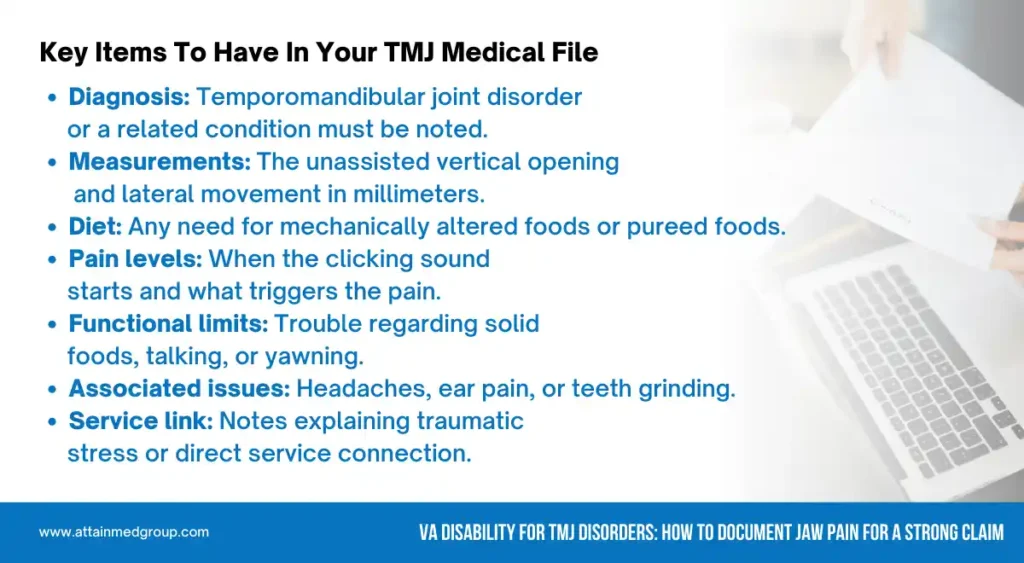
The best medical evidence usually includes several specific things. First, you need a clear diagnosis of temporomandibular disorders from a dentist or oral surgeon. Second, you need objective measurements of your unassisted vertical opening.
Third, you need descriptions of pain during daily tasks. This information often ends up on a Disability Benefits Questionnaire. The more specific you are, the better your chances.
The VA also looks at consistency across your records. If you claim daily pain but tell your dentist you are fine, the rater may doubt your claim. Every appointment should tell the same story about your service-connected condition.
How To Talk To Your Doctor So Your TMJ Gets Documented Right
Doctors and dentists are busy. A rushed exam can ruin an otherwise strong VA disability claim. You have to be ready to talk about your jaw pain clearly. There is a simple rule to follow. If your jaw hurts enough that you are filing for VA benefits, it is serious enough to document. Your goal is not to complain. Your goal is to create an accurate record of your condition.
Before The Appointment: Your Personal Jaw Log
For at least two weeks before your exam, keep a short daily log. It does not have to be fancy. You can track your symptoms on your phone.
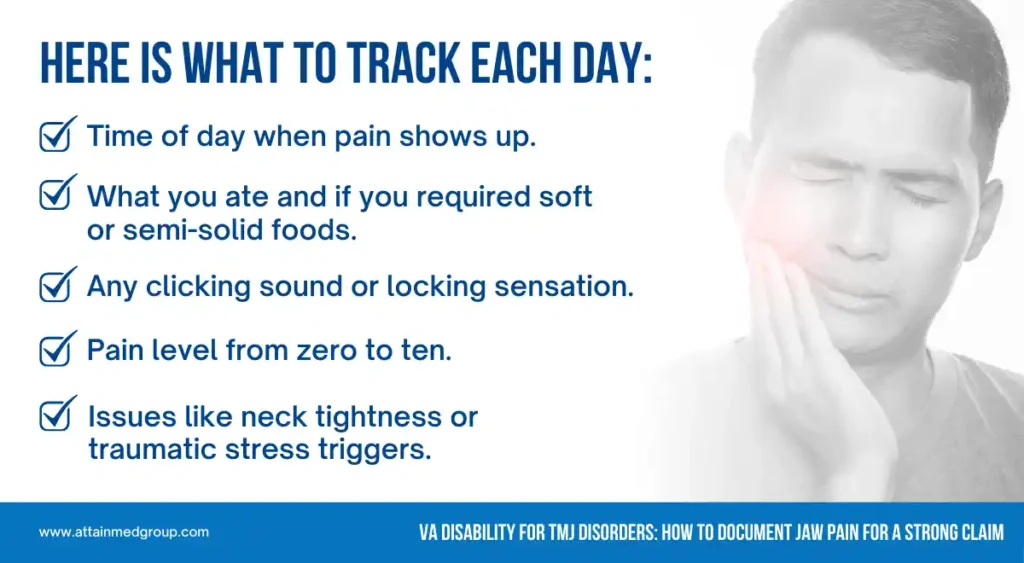
Bring this log with you and hand it to the provider. Explain that you tracked your pain so they could see the frequency. Most providers will appreciate the data and may add it to your file.
During The Appointment: Words That Help Your Claim
Instead of saying “My jaw clicks,” be specific. Say, “My jaw makes a loud clicking sound when I eat solid foods.” Mention if it locks up.
Describe your worst days, not just the good ones. The VA rates based on functional loss. You should mention specific limitations.
- “Talking at work makes my jaw throb.”
- “I require mechanically altered food because I cannot chew steaks.”
- “I have to eat pureed foods when my jaw flares up.”
Ask your dentist to measure your mouth opening with a ruler. Ask them to write down the unassisted vertical opening in millimeters. This language matches the rating schedule found in veterans law.
Step By Step: How To Medically Document TMJ Jaw Clicking, Pain, And Limited Mobility To Boost Your VA Rating
This section acts as your evidence checklist. You can follow these moves in order. Use this guide for your next medical visit or when preparing a new claim.

Step 1: Get An Official TMJ Diagnosis On Record
The VA wants a diagnosed condition. Your first move is to see a specialist for an evaluation. Share your military service history. Mention any blast exposure or direct service injuries. If you have post traumatic stress, mention if you clench your jaw. Ask the provider to clearly diagnose “temporomandibular joint disorder” in your chart.
Step 2: Document Range Of Motion With And Without Pain
You need measured motion for a proper VA rate. The examiner should measure your interincisal range in millimeters. They should note when pain begins. They should also record your maximum unassisted vertical opening. This specific number is what the diagnostic code 9905 relies on. Without it, you might receive a lower rating.
Step 3: Make Pain And Flare Ups Impossible To Ignore
VA rules talk about painful motion. You need records that show how your TMJ flares up. This proves your functional loss. Ask your provider to describe frequency. They should note how long episodes last. They should also record if you cannot eat solid foods during a flare. Describe this in your own words as well. Connect your flare-ups to stress if applicable. This supports your claim for disability benefits.

Step 4: Tie TMJ To Service Or To PTSD With A Nexus
To get service connection, you usually need a nexus. This links your condition to your military service. A nexus letter is often required. You can learn more about nexus letters overview from experts. A doctor might state your TMJ is linked to combat-related stress disorder. Studies show veterans with PTSD have more TMJ issues.
If your condition stems from a traumatic brain injury, mention that. Ask the doctor to reference specific events in your records. Clear language helps the rater understand the cause.
Step 5: File A Fully Documented VA Claim For TMJ
Once you have your diagnosis and measurements, you are ready to file. You can submit a claim online easily. You can also download VA Form 21-526EZ if you prefer paper.
Attach or upload the following:
- Recent TMJ treatment records.
- Specialist notes regarding jaw opening.
- A nexus letter linking it to service.
- Your symptom log detailing dietary restrictions.
Watch for updates on your case. You can check VA news updates for general information. Staying informed helps you manage deadlines.
How TMJ Fits Into Your Whole Disability Picture
Many veterans have ratings for other conditions. You might have digestive problems or orthopedic injuries. TMJ is another piece of the puzzle. If you want to boost hiatal hernia rating, a TMJ claim can be separate. The same applies if you want to boost shoulder rating percentages. You can also review ratings for gynecological conditions to see how they combine.
TMJ can also affect your ability to work. If you cannot speak due to pain, it impacts employment. This might support a claim for Individual Unemployability.
How The VA Actually Chooses A Percentage Under Diagnostic Code 9905
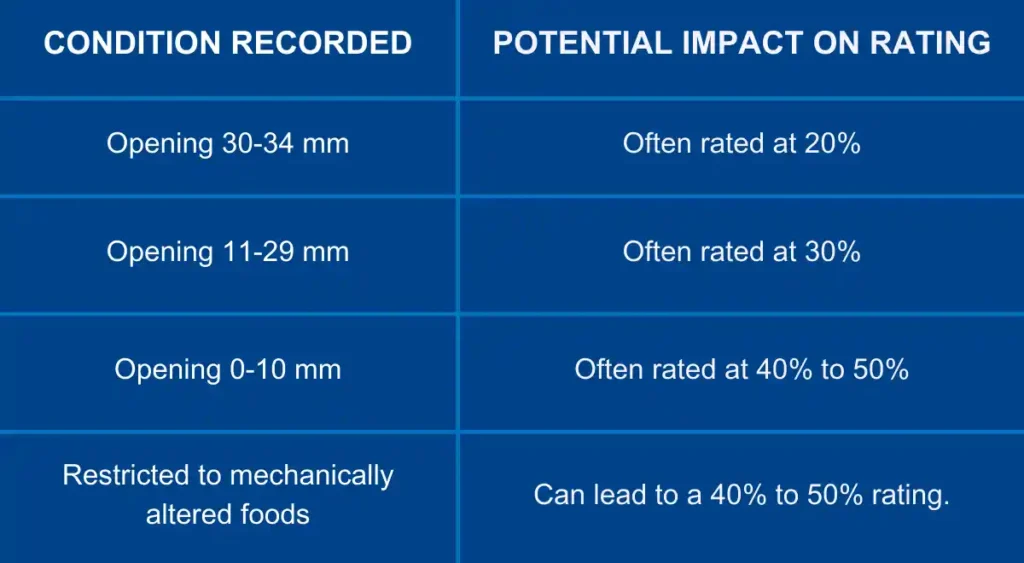
It helps to know how measurements turn into a VA rate. Under Diagnostic Code 9905, ratings are based on opening ability and diet. The specific millimeter ranges are strict.
For example, a maximum unassisted vertical opening between 30 to 34 millimeters may grant a specific percentage. An opening between 11 to 29 millimeters often warrants a higher rating. If your opening is 0 to 10 millimeters, the rating is higher still.
Dietary restrictions also play a massive role. If you are limited to mechanically altered foods, the VA takes notice. This category includes more than just soft foods.
Mechanically altered food refers to food that must be blended or ground. This includes pureed foods or semi-solid foods that require no chewing. If you are restricted to this diet due to TMJ, you may qualify for a higher rating even if your opening is decent.
The rater reads your benefits questionnaire and matches it to these numbers. They look for keywords like “mechanically altered foods.” You must make sure these details are in your records.
Practical Tips To Capture Your Daily TMJ Limits
It is important to translate medical rules into real life. Daily examples help doctors and raters understand your struggle. You have the power to clarify your situation.
Here are situations you can describe:
- Meals: Explain if it takes you longer to eat than your family.
- Diet: State if you avoid solid foods completely.
- Talking: Mention if phone calls leave your jaw aching.
- Sleep: Note if you grind your teeth due to stress disorder.
- Hobbies: List activities you stopped, like playing an instrument.
- Textures: Describe if you rely on semi-solid foods only.
The VA looks for patterns. They do not rate a joint just by one movement. They look for repetition and pain, similar to how they view other joint regulations. Your TMJ documentation should be just as thorough.

Getting Ongoing Help And Second Opinions
Sometimes the first claim comes back with a low rating. That is where second opinions come in. An independent medical review can find missing details.
For some, TMJ is part of a strategy to increase overall benefits. You might combine it with mental health claims or other physical issues. Understanding the full picture of your health is vital.
Using Smart Tools To Boost Your Documentation Habits
Building a strong VA claim relies on good habits. Tracking symptoms and storing files takes time. You can use technology to help you stay organized.
Think of it like any other system. Just like website owners use rich snippets for SEO to get noticed, you can use “snippets” in your notes. Repeat the same descriptions of your pain daily.
You can also use keyboard tricks for productivity to log symptoms faster. Set up templates on your phone. This makes logging your jaw flares much easier.
Even business owners know to boost your online store by tracking data. You should do the same for your health. Track your pain data, notice patterns, and present them clearly.
What To Expect At Your C&P Exam For TMJ
The VA will likely send you to a Compensation and Pension exam. This visit is critical for your tmj va rating. The examiner will fill out the disability benefits questionnaire.
Here is what usually happens during the exam. The examiner will ask about your history. They will check for clicking sounds and pain.
- They will ask about diet restrictions.
- They will look in your mouth and feel the joint.
- They will measure your maximum unassisted vertical opening.
- They will record when pain starts.
Your job is to be honest. If the examiner rushes, politely ask them to measure carefully. You have the right to an accurate exam.

Conclusion
Your jaw pain is real. That loud click and the inability to eat solid foods are significant issues. The VA has rules to rate TMJ, and those rules can work for you. Learn how to medically document TMJ jaw clicking pain and limited mobility to boost your VA disability rating, and you give yourself a better chance at success.
Think about your military service and your daily struggles. Use the advice here to build a solid paper trail. Track your symptoms and push for precise measurements. Link your condition to your service with a nexus letter. This is about standing up for your health and your future.
The journey to the right VA rating can be long. However, you do not have to do it alone. Keep documenting and pushing for the benefits you deserve. Learn how to medically document TMJ jaw clicking pain and limited mobility to boost your VA disability rating, and let that knowledge help you win your claim.