

Sinusitis and rhinitis are among the VA’s most commonly denied disability claims. Yet for many veterans, these conditions can be chronic, debilitating, and deeply tied to military service — especially when exposure to dust, burn pits, or other airborne hazards played a role. At Attain Med Group, we understand how vital it is to build a strong, evidence-based claim. In this guide, we’ll walk you through exactly what medical evidence you need, why a nexus letter often makes the difference, and how to give your claim the best shot of success.

1. Understanding Sinusitis and Rhinitis in the VA System
What Are These Conditions?
- Sinusitis is inflammation or infection of the sinuses (frontal, ethmoid, sphenoid, maxillary), often causing symptoms like congestion, sinus pressure, tooth or facial pain, post-nasal drip, or headaches.
- Rhinitis refers to inflammation of the nasal mucous membrane. It can be allergic (due to allergens), vasomotor, bacterial, or granulomatous.
Both conditions can be chronic and recurrent, particularly in environments with particulate exposure (e.g., burn pits, sandstorms), making them common among veterans.
2. Why These Claims Are Often Denied
- The VA requires three key elements to grant service connection: a current diagnosis, an in-service event or exposure, and a nexus (a medical connection) linking the two.
- Without a clear nexus, or if service records don’t reflect sinus or nasal complaints, claims are frequently denied.
- Some veterans don’t realize that rhinosinusitis (a combined nasal & sinus diagnosis) can fall under newer rules, especially for exposure-based claims.
3. VA Rating Criteria for Sinusitis & Rhinitis
To understand how strong your case needs to be, you first need to know how the VA rates these conditions.
Sinusitis (Diagnostic Codes 6510–6514)
According to VA scheduling:

Rhinitis
Rhinitis is rated under Diagnostic Code 6522 (allergic/vasomotor), 6523 (bacterial), or 6524 (granulomatous) depending on type.
- 6522 (Allergic/Vasomotor Rhinitis):
- 10% Rating: No polyps + greater than 50% obstruction of both nasal passages, or complete obstruction of one side.
- 30% Rating: Nasal polyps present.
- Other types: e.g., bacterial rhinitis (6523) — ratings depend on hypertrophy, obstruction, or severe bacterial disease.
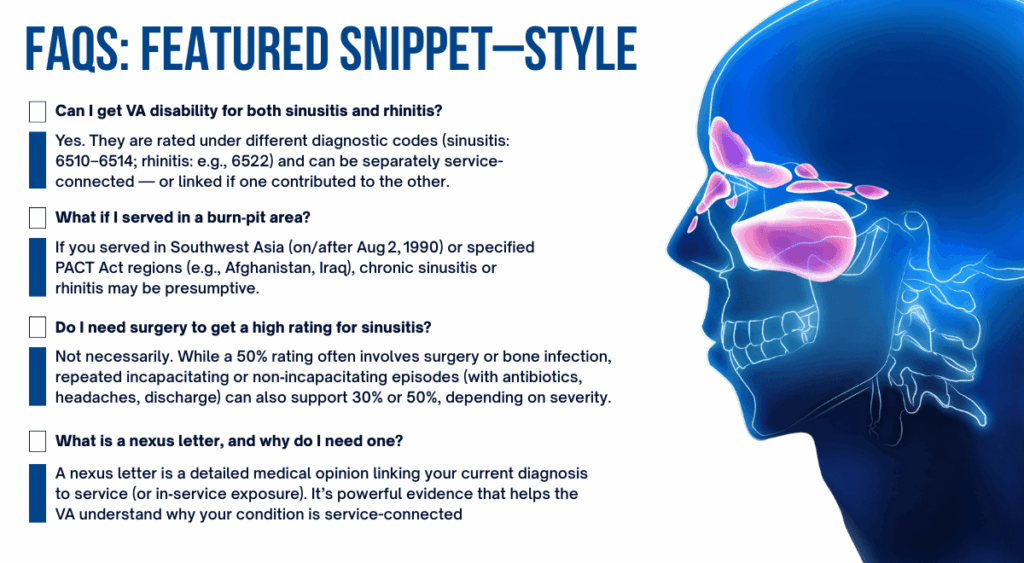
4. New Presumptive Rules Under the PACT Act
One of the most powerful developments for sinusitis and rhinitis claims is the PACT Act. Under certain conditions, veterans no longer need to prove service connection in the traditional way — it’s presumed.
- If you served in Southwest Asia (on/after Aug 2, 1990), or in Afghanistan, Syria, Djibouti, etc., (on/after Sept 11, 2001), and you developed sinusitis or rhinitis, these may be presumptive respiratory conditions.
- Importantly: under this presumption, the condition only needs to manifest to a 0% level — you don’t necessarily need to hit a compensable rating to establish service connection.
- VA’s own regulation updates confirm this.
This means that for qualifying veterans, the burden of proof is lighter, but you still must show current diagnosis.

5. Building Strong Evidence for Your Claim
Here’s how to put together the most compelling evidence for sinusitis or rhinitis under a VA claim.
A. Document Your Current Diagnosis
- Get a recent, formal diagnosis from a medical provider (ENT, primary care, etc.). VA wants clear, current medical diagnosis.
- Use a Disability Benefits Questionnaire (DBQ): this is a structured form aligned with VA’s rating criteria (symptoms, frequency, obstruction, medication, surgery, etc.).
- Collect medical imaging (X-rays, CT scans) and reports. These provide objective evidence of sinusitis or nasal structure issues.
B. Demonstrate In‑Service Connection
- Review your service treatment records (STRs): Look for documented nasal/sinus complaints, infections, or any ENT visits while in service.
- Identify exposures: Particulate matter, burn pits, dust, sandstorms, chemical exposures — anything in your duty history that could contribute.
- Get buddy statements or lay witnesses (e.g., fellow service members, supervisors): these can support reports of frequent sinus issues, nosebleeds, congestion, etc.
C. Secure a Solid Nexus Letter
A nexus letter is often the turning point in these claims. Here’s why:
- It’s a medical opinion, ideally from a specialist (ENT, pulmonologist) or a doctor familiar with your history.
- The letter should clearly state that, “to a reasonable degree of medical certainty (or ‘at least as likely as not’), your sinusitis/rhinitis is linked to your in‑service event or exposure.”
- Explain the reasoning: For example, link your in-service exposure (e.g., burn pit) to chronic inflammation, recurring sinus infections, polyps, etc.
D. Prepare for the Compensation & Pension (C&P) Exam
- Be honest, thorough, and consistent: describe how often episodes occur, how severe they are, how they interfere with daily life.
- Bring your private medical records, DBQ, and nexus letter. These strengthen your narrative and support your case.
- Ask your provider if they can document “incapacitating episodes” if applicable — these are significant for rating.
6. Why a Nexus Letter Matters (and How Attain Med Group Helps)
- The VA does not require a nexus letter, but in practice, such letters are often the deciding factor when claims are denied for lack of service connection.
- At Attain Med Group, we specialize in independent, veteran-centered medical evaluations. Our providers are experienced in writing high-quality, VA‑friendly nexus letters that lay out the medical logic: diagnosis → in‑service exposure → current disability.
- In complex cases (e.g., when radiology is ambiguous, symptoms are intermittent, or your STR is thin), a well-supported nexus letter can make or break your claim.

7. Common Challenges & How to Overcome Them
Here are some hurdles veterans often face — and how to navigate them.
- Service Records Don’t Show Sinus Problems
- Solution: Use lay statements, buddy letters, and your nexus letter to explain latent onset or gradual worsening.
- Denied After C&P Exam
- Solution: File a Supplemental Claim (VA Form 20-0995) with new evidence (like a nexus letter you didn’t submit before).
- Low or 0% Rating
- Even a 0% helps: it establishes service connection, which may open the door for secondary conditions or future upgrades.
- Presumptive Denied
- Ensure you clearly document your eligible service window (PACT Act locations/dates), exposures, and medical manifestation.
9. Real‑World Success: How Attain Med Group Helped Veterans
(Note: If you have anonymized or real client stories, insert them here. Example below is fictional but representative):
- Case Study: Veteran A, who served in Southwest Asia, struggled with recurrent sinus infections and congestion. Despite having documented exposure, his first claim was denied for lack of nexus. Attain Med Group coordinated an independent ENT evaluation, obtained a nexus letter linking his burn-pit exposure to chronic inflammation, and helped him secure a 30% rating.
- Case Study: Veteran B, with nasal obstruction and polyps, was previously rated 10%. After submitting a private DBQ and a nexus letter from an ENT, Attain Med Group helped file a supplemental claim, resulting in an upgrade to 30%.
10. Next Steps: Strengthen Your Claim with Attain Med Group
- Schedule a Free Consultation
Contact us to review your case history, service record, and current diagnosis. - Get an Independent Medical Evaluation
We’ll connect you with a veteran‑friendly provider (ENT or relevant specialist) who understands VA documentation. - Request a Nexus Letter
Our medical experts can write a detailed nexus opinion tailored to VA standards. - Prepare for Your C&P Exam
We’ll coach you on presenting your history and evidence in a way that aligns with VA rating criteria. - Follow Up & Appeal
Even if your claim was denied, we can guide you through supplemental claims, Higher-Level Reviews (HLRs), or appeals — backed by new, compelling evidence.
Conclusion
Proving service connection for sinusitis and rhinitis can feel overwhelming — but you’re not alone. With the right medical documentation, a clear in‑service history, and a well-crafted nexus letter, many veterans have successfully won their VA disability claims. At Attain Med Group, we’re committed to bridging the gap between veterans and independent medical experts to help you build the strongest case possible.
Ready to take action? Reach out today to schedule your consultation. Let us help you get the medical support you deserve — and the VA rating you’ve earned.