

Back pain is one of the most common and challenging conditions veterans face — physically, emotionally, and administratively. Even when imaging (like X-rays or MRIs) shows only mild abnormalities, daily pain matters, and how you document that pain can heavily influence your VA disability claim.
At Attain Med Group, we help veterans bridge the gap between their lived experience and the VA’s technical requirements, by delivering expert medical record reviews, DBQs, and nexus letters that translate your struggles into compelling, evidence-based advocacy.
This guide will walk you through how to properly document back pain, flare-ups, and functional limitations — equipping you with the tools to strengthen your VA claim, maximize your rating, and get the benefits you deserve.

1. Understanding How the VA Evaluates Back Pain
To successfully claim VA disability for back pain, it’s essential to grasp what the VA actually looks for in its evaluation. Here’s how the system works:
- Service Connection
- You need to show a current diagnosis of a back condition (e.g., degenerative disc disease, herniated disc).
- You must prove an in-service event or injury (or continuous strain) that triggered or aggravated the condition.
- You need a nexus (medical link) showing your back condition is at least as likely as not related to your service.
- VA Rating Criteria
The VA doesn’t base back pain ratings solely on subjective pain — they consider:
- Range of Motion (ROM) measurements (using a goniometer)
- Frequency and severity of flare-ups or incapacitating episodes
- Functional loss during flare-ups (how pain restricts your daily life)
- Whether a doctor has prescribed bed rest or downtime during flare‑ups.
- Secondary conditions (e.g., radiculopathy) that may flow from your back pain.
2. Why Daily Pain Matters — Even When Imaging Looks Mild
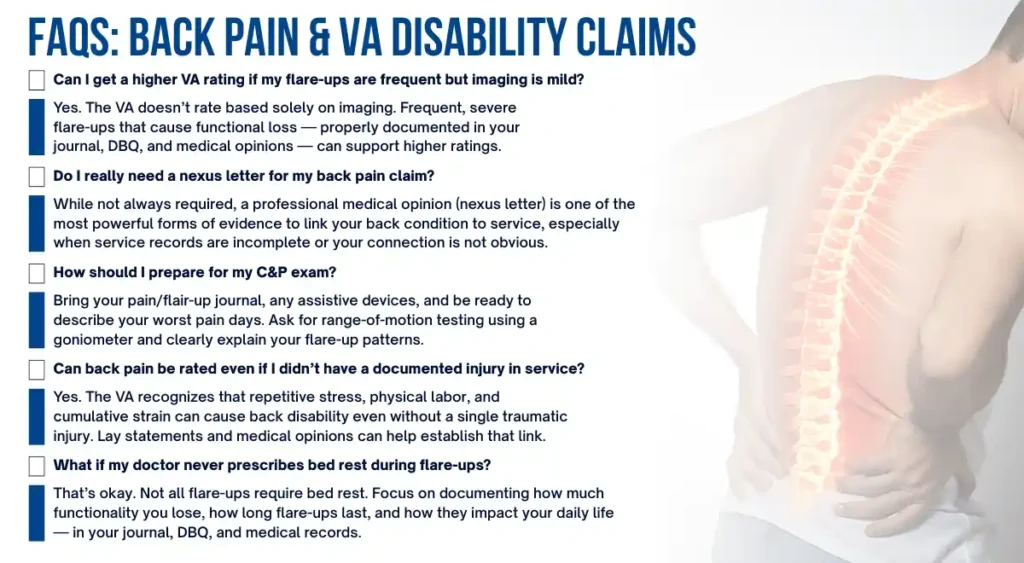
It’s common for veterans to face a disconnect: the pain they live with every day doesn’t always match up with what shows on an MRI or X-ray. But the VA knows this — and so should you.
- Structural imaging (like MRI) may indicate only mild degeneration or subtle changes, but pain isn’t always proportional to imaging.
- According to VA’s DBQ (Disability Benefits Questionnaire) for back conditions, what really counts is how you function during flare-ups: how often they occur, how long they last, what triggers or relieves them, and how they impair your daily life.
- In other words: your subjective experience — documented clearly — can carry tremendous weight, especially when backed by medical evidence.

3. How to Document Flare‑Ups and Functional Limitations Effectively
Here’s a detailed, practical roadmap for capturing the critical evidence you need to build a compelling VA back pain claim.
A. Keep a Detailed Pain & Flare-Up Journal
A pain journal is one of the most powerful tools in your arsenal. Here’s what to include:
- Daily entries: Rate your pain (e.g., on a scale of 0–10), note when it’s worse, and document what you were doing.
- Triggers / Precipitants: Record activities, movements, or events that spark flare-ups (lifting, bending, standing, work, stress).
- Duration and recovery: How long does each flare-up last? Do you need rest, bed rest, or other downtime?
- Functional impact: What can you not do during flare-ups? For example:
- “Can’t bend to pick things up”
- “Must lie down after standing more than 15 minutes”
- “Use a brace / cane / TENS unit”
- Alleviating factors: Is there anything that helps? (Medication, heat, rest, stretching)
- Treatment & doctor interventions: Note appointments, prescriptions, PT, referrals, or when your doctor prescribes rest or other interventions.
B. Leverage Lay & Buddy Statements
Having others describe your condition can help substantiate your claims:
- Personal statement: Write (or record) how back pain affects your day-to-day life, work, sleep, chores, social activities — especially on bad days.
- Buddy letters: Ask family, friends, or fellow service members to write short statements observing how your back pain affects you (e.g., difficulty walking, needing to rest, use of assistive devices).
- Employer documentation: If pain has impacted your job (missed days, restrictions), gather memos, work accommodation notes, or performance reviews.
C. Make Your C&P Exam Count
The Compensation & Pension (C&P) exam is a critical moment. Be strategic:
- Bring your journal: Share your pain/flair-up log with the examiner; point out triggers, frequency, and how flare-ups restrict your function.
- Request proper ROM measurement: Ask the examiner to use a goniometer and note exactly where pain begins, not just where range ends.
- Talk about flare-ups: If you’re not in a flare-up during the exam, describe your worst flare-ups, how often they happen, and what your functional loss is during them.
- Show assistive devices: If you use a brace, cane, or other device, bring it; demonstrate how and when you use them.
- Declare what’s missing: If an exam is limited (for example, the examiner says they can’t do measurements because of pain), make sure they note that in the report. Some veterans report their examiners doing this when flare-ups prevent full testing.
D. Get Strong Medical Support
- DBQ (Disability Benefits Questionnaire): Ask your treating provider (VA or civilian) to complete the Thoracolumbar Spine DBQ or back/spine DBQ. The DBQ specifically asks about flare-ups (frequency, duration, severity) and functional loss.
- Nexus / Medical Opinion: Work with a qualified physician (specialist) to write a nexus letter. This should:
- Review your service records and medical history
- State that your back pain is “at least as likely as not” (VA standard) linked to service or to another service-connected condition
- Explain why your back condition causes your symptoms, drawing on how your flare-up journal and functional loss demonstrate that.
- Prescribed bed rest: If your doctor has ever prescribed bed rest or significant downtime during flare-ups, make sure that’s documented in your medical record. That documentation may help support a higher rating.

4. Building a Compelling Evidence Package: Putting It All Together
When you file (or appeal), your evidence package should present a cohesive, consistent narrative. Here’s what that looks like:
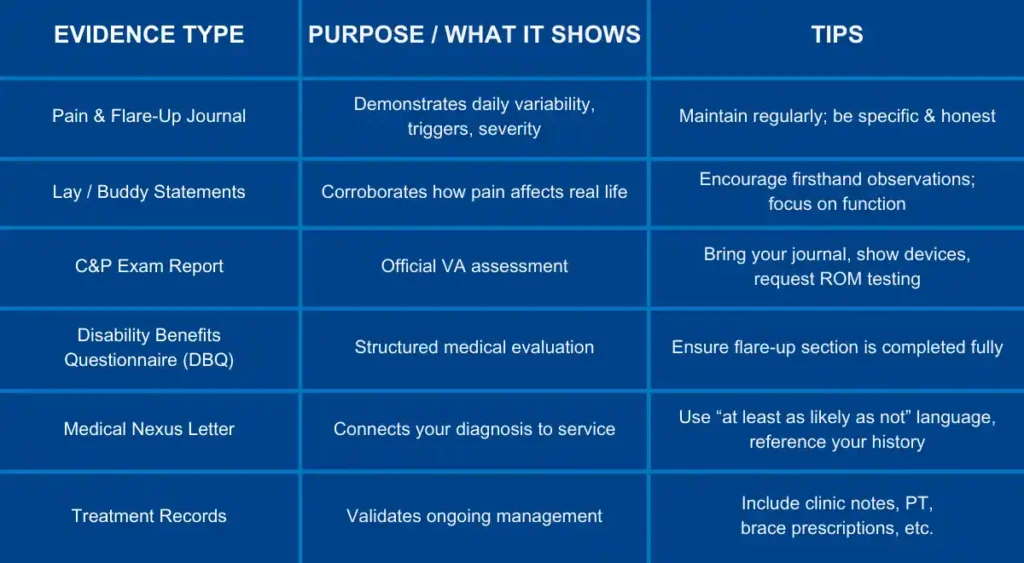
This type of multifaceted evidence helps the VA see that your condition is not just measurable on paper—but lived every day in a way that limits your life.
5. Special Considerations & Tips for Common Challenges
Here are some specific scenarios veterans often face — and how to navigate them:
- Mild Imaging, Severe Pain
Even if your MRI or X-ray shows only mild disc degeneration, your pain journal and DBQ can tell the rest of the story. The VA examines functional loss, not just imaging. - Flare-Ups Not Captured in Office Visits
If your doctor appointments don’t align with your worst flare-ups, your pain journal, lay statements, and a strong nexus letter become even more critical. - Exam During a “Good Day”
Many C&P exams happen when symptoms are mild. That’s okay — use your journal or a personal statement to describe your worst days, how often they happen, and how they limit you, even if they don’t occur during the exam. - Bed Rest Episodes
If your doctor ever prescribed bed rest during flare-ups, ask them to document the dates, duration, and any functional limitations. That is persuasive evidence for rating purposes. - Secondary Conditions
Back pain often leads to or coexists with other issues — for example, radiculopathy (nerve pain), depression, or sleep problems. Document these thoroughly because they may increase your overall rating.
7. Why Working With Attain Med Group Makes a Difference
Navigating a VA back pain claim can feel overwhelming — especially when your pain is real, but not always visible on scans. That’s where Attain Med Group steps in, with veteran-centered expertise to help you:
- Gather and interpret the right medical evidence
- Complete DBQs aligned with VA‑compliant standards
- Develop compelling nexus letters from qualified clinicians
- Build a cohesive, powerful narrative around your pain, flare‑ups, and limitations
- Support your claim or appeal with expert guidance every step of the way
We’re veteran-owned, and deeply committed to making the claims process smoother, more accurate, and more effective — so you can focus on your health, not paperwork.
Conclusion & Call to Action
Your daily back pain matters — even if your imaging looks mild. The right documentation, consistent recording of flare-ups, and expert medical support can transform your VA disability claim from uncertain to compelling.
If you’re ready to build a strong, evidence-backed case, let Attain Med Group help. Contact us today to schedule a consultation, get help with a DBQ or nexus letter, and take the next step toward securing the VA benefits you deserve.
→ Book a Consultation | → Download Our Free Back Pain Claim Checklist