

That tightness in your chest can be a constant reminder of your service. The cough that just won’t go away and the feeling of not getting a full breath is exhausting. If this struggle started during or after your military service, you deserve answers and support.
You might be thinking about filing for chronic respiratory VA disability. Discover key medical tests and specialist letters that strengthen your claim right here. Proving your condition to the VA can feel like a steep climb, but it’s not impossible with the right preparation.
Having the right medical evidence is everything. This is about showing the VA, with clear proof, how your service affected your ability to breathe. You will learn what proof you need before filing for chronic respiratory VA disability, giving you the best shot at success with your disability benefits claim.

Understanding How the VA Looks at Respiratory Claims
Before getting into specifics, it’s good to understand how the VA thinks about disability benefits. For almost any disability claim, they look for three main things. This framework is essential for building a successful case for your VA benefits.
First, you need a current diagnosis of a respiratory condition from a medical professional. Second, there must be an event, injury, or illness that happened during your military service. This could be exposure to burn pits, dust, or other hazardous materials.
Third, you need a medical link, or nexus, connecting your current diagnosis to that in-service event to establish a service connection. Many veterans get stuck on this part of the VA disability claim. You know the dust storms in Iraq caused your illness, but proving it to a claims rater requires solid evidence.
This is why objective medical evidence is so important. Your personal testimony is valuable, but test results and specialist opinions are the hard proof the VA needs to approve your disability claims. Without it, you are less likely to receive the disability compensation you deserve.
Filing for chronic respiratory VA disability? Discover key medical tests and specialist letters that strengthen your claim.
Let’s break down the most powerful pieces of evidence you can gather for your VA claim. Think of this as building a case for yourself. Each test result and doctor’s note is a solid block in your foundation, making your claim much harder for the VA to deny.
The First Step: Getting a Current Diagnosis
You cannot get a VA rating for a condition you do not officially have. The very first step is seeing a doctor about your breathing problems. You must get a clear diagnosis for a chronic condition written in your medical records.
Some common respiratory conditions that veterans claim include chronic bronchitis, asthma, emphysema, sleep apnea, and Chronic Obstructive Pulmonary Disease (COPD). More recently, conditions like constrictive bronchiolitis and sarcoidosis have become more recognized, especially with new laws like the PACT Act. Your medical records from a VA hospital or private health care provider are crucial here.
Make sure your doctor documents your specific disability. A vague diagnosis like “shortness of breath” is not enough to get your VA benefits approved. You need the name of the specific chronic lung disease causing your symptoms, as this will align with a diagnostic code used for disability ratings.
Vital Medical Tests for Your VA Claim
Medical tests give the VA objective numbers to evaluate. They remove the guesswork from your VA disability claim and show the real impact on your lung function. Some tests are more important than others for getting a service-connected disability approved.
Pulmonary Function Tests (PFTs)
This is probably the single most important type of pulmonary function test for a respiratory claim. A PFT, or function test, acts as a performance review for your lungs. It measures how much air your lungs can hold and how quickly you can move air in and out.
The machine used for this is called a spirometer. The pulmonary function test provides a few key numbers, but the VA pays close attention to two of them. These numbers are central to how the VA assigns a VA rating for respiratory conditions.
FVC (Forced Vital Capacity) is the total amount of air you can exhale after a deep breath. FEV1 (Forced Expiratory Volume in one second) is the amount of air you can force out in just one second. The VA uses the ratio of these two numbers and your FEV1 value compared to what is predicted for someone your age and height.
According to the VA’s rating schedule, these numbers can directly translate to your disability rating. You should always submit current evidence from your function tests. It’s important to submit additional evidence if your condition worsens over time.
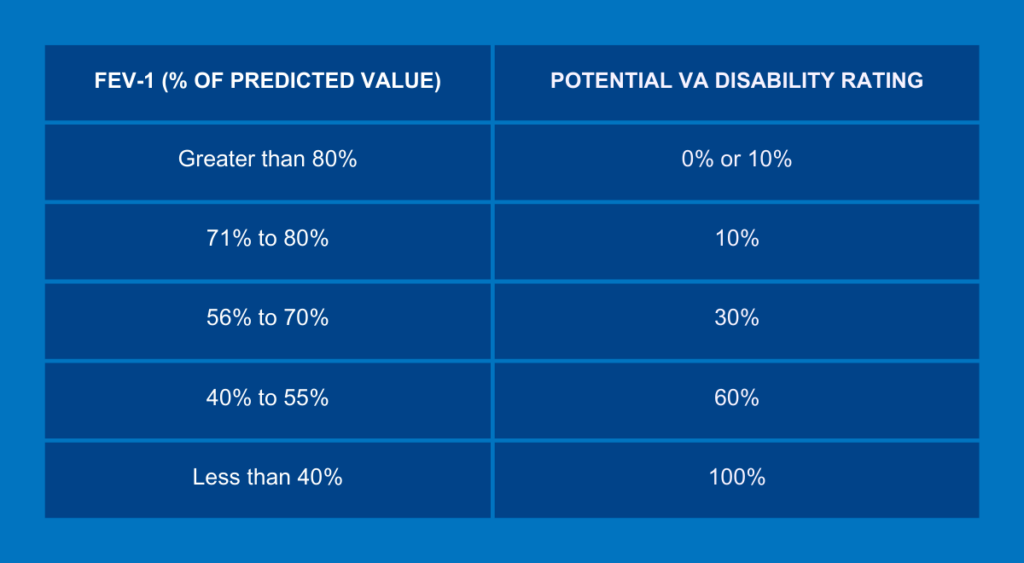
Make sure you get a copy of your full PFT results to submit with your claim. These numbers speak volumes to the VA. The data from these pulmonary function tests provides objective proof of your condition’s severity.
Imaging: Chest X-rays and CT Scans
While PFTs measure function, imaging tests show the physical structure of your lungs. A simple chest X-ray can reveal scarring, inflammation, or other visible problems. They are useful for conditions like sarcoidosis or chronic bronchitis.
A CT scan provides a much more detailed picture of your lungs. It can spot smaller issues that an X-ray might miss, making it vital for an accurate diagnosis. For conditions like interstitial lung disease, a CT scan is often necessary.
This visual proof adds another strong layer to your claim. Submitting these images and the radiologist’s report can make a significant difference. It’s an important piece of your overall evidence package.
Methacholine Challenge Test
This test is specifically for diagnosing asthma. If you have asthma symptoms but your regular PFTs appear normal, a doctor might suggest this test. You will inhale a mist called methacholine, which can cause airways to spasm in people with asthma.
If your lung function drops significantly during the test, it’s strong evidence of asthma. This can be very helpful if your asthma is intermittent and doesn’t always show up on a standard PFT. It proves your airways are hypersensitive, a key feature of the illness caused by your service.
The Game Changer: A Strong Nexus Letter
Nexus letters are a powerful tool for your claim. A nexus letter is a medical opinion from a qualified professional that connects your current respiratory diagnosis to your time spent in the military. This letter bridges the gap for the VA and is often the one thing that turns a denial into an approval.
Who should write it? Ideally, you want a letter from a pulmonologist, a lung specialist whose opinion carries more weight than a general practitioner. They are experts in the field and understand lung diseases inside and out, which adds credibility to your disability benefits claim.
A strong nexus letter does three things. It clearly states your diagnosis, references an event or exposure in your service, and gives a medical opinion linking the two. The doctor should use key phrases like “it is at least as likely as not” that your condition was caused or worsened by your service, as this is the legal standard the VA uses.
The doctor should explain their reasoning and cite medical research if possible. They should also state that they have reviewed your service records and VA medical file. This demonstrates a thorough and informed opinion.

Secondary Service Connection
Sometimes, a service-connected condition can cause or worsen another health problem. This is known as a secondary service-connected disability. For example, a chronic respiratory condition could lead to sleep apnea because of airway issues.
Additionally, the constant struggle to breathe can lead to mental health conditions like anxiety or a stress disorder. The physical limitations from your lung condition might cause you to gain weight, which in turn could lead to other health problems. Filing for these secondary conditions can result in additional compensation.
To win a claim for a secondary service-connected issue, you will need a medical nexus letter. This letter must link the new condition to your already service-connected disability. It’s another way your VA disability benefits can reflect the full impact of your military service.
Connecting Your Lungs to Your Service
Proving the nexus is where you connect the dots for the VA. You need to show them what you were exposed to during your time in service. Luckily, for many veterans who experienced acute symptoms after exposure, this part has become easier.
Burn Pits and the PACT Act
If you served in certain parts of the Middle East and Southwest Asia, you may have been exposed to toxic chemicals from burn pits. The PACT Act is a law that helps veterans who were exposed to these hazardous materials. It makes many respiratory conditions presumptive.
Presumptive means if you have a certain condition and served in a specific place and time, the VA automatically assumes it is service-connected. This means you do not need nexus letters to prove the connection for these specific conditions. This includes illnesses like chronic bronchitis, asthma diagnosed after service, COPD, and others.
This act has been a major step forward for veterans seeking VA health care and benefits for an illness caused by toxic exposures. Be sure to check if your condition and service location qualify under the PACT Act. This can significantly simplify your VA claim process.
Other Airborne Hazards
Burn pits are not the only risk. Veterans were exposed to all sorts of things that can damage the lungs. Think about the fine dust and sand in desert environments that were a daily part of life.
Maybe you worked with industrial solvents or around jet fuel on a flight line. Were you a welder or did you work with asbestos on a Navy ship? All of these things are known to cause long-term respiratory problems.
Documenting this exposure in your personal statement helps build your case. Your separation documents, like your DD-214, can prove your service locations. This information is critical to link your disability that’s linked to your time in the military.
Building Your Complete Evidence Package
When you file, you want to give the VA everything they need to make the right decision. Do not leave it to them to find the records. Put together a complete package that tells your story with proof.
Here’s a simple checklist of what you should include in your claim. Remember to fill out the correct VA form, typically the VA Form 21-526EZ, for your initial benefits claim. You may need additional forms for specific circumstances.
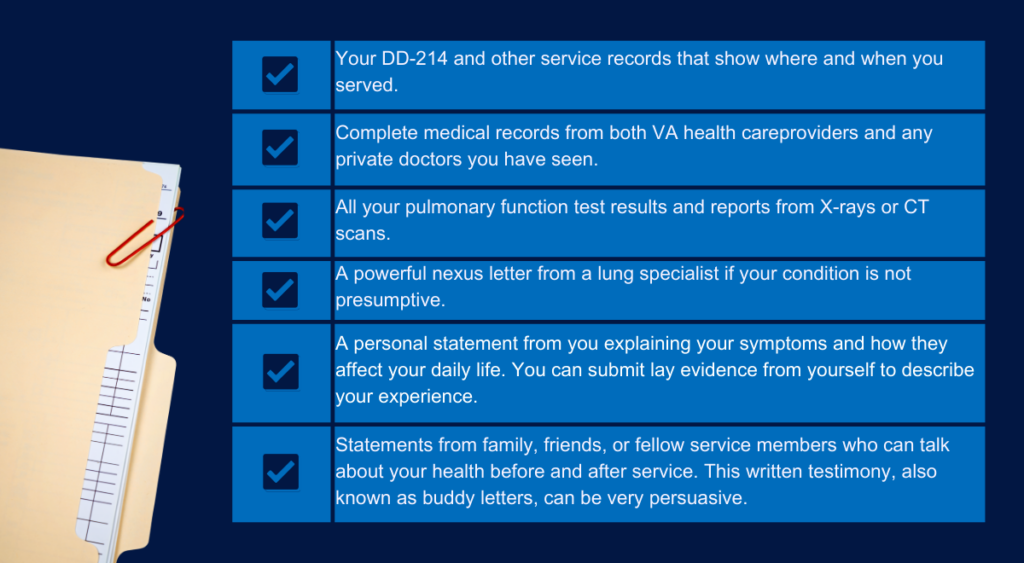
Handing the VA a well-organized and complete file makes their job easier. It also greatly increases your chances of a successful claim without long delays. The goal is to submit current evidence that leaves no room for doubt.
A disability benefits questionnaire (DBQ) filled out by your doctor can also be powerful. This is a standardized form that uses the VA’s own language to describe the severity of your condition. Asking your private physician to complete one can be a huge help.
Conclusion
Taking on the VA claims process can feel overwhelming, especially when you are not feeling your best. But you can win the benefits you have rightfully earned through your service. Focusing on strong medical evidence is the most important thing you can do for your claim.
By focusing on filing for chronic respiratory VA disability, you can discover key medical tests and specialist letters that strengthen your claim and help you take control of the process. Start with a firm diagnosis and get those critical PFTs done to show how your breathing is affected. A strong nexus letter from a specialist can tie everything together.
This combination of proof presents a powerful case to the VA. You served our country, and now it is time to get the help you need for the health conditions that followed you home. Do not hesitate to submit additional evidence and pursue the VA disability benefits you deserve.