

For many veterans, a denied VA disability claim marks the beginning—not the end—of a challenging journey. The key difference-maker in winning an appeal often comes down to one thing: strong, authoritative medical evidence. In fact, appeals succeed when evidence is strong.
At Attain Med Group, we understand how critical an independent medical opinion (IMO) from a qualified doctor is in shifting the outcome of a denial. As a veteran-owned, veteran-centered company, our mission is to bridge veterans with trusted medical providers who can deliver expert nexus letters, comprehensive record reviews, accurate diagnoses, and Disability Benefits Questionnaires (DBQs)—all tailored to help you secure the VA benefits you deserve.
In this article, we’ll walk you through why a doctor’s medical opinion matters so much in VA appeals, how it influences decision-making, and best practices to make your supplemental claim as strong as possible.

1. Why Medical Opinions Matter in VA Appeals
The Burden of Proof: Why Nexus Is So Critical
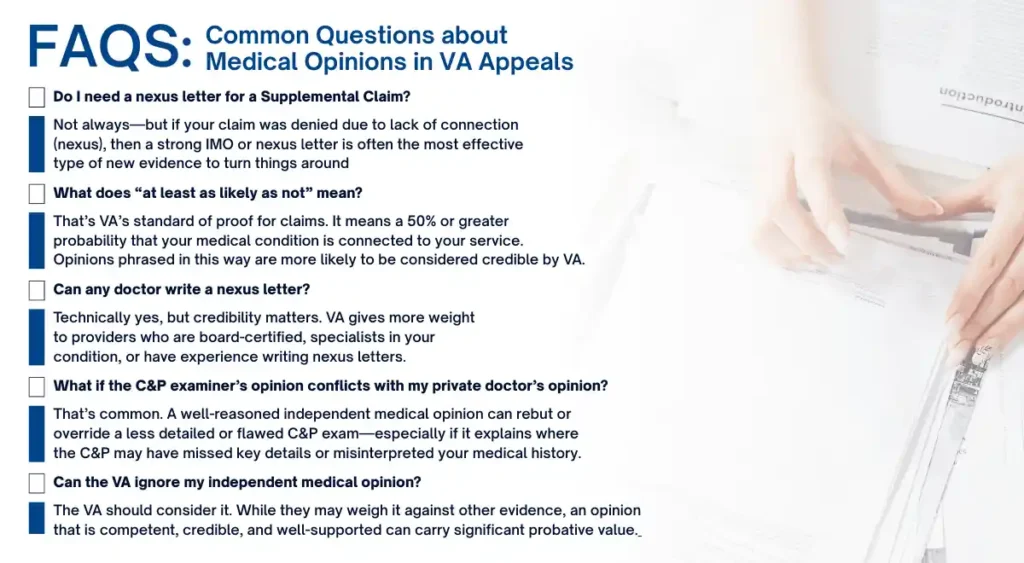
To win a VA disability appeal, one of the most common hurdles is establishing a nexus—a medical connection between your current condition and your service. Simply having a diagnosis isn’t enough; VA adjudicators need expert medical reasoning that links what you’re experiencing now to what happened in service.
A well-crafted medical opinion (often in the form of a nexus letter) serves exactly this function. It:
- Reviews your service medical records, VA exams, and current treatment history
- Explains, in medical terms, how and why your condition is connected to your military service
- Meets VA’s standard of proof by using language such as “at least as likely as not” (50% probability or greater)
- Includes a medical rationale that is grounded in your specific facts and in medical literature, where applicable
This expert opinion translates your medical story into the language VA decision-makers understand—and critically, it provides probative evidence that can tip the scale in your favor. As one analysis by Bross & Frankel, P.A. notes, IMOs “provide detailed rationale … and address and rebut the VA examiner’s reasons for denial.”
2. Types of Medical Opinions and Their Role in Appeals
Not all medical opinions are created equal. Here are the main types and what they’re best used for in VA appeals:
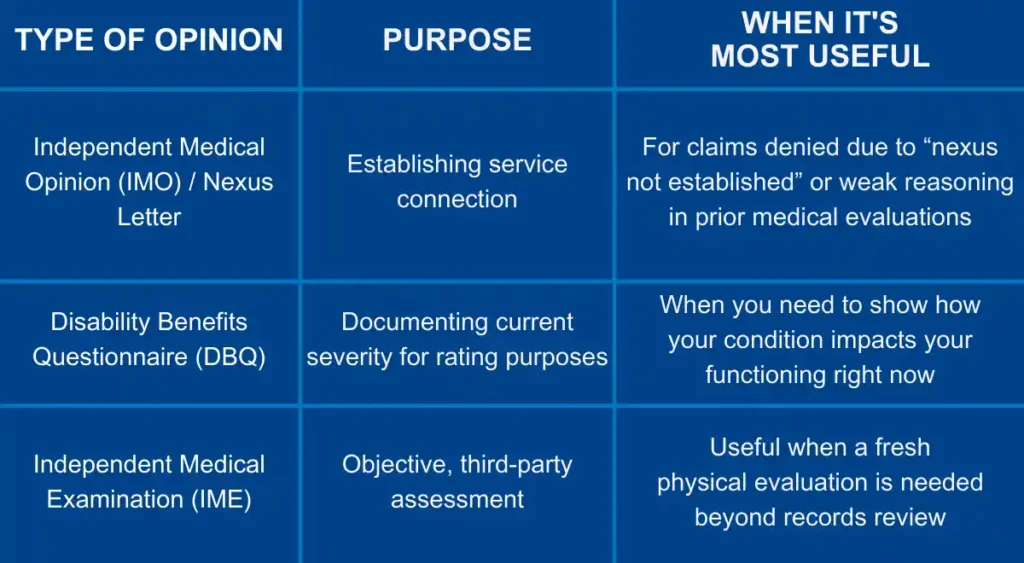
In many successful appeals, veterans combine a nexus letter (for causation) with a DBQ (for severity) to build a compelling, multi-faceted argument. As shown by back/spine appeal data, cases with both an IMO and a DBQ often have much higher success rates than those without.
3. What Makes a Medical Opinion Persuasive to the VA
To influence a VA appeal decision, a doctor’s opinion needs to hit certain marks. Here are the hallmarks of a high-quality medical opinion:
- Qualified Provider
- Board-certified physician (or appropriate specialist) with relevant experience.
- Credentials and expertise clearly stated in the report.
- Thorough Review of Evidence
- The doctor reviews your full C‑file (service records, VA exams, private treatment) before forming an opinion.
- The rationale is based on factual medical history, not just lay statements.
- Clear, Probative Language
- Uses precise probability standards: “at least as likely as not,” “more likely than not,” etc.
- Avoids vague language (“maybe,” “possibly”) which undermines credibility.
- Medical Rationale & Evidence
- Provides a logical, detailed explanation linking service to the current condition.
- Cites peer-reviewed studies or medical literature when relevant.
- Transparency about Methodology
- Discloses what records were reviewed and how the opinion was reached.
- If there’s conflicting evidence, addresses it directly rather than glossing over obstacles.
- Tailored & Specific
- Avoids generic or template-based wording.
- Puts the veteran’s individual medical history front and center.
When these elements come together in your medical opinion, VA adjudicators are much more likely to find it “competent, credible, and probative”—in other words, weighty enough to change a decision.
4. How Independent Medical Opinions Can Turn Around Denials
Here’s how a strong medical opinion from an independent, civilian (non-VA) provider can specifically help in the appeals process:
A. Rebutting an Unfavorable C&P Exam
VA-contracted Compensation & Pension (C&P) exams are often critical, but not infallible. Sometimes these exams lack depth, skip relevant history, or draw conclusions based on limited data. A well-written iMO can:
- Highlight gaps or errors in the C&P examiner’s methodology
- Provide a more comprehensive review of your records and treatment
- Offer a counter-opinion that better reflects your real condition and its causes

B. Filling Evidentiary Gaps
If your initial claim was denied due to “no nexus” or “insufficient evidence,” an IMO delivers new, relevant, and material evidence that directly addresses the reason for denial. This is especially powerful when submitting a Supplemental Claim under the modern appeals system.
C. Strengthening Secondary and Aggravation Claims
For conditions that are secondary (caused or worsened by a service-connected disability) or aggravated by service, a medical opinion can:
- Explain the pathophysiological link between your primary and secondary conditions
- Demonstrate how your service-connected disability has worsened over time
- Argue for higher disability ratings by substantiating the severity and continuity of symptoms
D. Supporting Higher-Level Appeals or Board of Veterans’ Appeals (BVA) Cases
At the BVA or Court level, decision-makers often give greater weight to independent specialist opinions—especially those that clearly explain the reasoning, cite evidence, and align with VA’s own probability standard.

5. Risks & Pitfalls of Weak or Inadequate Opinions
Not every medical opinion helps—and some can even hurt your appeal if poorly crafted. Common mistakes include:
- Using a doctor who lacks relevant expertise, or not clarifying their qualifications.
- Factual inaccuracies in the report (e.g., wrong service dates, missing intervening injuries) can invalidate the opinion.
- Weak probability language (“maybe,” “possibly”) fails to meet VA’s standard.
- Neglecting to reference medical literature or research when needed.
- Generic, boilerplate letters that are clearly not tailored to your case.
A cautionary example is from Reonal v. Brown, where the court rejected a medical opinion because the doctor based it purely on lay history, without reviewing the service medical records.
6. How Attain Med Group Helps Veterans Strengthen Their Appeals
At Attain Med Group, we leverage our veteran-centered mission and deep technical expertise to provide exactly the kind of medical evidence that appeals need to succeed. Here’s what sets us apart:
- Veteran-Owned, Veteran-Focused
We understand not just the medical side—but also the emotional, legal, and bureaucratic complexities you face. - Expert Providers Who Specialize in VA-Style Medical Opinions
Our network includes board-certified physicians, specialists, and independent medical experts experienced in writing nexus letters, IMOs, and DBQs tailored to VA standards. - Comprehensive Record Review
We perform full file reviews—service records, treatment history, prior C&P exams—to produce well-justified, fact-based medical opinions. - Regulation-Compliant Language
Our doctors use VA-approved standards of probability (for example, “at least as likely as not”) and base their opinions on medical evidence, not conjecture. - Support Through the Process
- We help you understand how to gather new evidence.
- We guide you on how to frame your Supplemental Claim.
- We collaborate with your representative (VSO, attorney) to ensure your medical opinion is presented for maximum impact.

7. Real-World Impact: Case Studies (Hypothetical Examples)
Here are two illustrative (anonymized) examples of how independent medical opinions helped veterans win their Supplemental Claims:
- Case Study A: Back/Spine Appeal
A veteran denied for low back pain after a negative C&P exam obtained an IMO from a spinal specialist. The specialist reviewed his military treatment records, current MRIs, and private treatment notes, then wrote a nexus letter explaining how his service-related injury “more likely than not” caused his current degenerative condition. On appeal, the VA granted service connection—citing the expert’s rationale and medical authority. - Case Study B: Secondary Migraine Condition
Another veteran had service-related TBI (traumatic brain injury) and later developed chronic migraines. The VA denied his migrainous claim on first review, stating no link. He submitted a supplemental claim with a nexus letter from a neurologist who explained how the TBI mechanistically leads to chronic migraine (supported by peer-reviewed studies). The claim was accepted, and the veteran was awarded service connection for migraine secondary to TBI.
These are representative of the kind of powerful evidence that Attain Med Group helps to generate.
9. Key Takeaways: Why a Strong Medical Opinion Can Make or Break Your Appeal
- Appeals succeed when evidence is strong. A well-written independent medical opinion is often the cornerstone of that strength.
- IMOs provide unbiased, expert analysis that speaks directly to VA’s standards.
- The quality of the opinion matters more than the quantity. Credible reasoning, proper language, and specialized expertise are critical.
- Combining a nexus letter with a DBQ gives you a two-pronged approach: causation and severity.
- With the right medical evidence, you can overturn a denial and make your Supplemental Claim more compelling.
10. How to Work With Attain Med Group to Strengthen Your Appeal
If you’re facing a denial or preparing to file a Supplemental Claim, here’s how Attain Med Group can support you:
- Book a Consultation: Reach out for a free, no-obligation review of your case.
- Record Review & Strategy: We analyze your service records, VA file, and medical history to identify gaps and develop a tailored evidence plan.
- Expert Opinion: Our medical team (MDs, DOs, specialists) prepares a carefully reasoned independent medical opinion or nexus letter written to VA standards.
- DBQ Support: If necessary, we can also coordinate DBQ completion to document your current disability severity.
- Appeal Submission: We’ll help you present your new evidence in your Supplemental Claim or higher-level appeal, whether you’re working by yourself, with a VSO, or with an attorney.

Conclusion & Call to Action
At Attain Med Group, we’ve seen firsthand how appeals succeed when evidence is strong. The independent medical opinions we facilitate don’t just supplement your VA file—they can transform your case by giving decision-makers the expert, specialized testimony they need to grant service connection or higher ratings.
If your claim was denied, or you’re preparing for a Supplemental Claim, don’t go it alone. Contact Attain Med Group today to schedule a consultation. Let us help you build the authoritative medical evidence you need to strengthen your VA appeal and secure the benefits you’ve earned.