

GERD is often linked to PTSD, medications, and chronic pain. Find out how to medically link GERD to existing service‑connected conditions for approval.
Gastroesophageal Reflux Disease (GERD) is more than occasional heartburn — for many veterans, it can be a chronic, debilitating condition. Even more challenging: sometimes GERD develops not directly from service, but as a secondary condition, caused or worsened by other service-connected disabilities like PTSD, chronic pain, or the medications used to treat them.
At Attain Med Group, we specialize in helping veterans navigate these complex claims. We provide expert nexus letters, medical record reviews, independent evaluations, and DBQs — all tailored to establish strong secondary service connections. This guide will help you understand how to prove GERD for your VA disability claim, what medical evidence you need, and why a nexus letter can make all the difference.
What Does “Secondary Service Connection” Mean?
- Secondary service connection refers to a condition that arises because of (or is aggravated by) another service-connected disability. Under VA law (38 CFR § 3.310), a disability that is “proximately due to, or the result of, a service‑connected disease or injury” can be eligible for service connection.
- In practical terms, if you are already rated for PTSD, and your PTSD (or its treatment) contributes to GERD, you may be able to claim GERD as a secondary condition.
Why GERD Is Common Among Veterans With PTSD or Chronic Pain
There are several medically plausible pathways by which PTSD, anxiety disorders, or their treatments can lead to or worsen GERD:
- Stress and Hyperarousal
- PTSD triggers the sympathetic nervous system (“fight-or-flight”), increasing gastric acid production and slowing gastric emptying, which can promote reflux.
- Chronic stress may weaken the lower esophageal sphincter (LES), allowing more stomach acid to flow back into the esophagus.
- Behavioral Factors
- Veterans with PTSD may engage in behaviors that worsen GERD: smoking, alcohol use, poor diet, or irregular eating schedules.
- Sleep disturbances, such as insomnia or fragmented sleep (common in PTSD), can exacerbate nighttime acid reflux.
- Medication Side Effects
- Many medications used to treat PTSD — including SSRIs, SNRIs, and other antidepressants — may irritate the gastrointestinal tract or impact motility, contributing to GERD.
- Other drugs used for comorbid conditions (anxiety, depression, pain) can also worsen reflux.
- Physiological Aggravation by Comorbid Conditions
- Chronic pain conditions can lead to increased reliance on NSAIDs, which may damage the gastrointestinal lining and worsen reflux.
- The interplay between stress, sleep disruption, and GI motility can chronically aggravate GERD in a way that directly ties back to a service‑connected mental health or pain condition.

VA Rating Criteria for GERD (Diagnostic Code & Severity)
To be granted a VA disability for GERD, you need a formal diagnosis and a service connection (direct or secondary). Understanding the VA’s rating criteria is key.
- According to Trajector Medical, as of May 19, 2024, the VA uses Diagnostic Code 7206 for GERD.
- Under this code, VA ratings may be: 0%, 10%, 30%, 50%, or 80%, depending on severity.
- Rating factors may include:
- Presence of esophageal strictures (narrowing of the esophagus)
- Dysphagia (difficulty swallowing)
- Frequency and need for dilations
- Complications such as aspiration, undernutrition, weight loss, or bleeding.
- For example: frequent or recurrent strictures requiring multiple dilations may support a higher rating.
Building a Strong GERD Secondary Claim: Evidence You’ll Need
To successfully prove GERD as a secondary condition to PTSD (or another service-connected disability), you must provide compelling evidence. Here’s what that typically involves:
- Current Diagnosis
- Medical documentation (GI specialist records, endoscopy reports, pH monitoring) confirming GERD is essential.
- Your diagnosis can come from VA or non-VA providers, as long as it’s credible and well-documented.
- Evidence of Service-Connected Primary Condition
- Proof that you have a service-connected disability (e.g., PTSD) with a current VA rating.
- Medical records, treatment notes, and prescription history for that condition can strengthen your case.
- Nexus / Medical Opinion (Nexus Letter)
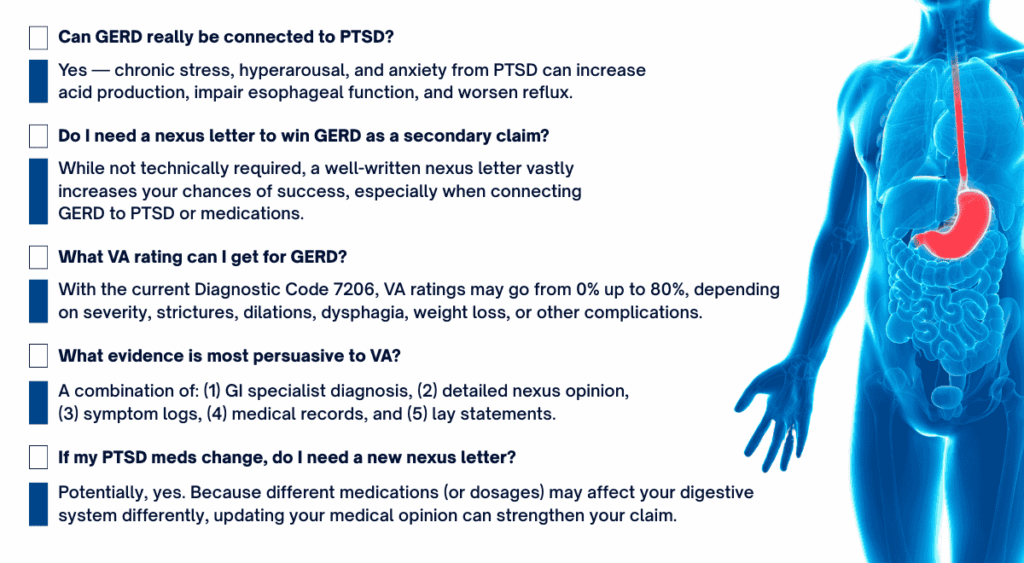
- A nexus letter is often critical: a qualified medical provider (gastroenterologist, internal medicine, or psychiatrist) should explicitly state that it is “at least as likely as not” that your GERD is caused or aggravated by your service‑connected condition (PTSD, medications, etc.).
- The letter should explain the medical mechanism: how physiological stress reactions, PTSD-related behaviors, or medication side-effects lead to or worsen GERD.
- Referencing peer-reviewed research or clinical studies in the nexus opinion can make it more persuasive.
- Symptom Documentation
- Maintain a symptom log (journaling): record heartburn episodes, regurgitation, difficulty swallowing, chest pain, sleep disruption, and how these symptoms change over time.
- Note when symptoms worsen (e.g., during PTSD flare-ups, stress, or after taking medication).
- Medical Records & Treatment History
- Include all relevant GI records (endoscopies, pH testing), prescription history for GERD medications (PPIs, H2 blockers), and any interventions (dilations, surgeries).
- Document how your GERD has responded (or not) to treatment.
- Lay Statements / Witness Statements
- Statements from family, friends, or coworkers can corroborate how GERD affects your life (e.g., “He often wakes up gasping for air,” or “She avoids meals because of pain in her chest”).
- These help illustrate the real-life impact of GERD, which can support a higher rating.
- C&P Exam Preparation
- Be ready to clearly explain your GERD symptoms, their frequency, severity, and how they tie to your PTSD or medication use.
- Bring your nexus letter, symptom log, and medical records to your Compensation & Pension (C&P) exam.

Challenges & Tips for Overcoming Them
Proving GERD as a secondary condition can be tough. Here are common hurdles and how to navigate them effectively:
- Challenge: VA examiner does not recognize nexus.
Tip: Work with your provider to ensure the nexus letter details how your PTSD or its treatment causes or worsens GERD, backed by medical rationale. - Challenge: Symptoms but no specialist diagnosis.
Tip: If you haven’t seen a GI specialist, consider getting an evaluation — even a basic endoscopy or pH study can strengthen your case. - Challenge: Inconsistent documentation.
Tip: Keep a detailed journal of your GERD symptoms, including food triggers, sleeping issues, and stress correlations. Submit that with your claim. - Challenge: Medication changes.
Tip: If your PTSD medication changes, update your medical evidence. New nexus letters reflecting changes in dosage or medication can help. - Challenge: Low VA rating for GERD.
Tip: If you receive a low rating, an appeal (supplemental claim or higher-level review) with an improved nexus opinion and additional medical evidence may be warranted.
Real-World Example / Case Study
Veteran A served with active-duty combat and was later rated 70% for PTSD. Over the years, he began experiencing frequent heartburn, regurgitation, and chest discomfort — especially during periods of high stress and after starting SSRIs for PTSD. He documented his symptoms in a daily log, saw a GI specialist who confirmed GERD via endoscopy, and obtained a nexus letter stating that his GERD is “as likely as not” aggravated by his PTSD and medication regimen.
He submitted a secondary claim with all this evidence. The VA granted him a 30% rating, recognizing his GERD as secondary to his PTSD. His combined rating went up, improving his monthly compensation and giving him access to more specialized care.
Why a Nexus Letter from Attain Med Group Can Make the Difference
Conclusion & Call to Action
GERD may not seem like a psychiatric condition — but for many veterans, it’s deeply tied to the stress, hyperarousal, and treatments associated with PTSD or chronic pain. When you understand the medical mechanisms, document your symptoms diligently, and work with a knowledgeable provider to obtain a nexus letter, you significantly boost your chances of proving GERD as a secondary service-connected condition.
Ready to take action?
Contact Attain Med Group today to schedule a free consultation. Our team will help you connect with GI specialists, prepare your nexus letter, and build a comprehensive VA disability package — so you can get the benefits you’ve earned.