


If you are a veteran living with pounding, never ending head pain, you already know the reality. The hardest part is not always the migraine or headache itself. It is trying to explain the impact to people who do not see you on the bathroom floor with the lights off. For many vets, VA disability chronic headaches. chronic headache frequency documentation and severity. is not just a topic you search for once. It is the question hanging over every disability claim, denial, and appeal. It keeps you awake during long nights staring at the ceiling.
You might wonder how often your headaches need to happen or how bad they need to be. You may question what kind of proof the VA actually believes. Many veterans worry they have underreported their symptoms and left money on the table. You are not alone in that thought. This guide breaks down VA disability chronic headaches. chronic headache frequency documentation and severity. in plain English. We provide straight talk backed by solid sources and years of cases from real veterans.

Why Chronic Headaches Are A Big VA Disability Issue
Migraine and chronic headaches are among the most common conditions in the VA system. The Department of Veterans Affairs acknowledges this widespread issue in their data. The VA’s 2019 Annual Benefits Report shows migraine headaches rank as the ninth most common service-connected condition for new compensation recipients.
Over 43,000 veterans started getting benefits for them in that year alone. You can review that data in the 2019 Annual Benefits Report. This volume proves that military service takes a toll on neurological health. Research backs up what many of you feel every day. In one long term study of veterans over twelve years, about 5.3 percent reported living with migraine symptoms. This number is much higher than the general population in some groups.
That research is available through the National Library of Medicine. It highlights the long term nature of these conditions. Another group of researchers found that as many as 36% of veterans who served in the Middle East after 9/11 may deal with migraines. That estimate is published in a comprehensive review. Factors like exposure to burn pits may play a role in these high numbers.
So no, it is not “just in your head.” Headaches and migraines are very real. They are very disabling. They are also very common for those receiving VA disability.
Establishing Service Connection For Headaches
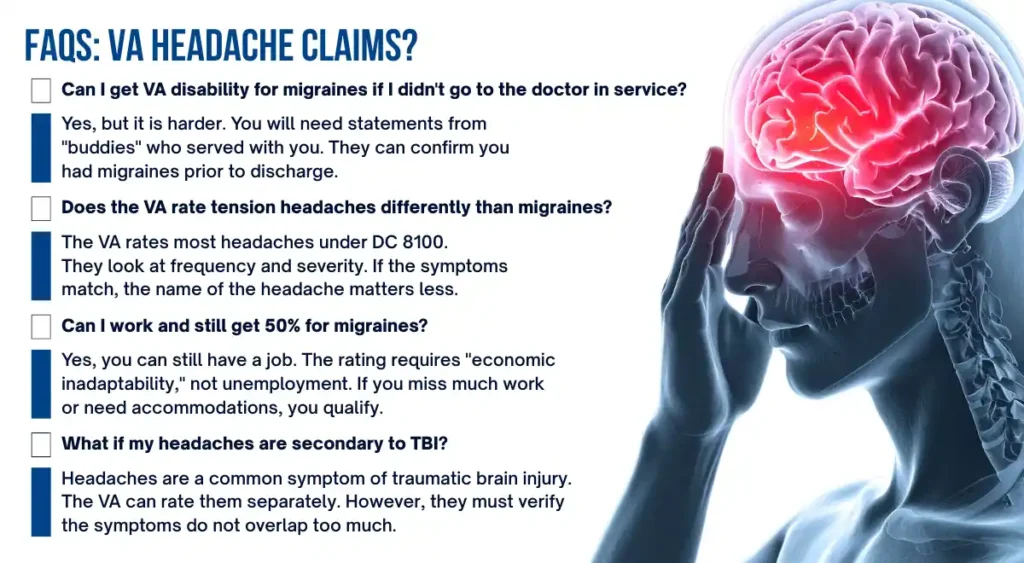
Before worrying about the rating, you must prove the headaches are related to your time in uniform. This is called a service-connected condition. You cannot simply tell the VA you have headaches; you must link them to an in-service event. There are generally two ways to do this. The first is direct service connection. This means your migraines started while you were on active duty. Perhaps you have medical history showing you sought treatment at sick call for head pain.
The second way is as a secondary condition. This happens when another service-connected disability causes your headaches. For example, a neck injury involving the cervical spine can trigger severe tension headaches.
Many veterans also file for migraines secondary to mental health issues. A stress disorder like post-traumatic stress disorder can easily trigger migraine episodes. To succeed here, you need a medical nexus.
A medical nexus is a letter from a doctor linking your current diagnosis to your service. Without this link, the VA may deny the claim even if you have a current diagnosis.

How The VA Rates Migraine And Chronic Headache Conditions
The VA uses something called Diagnostic Code 8100 to rate migraines and many chronic headache conditions. This code dictates how the VA rates your pain level and frequency. You can see the actual rating schedule in the VA Schedule for Rating Disabilities.
Under that code, migraine and related headache conditions are rated at 0, 10, 30, or 50 percent. The same breakdown appears in more detail on this Cornell law page covering Diagnostic Code 8100.
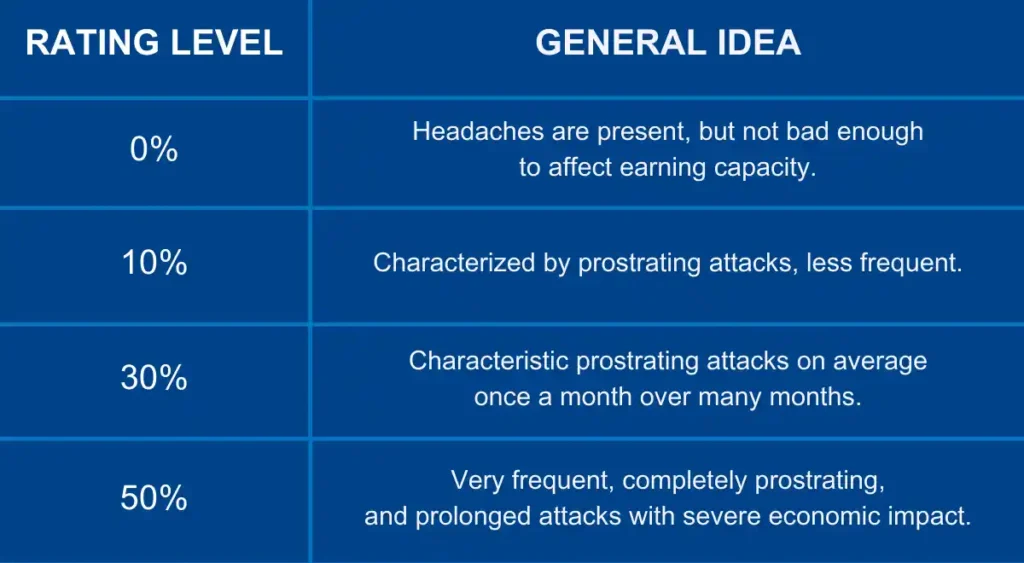
The VA states that migraine headaches receive ratings based on frequency and severity. They look at how often the attacks occur and how they interfere with your daily activities. This is laid out clearly at this section of the regulation.
The top rating of 50% is for very severe migraines. These must strike more than once a month. They must also cause major occupational and social problems. Cleveland Clinic defines chronic migraines at this resource on chronic migraine.
Key Words The VA Uses For Headache Ratings
Reading the rating schedule is one thing. Understanding what the VA means by certain phrases is something else. Many vets get stuck on specific terms. The rating rules do not define important terms such as “prostrating” or “very frequent.” However, the VA’s internal Manual M21-1 explains how raters should use those words. You can read those internal definitions at this M21-1 section.
The VA updated its M21-1 manual in September 2023. This update gives more direction on what a prostrating migraine is. It also clarifies what proof they look for in migraine claims. You can see that update at this more recent M21-1 section. The words the VA uses carry real weight. Strong documentation can make a major difference.
VA Disability Chronic Headaches. Chronic Headache Frequency Documentation And Severity.
Let’s break the phrase VA disability chronic headaches. chronic headache frequency documentation and severity. into real life questions. You probably have these questions right now. You may think: How often do my headaches count? What do I write in my log? What does “severe” mean to the VA compared to what it feels like?
The VA looks at three big areas for chronic headaches under Diagnostic Code 8100. Those are frequency of the attacks, severity of each attack, and ability to function. If you clarify these three areas, you are ahead of many veterans.
How Often Your Headaches Happen: Getting Frequency On Paper
Frequency is usually where VA decisions start. The rating schedule ties higher ratings to headaches that strike once a month or more. This leads to a 30% rating. For a 50% rating, you need very frequent attacks. These must also cause major work problems. This language is laid out in Diagnostic Code 8100. The VA rarely accepts just your memory as enough for higher ratings. You need a pattern in writing. That is where a headache log becomes a vital tool.

How To Track Chronic Headache Frequency In A Way The VA Respects
You do not need a fancy app or program. A simple notebook works as long as you use it often. Here are core details to record for each headache day.
- Date and time the headache started and stopped.
- How bad it was on a scale of one to ten.
- Whether you had to lie down in a dark room.
- What you missed because of it, like work or family time.
- Any triggers, like stress, noise, or smells.
- What medication you used and if it helped.
If writing during the headache is hard, make a quick note. Fill in the rest later that day. The goal is to create a trail that matches what you tell the examiner.
This tracking mirrors how experts study migraine patterns. The National Library of Medicine shares information about evaluation tools at this overview. Your log shows your headaches follow a pattern.
What “Prostrating” Really Means In Real Life
“Prostrating” sounds like a word from an old textbook. Many veterans ignore it, which is why claims often land at 10%. But this word is central to migraine ratings. In simple terms, a prostrating attack stops you in your tracks. You need to lie down in a dark or quiet place. You cannot continue daily activities.
Prostrating attacks occur when you cannot push through the pain. The VA’s manual update on prostrating migraine spells out how they judge this. You can see that language at this M21-1 update. If your headaches are a constant ache, the VA may rate them lower. If you have characteristic prostrating attacks where you must hide from light, those count more. This detail must be in your log.
Severity: Painting The Full Picture Of What Your Headaches Do To You
Frequency shows how often you are in trouble. Severity shows the damage during each storm. Headache severity is not just about a pain score. Recent case law discussed under 38 CFR 4.124a DC 8100 at this regulation text makes this clear. The VA must consider the whole cluster of symptoms. This includes sensitivity to light and sound.
Migraines include many symptoms beyond just head pain. The National Library of Medicine has background on how disabling they can be. You can see examples at this migraine impact study and in this clinical review.
Common Symptoms And Visual Disturbances
When documenting severity, do not leave out visual disturbances. Many veterans experience tunnel vision or seeing spots. These are often called auras.
To show severity, include clear notes on things such as:
- Vomiting or nausea during attacks.
- Needing total darkness or silence.
- Blurred or flashing vision.
- Trouble thinking or finding words.
- Balance issues or dizziness.
- Emotional impact like fear of the next attack.
Mentioning that you experience tunnel vision helps establish the severity. It shows the biological impact of the condition. These symptoms are what the term characteristic prostrating is meant to capture.

“Severe Economic Inadaptability” And How Headaches Impact Work
The top 50% rating requires “severe economic inadaptability.” This phrase confuses many people. It boils down to a simple question. Are your headaches so frequent that work becomes impossible? Does it make your employment very unstable? You do not need to be fired to meet this standard. The courts explain that evidence needs to show serious work problems. Think about missed shifts or leaving work early. Think about sitting in dark rooms during breaks.
This is where concepts like individual unemployability come into play. If your rating reaches a certain level but you cannot work, you might get paid at the total disability rate. This is true even if your math rating is not 100%. You can strengthen this part of your case with statements from employers. Social Security has its own policy on headaches. You can see that approach at this Social Security ruling. The VA must consider all symptoms linked to migraine attacks. That requirement is confirmed under 38 CFR 4.124a DC 8100. They must look at the full economic impact.
Documentation That Moves The Needle With VA Raters
You might feel you have told your story many times. But words only carry weight when backed by patterns. Here is what matters most.
Your Headache Or Migraine Log
Your log is the backbone of your claim. It shows consistent characteristic prostrating attacks over months. Keep the same structure each time. If a spouse tracks your bad days, have them write a statement. This cross check makes records credible. Platforms like Healthline offer community examples. You can see how others track symptoms at Healthline. You can also check the Bezzy migraine community at Bezzy.
The Disability Benefits Questionnaire (DBQ)
When you go for an exam, the doctor uses a specific form. This is the disability benefits questionnaire. It is often called the DBQ. This benefits questionnaire asks specific questions about prostrating attacks. It asks about frequency and economic loss. You should be familiar with this form before you go. A private healthcare provider can also fill out a DBQ for you. This can sometimes be more thorough than a VA exam. It adds strong medical history to your file.

Lay Statements From People Who See You Struggle
Lay statements come from non-experts. These are letters from friends or family. They see how your headaches play out in real life. They can mention how often you cancel plans. They can describe you hiding in a dark room. This supports the social side of your disability claim. Guidance from the M21-1 manual supports using this evidence. The migraine sections at this manual page show what facts VA staff look for. They need to see how the disability affects you.
Case Example: A Veteran Fighting For A Higher Migraine Rating
You are not the first veteran to battle for this. In one appeal, a veteran fought for an increased rating. She served from 1996 to 1999. That case is publicly available at this Board decision. The Board looked at how often she had to lie down. They looked at how attacks affected her job. Reading an appeal helps you see what facts matter. The Board focuses on frequency and prostrating attacks. They look for economic impact just as the rules describe.
Getting The Right Rating And Not Leaving Benefits Behind
It is common to get stuck at 10 or 30%. The VA often underestimates how often attacks happen. They may miss the severity of your prostrating attacks. The maximum schedular rating for migraine is 50%. This is shown at this law page. That top level can help with total disability claims. To see the dollar amount for each rating, use the payment table. You can view thecompensation rate chart. This shows the value of getting the rating right.

How Headache Claims Fit Alongside Your Other VA Disabilities
Most veterans file more than one claim. Headaches often appear with tinnitus or post-traumatic stress disorder. These conditions can interact. Connecting migraines to other issues is a smart strategy. For instance, tinnitus may trigger migraine episodes. You should read about the VA disability rating for tinnitus.
You can learn more from this partner guide on VA disability rating for tinnitus. This shows how conditions work together. Secondary conditions can increase your overall combined rating. At Attain Med Group, we see many veterans with multiple issues. You can see similar guides on other body systems. We have an overview on VA disability ratings for hiatal hernia.
We also have a breakdown of va disability for rotator cuff repair and bursitis. We even cover specific claims like va disability ratings for gynecological conditions. Your headache claim is part of a bigger story. The VA needs to see the whole picture. Strong documentation helps every piece of your case.
Daily Life With Chronic Headaches: Taking Care Of Yourself While You Fight The VA
The claim process takes time. Meanwhile, the pain continues. It is easy to ignore your mental health. Mental health experts see a link between migraine and stress. Post-traumatic stress often worsens the pain cycle. Sites like Psych Central offer resources. You can find this mental health resource helpful. Greatist also shares strategies. Visit their wellness platform for lifestyle ideas.
Small changes can soften the impact. You can read strategies at this article about stress and migraine. If you need medication refills quickly, online care helps. One option is shared at this page on short term migraine medication refills. These tools give you breathing room.
Conclusion
VA disability chronic headaches. chronic headache frequency documentation and severity. may sound like dry legal language. But underneath it is your real life story. It is the missed birthdays and the slow dread of another attack. The VA has a framework for rating your headaches under Diagnostic Code 8100. Ratings range from 0 to 50 percent. You can see the official rules at this VA regulation. The highest ratings hinge on clear proof. You must show how often attacks occur. You must show they are prostrating and wreck your work life.
Your job is to become the best witness to your own story. Keep a simple headache log. Talk openly with your healthcare provider. Gather statements from people who see your daily activities. Learn how other vets have fought these cases. You can read the appeal at this Board case. Whether you are starting a claim or seeking an increase, you are not guessing. Medical research and VA rules back you up. The more your records match the rating schedule, the harder it is to deny your claim.
You carried a lot for this country during your military service. You should not have to carry chronic headaches alone. Build your documentation and fight for the disability compensation you earned.VA Disability Chronic Headaches: Severity & Documentation