


You’ve served your country, and now you’re fighting another battle. It is a battle with paperwork, appointments, and a system that can feel stacked against you. For veterans, Filing a high-value VA disability claim? Discover why medical opinions are essential to securing the rating you deserve. is a critical question. It is about more than just filling out forms; it is about proving your case beyond any doubt.
You know your body better than anyone. You live with the chronic pain, the sleepless nights, and the daily reminders of your service. But the VA needs more than your word; they need solid medical evidence to approve your VA disability benefits.
This evidence must create a bridge connecting your current struggles to your time in uniform. A strong, well-reasoned medical opinion is that bridge, giving you the best chance at the disability rating you have earned.

Understanding the Three Pillars of a VA Claim
Before going deeper into medical opinions, let’s cover the basics of the claims process. Think of your VA disability claim like a three-legged stool. If one leg is missing or weak, the whole thing collapses, leading to a denied claim that may enter a lengthy appeals process.
First, you need a current, diagnosed disability from a qualified healthcare provider. This means a doctor has officially identified your condition in your medical documentation. Vague complaints about aching joints are not enough; you need a specific diagnosis like degenerative arthritis or post-traumatic stress disorder for a mental health claim.
Second, you must provide evidence of an event, injury, or illness that happened during your military service. This could be an entry in your service treatment records, records of combat, or documentation of serious orthopedic injuries from a training accident. Gathering evidence from your time as one of our nation’s service members is a critical step.
The third leg is often the most difficult for veterans to prove. This is the “nexus,” which is a medical link connecting your current disability to that in-service event. This is where you establish service connection, and it is precisely where a powerful medical opinion makes all the difference for your veteran disability claim.
What Exactly is a Medical Opinion or Nexus Letter?
So what is this document that holds so much power over VA disability claims? A medical opinion, often called a nexus letter, is a detailed report from a qualified medical professional. This letter clearly explains how your diagnosed condition is related to your military service.
This is not a simple note scribbled on a prescription pad. A strong nexus letter provides a detailed, evidence-based argument that forms the foundation of a compelling case. The authoring physician writes it after reviewing your entire file, from service records to current medical charts from va medical centers or private healthcare providers.
The nexus letter serves a vital purpose.The Department of Veterans Affairs has your service records (Point A) and your current medical diagnosis (Point B). A nexus letter is the solid, well-built bridge that connects them, making the path clear for the VA rater to follow and approve your disability benefits.

Why Your Claim Needs a Strong Medical Opinion
You might wonder if a medical opinion is truly necessary. You have your service records and a diagnosis from your doctor, so isn’t that enough medical evidence? For a very straightforward, minor va claim, it might be, but for a high-value claim that could award significant disability compensation, you cannot leave anything to chance.
The Limitations of C&P Exams Alone
The VA will almost always schedule you for a Compensation and Pension (C&P) exam. This exam is conducted by one of the VA examiners or a contracted physician. Their job is to evaluate your condition and provide an opinion on its service connection.
However, these exams have significant limitations that can harm your disability claim. The examiner might only spend 15-20 minutes with you and often has not had time to perform a thorough review of your extensive medical history. In short, they do not know you or the full context of your daily life.
Worse, they are not your advocate; they work for the Veterans Affairs. An unfavorable opinion from a C&P examiner can sink your VA disability rating, even if you have a legitimate service-connected disability. You must be prepared for this possibility by having your own evidence ready.
How a Private Medical Opinion Strengthens Your Case
This is where your own private medical opinion becomes your most powerful tool. It is an expert opinion from a doctor who has taken the time to do a thorough records review and truly understands your history. This can be the key to getting a higher rating and the monthly compensation you deserve.
When a VA rater is faced with two conflicting opinions, the one from the brief C&P exam and the other from your treating specialist who wrote a detailed report, which one do you think will carry more weight? A well-reasoned medical opinion from a credible expert has significant probative value. This provides the VA with a clear reason to grant your service-connected disabilities.
A private opinion can also identify and correct errors made during a C&P exam. It shows you have taken the initiative to build a solid claim. It demonstrates that another medical professional firmly believes your condition is service-connected, helping you secure the VA disability compensation you are fighting for.
Proving Secondary Conditions and Aggravation
Many high-value disability claims involve secondary conditions. These are disabilities caused or worsened by an already service-connected disability. For example, a veteran’s service-connected knee injury might cause them to walk with a limp, leading to hip and back problems years later, all of which could impact their combined disability rating.

Proving these connections is nearly impossible without a strong medical opinion. The VA needs a doctor to medically explain how one condition led to another. A C&P examiner, in a brief appointment, may not make this connection, but your own expert can lay out the medical science behind it step-by-step.
The same logic applies to pre-existing conditions that were aggravated by your service. If you had asymptomatic flat feet before you joined but years of marching in combat boots made them severely painful, you need a medical opinion. A doctor must state that your military service permanently worsened the condition beyond its natural progression to win these types of VA disability ratings.
The Anatomy of a Powerful Medical Opinion
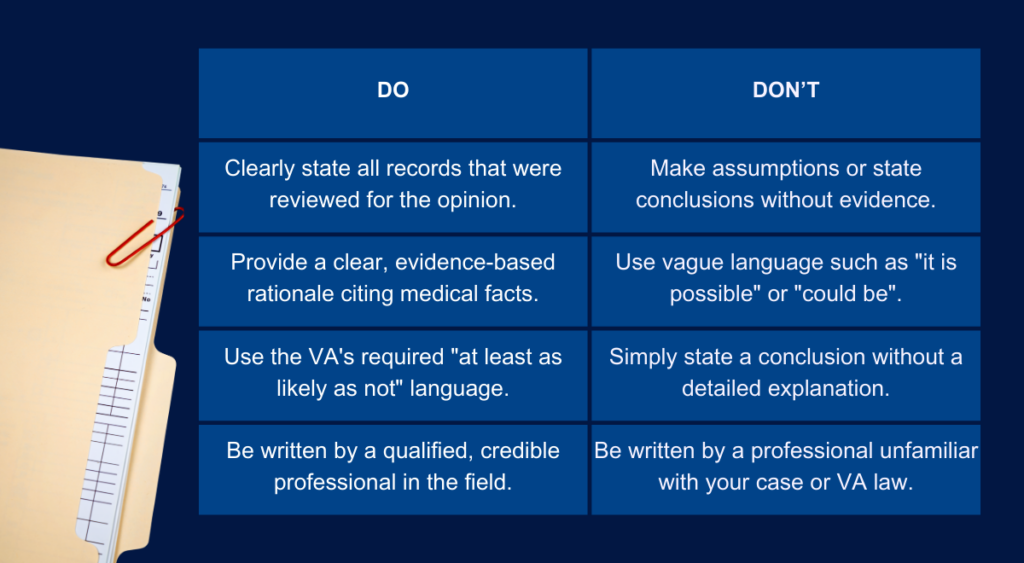
Not all medical opinions are created equal, and a weak, poorly written letter can do more harm than good. A strong nexus letter that helps you get the disability benefits you deserve has several key components. The key factors in an effective letter make it much more persuasive to a VA rater.
A truly effective letter should include:
- A review of all relevant records. The letter must state that the doctor reviewed your service medical records, DD214, private medical records, buddy statements, and any other important documents. This shows the opinion is based on the facts of your case.
- A clear rationale. The doctor must explain the “why” behind their opinion using accepted medical principles. For instance, explaining how a traumatic brain injury can lead to secondary conditions like migraines or depression is much stronger than just saying they are connected.
- The correct terminology. The VA operates on a standard called “at least as likely as not,” which means there is a 50% or greater chance the condition is service-connected. Your doctor’s opinion must use this exact phrasing or something stronger, like “more likely than not,” to be effective.
An opinion that hits all these points is much harder for the VA to dismiss. It presents a complete and persuasive argument that speaks their language. Ultimately, it helps the rater at the VA regional office do their job, which is to approve valid VA disability claims.
To make it clearer, here is a breakdown of what makes an opinion letter strong.
Gathering Evidence: How to Get the Medical Opinion You Need
So, you are convinced of the importance of a medical opinion. How do you go about getting one that will help you win your va claim? You have a couple of solid options, each with its own advantages.
Working With Your Treating Doctor
Your first thought might be to ask your family doctor or the specialist you have been seeing for years. This can be a great option because your doctor already knows your medical history and has an established relationship with you. They have witnessed the impact of your condition on your daily activities.
However, there are potential downsides. Many private doctors are not familiar with the VA’s specific requirements or the specific language needed on a VA form. Some are simply unwilling to get involved in disability matters due to time constraints or liability concerns.
You can help by providing them with a template and explaining what is needed. If they decline, do not be discouraged. This is a specialized area, and not all healthcare providers are comfortable with it.
Using a Third-Party Medical Expert
Another excellent route is to work with an independent medical professional or a service that specializes in writing opinions for veterans. These experts are immersed in the VA system and know exactly what raters at the VA are looking for. They understand how to build a case for multiple disabilities and achieve a favorable combined rating.
These services will review all your records and connect you with a qualified doctor. This doctor will then write a comprehensive, evidence-based medical opinion for your claim. This approach removes the guesswork from the process and ensures the document meets the VA’s standards.
Yes, these services come at a cost, but you have to consider the alternative: what is the cost of a denied claim? Investing in a strong medical opinion upfront can save you years of frustration and help you get the benefits you and your family rightfully deserve, potentially impacting your financial future for decades.
Supporting Your Medical Opinion with Other Evidence
A medical opinion is powerful, but it becomes even more effective when supported by other forms of evidence. Lay evidence, for example, can be extremely valuable. This includes personal statements and so-called buddy statements.

Statements from you, your spouse, or fellow service members can paint a vivid picture of how your condition affects your life. A letter from a fellow service member who witnessed your injury can corroborate the events in your service records. This helps to establish the facts surrounding your condition incurred during service.
A symptom diary is another simple but effective tool. In it, you can regularly document your pain levels and how your pain prevents you from performing certain tasks. This diary provides concrete data that your doctor can reference in their medical opinion and shows the VA the real-world impact of your condition.
Conclusion
You have done the hard part. You served honorably and sacrificed for your country. Now, it is time to build the strongest case possible to get the VA disability benefits you have earned. Do not let your claim get denied over a missing piece of evidence.
Remember that when you are filing a high-value VA disability claim? Discover why medical opinions are essential to securing the rating you deserve. A medical opinion gives the VA the clear, professional proof it needs to make the right decision. This nexus letter can be the single most important document in your entire claim file. Take the time to secure a strong one, because your health and well-being are worth it.