

Strengthen your claim with an independent medical opinion for VA benefits backed by peer-reviewed studies and medical research.
You’re staring at that letter from the VA. Maybe it’s a denial, or maybe it’s a low disability rating that just doesn’t make sense. It feels like a gut punch after everything you’ve been through.
But what if you had a tool, a powerful piece of evidence the VA can’t easily ignore? You do, and it’s how you can strengthen your claim with an independent medical opinion for VA benefits backed by peer-reviewed studies and medical research.
The VA disability claim process can feel like you’re trying to shout through a brick wall. You know your current condition is from your service, but proving it feels impossible. This is where you can take back some control and proactively build your case.

What is an Independent Medical Opinion, Anyway?
An Independent Medical Opinion, or IMO, is an expert medical evaluation from a private doctor. This qualified medical professional is not employed by the VA. They are working for you to provide a clear medical nexus opinion.
Think about the Compensation and Pension (C&P) exam you had. It was likely brief, with a doctor you’d never met before who spent little time with you. An IMO is the complete opposite of that experience.
Your private medical expert takes the time to thoroughly review your entire file. They review your service treatment records, post-service medical records, and your complete medical history. Their job is to give a detailed, evidence-based opinion on your condition for your VA disability claim.
The Difference Between a C&P Exam and an IMO
A VA C&P examiner’s primary role is to gather medical information for the VA’s rating decision. They are not there to be your personal doctor or advocate. Many veterans report feeling rushed or not fully heard during these exams, which can negatively impact their disability claims.
An IMO provider, on the other hand, is hired by you. Their sole focus is to conduct a detailed evaluation of your specific condition. This creates a much more comprehensive and personal medical report that can be vital for your VA disability benefits.
This difference is huge. One is a quick snapshot for the VA’s file. The other is a deep analysis designed to tell the full story of your medical condition and its origins.
Why Your Claim Is Stuck (And How an IMO Fixes It)
Did your denial letter mention a “lack of nexus” or “insufficient evidence”? These are common roadblocks for veterans filing VA claims. The VA is telling you that you failed to connect your current disability to your time in service.
This “medical nexus” is the bridge between your condition and your military service. Without it, your VA claim will almost certainly be denied or result in a low VA disability rating. The VA needs a doctor to say your current condition is, more likely than not, because of your service.
This is exactly what a powerful IMO does. It builds that bridge with concrete medical evidence and a clear, professional medical nexus opinion. It’s often the one piece of paper that turns a denial into an approval for disability benefits.
The Power of a Nexus Letter
The term IMO is often used interchangeably with Nexus Letter. The medical nexus letter is the written report from your doctor. This document explicitly links your medical condition to a specific event, injury, or illness from your service.
A strong nexus letter explains the doctor’s reasoning in detail. It becomes the cornerstone of your veterans’ appeals or supplemental claims. It speaks the VA’s language and directly addresses the reasons they denied your initial veterans claims.
These letters are critical tools when appealing VA disability decisions. They provide the specific medical evidence the VA requires to grant service connection. A well-written letter from a medical professional can make all the difference.

Strengthen Your Claim with an Independent Medical Opinion for VA Benefits Backed by Peer-Reviewed Studies and Medical Research
Here’s where we get to the real secret weapon for VA disability claims. A good IMO is great. But an IMO that uses medical research is on another level.
It’s one thing for a doctor to write their opinion. It’s a completely different level of power when that doctor backs up their opinion with scientific studies. They are showing the VA that the entire medical community supports their conclusion, which strengthens all types of health claims.
This transforms the doctor’s opinion from a subjective statement into an objective, evidence-backed argument. The VA adjudicator can’t easily dismiss an opinion that cites respected medical journals. They are trained to weigh medical opinions, and scientific research is very heavy evidence.
What is a Peer-Reviewed Study?
You’ve probably heard this term before. A peer-reviewed study means that before a medical research paper was published, it was scrutinized by other experts in the same field. This process is like a quality control check for science.
These experts check the methods, results, and conclusions to make sure the research is sound and unbiased. When your doctor cites studies from sources like the New England Journal of Medicine or JAMA, they are using the gold standard of medical evidence. It shows the VA this isn’t just one doctor’s idea; it’s a finding supported by rigorous scientific investigation.
Finding these studies is easier than you think. Websites like PubMed, which is run by the National Library of Medicine, are free databases containing millions of medical articles. You or your doctor can search for research linking military sexual trauma to PTSD or exposure to burn pits to respiratory conditions.
Connecting Service Exposures to Current Conditions
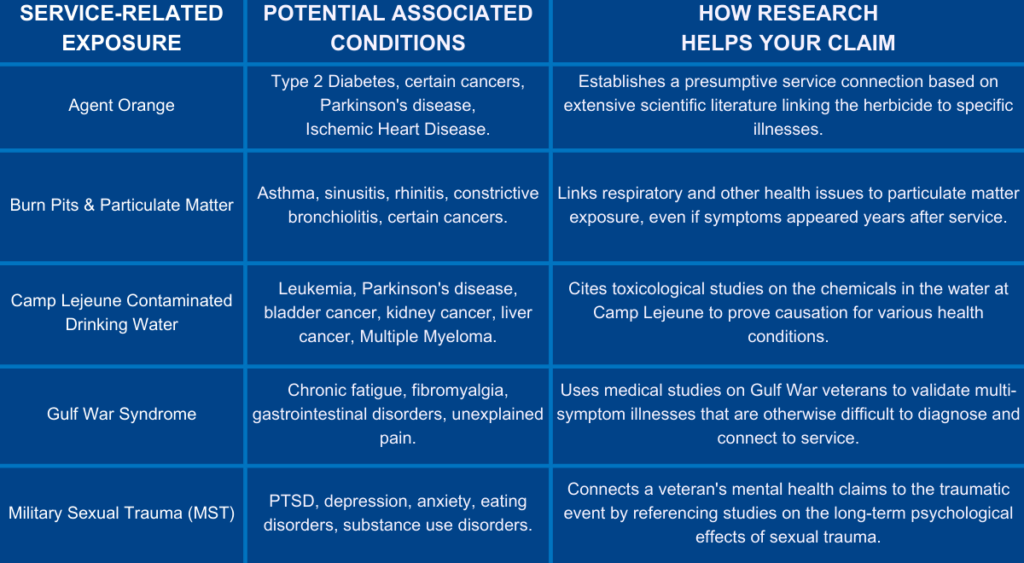
Many disability claims are based on exposure to environmental hazards during service. A medical expert can use research to link your condition to things like Agent Orange, particulate matter exposure, or radiation exposure. This is crucial for establishing a service connection when direct evidence from your service records is missing.
For example, a veteran suffering from respiratory issues might have been exposed to burn pits in Iraq or Afghanistan. An IMO can cite studies on particulate matter and its long-term health effects. This research can be the missing link needed to approve your VA disability claim.
Similarly, veterans who served at Camp Lejeune may have claims related to contaminated drinking water. Medical research on the health impacts of the specific chemicals found in the Lejeune contaminated drinking water is extensive. An IMO citing this research provides powerful support for claims related to Camp Lejeune contaminated drinking water.
Finding the Right Doctor for Your IMO
Not just any doctor can write a persuasive IMO. You need a medical professional who understands the unique requirements of the VA claims system. This is not the time to simply ask your family doctor, unless they have specific experience with this.
Look for a physician who has experience working with veterans. They should be willing to do a deep dive into your records. They must also be open to finding and citing relevant medical literature to support your va claim.
Be careful of services that promise nexus letters without a thorough review. A quality IMO takes time and effort. Your doctor should spend hours, not minutes, on your case before writing a single word.
Specialists Can Make a Big Difference
If you have a heart condition, an opinion from a cardiologist carries more weight than one from a general practitioner. For a mental health claim related to military sexual trauma, a psychologist or psychiatrist is your best bet. A specialist in traumatic brain injury is essential for a TBI claim.
The VA gives more “probative value” to the medical opinions of specialists in their specific practice areas. When you’re searching for a doctor, try to find one who specializes in the area of your disability. Their expertise gives their nexus opinion more credibility in the eyes of the VA rater.
This shows you are taking your claim seriously by getting a true expert’s opinion. This is particularly important for complex cases like Gulf War Syndrome or claims involving a brain injury. A specialist’s view can be decisive.
How to Work With Your Doctor for a Powerful IMO
You play a big part in this process. You need to give your chosen doctor everything they need to write a killer IMO. Get organized before you even have your appointment.
Gather all your relevant documents in one place. Your doctor will need these to get the full picture of your situation. Being prepared makes the doctor’s job easier and results in a stronger, more detailed report for your disability claim.
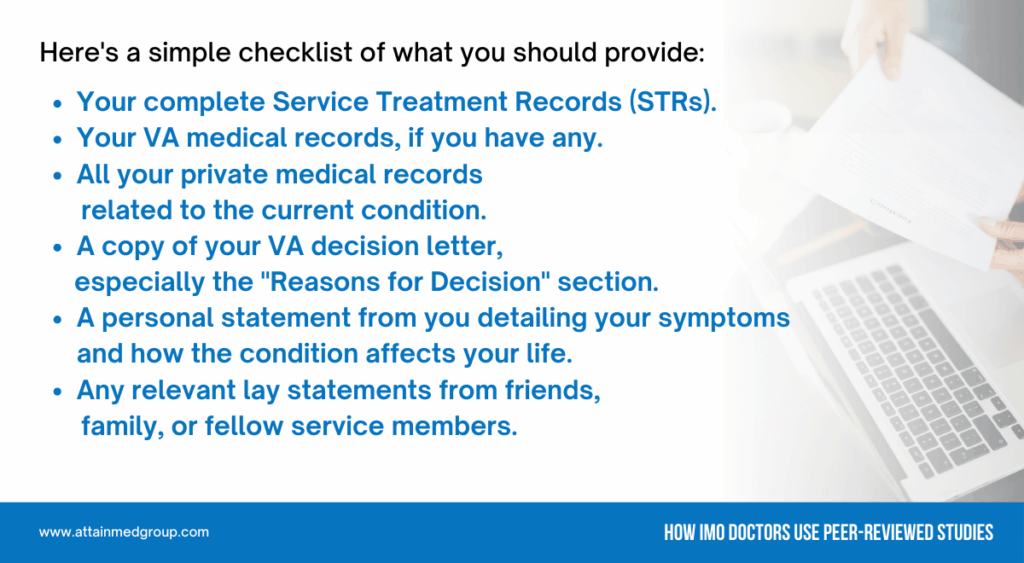
This preparation shows you’re a partner in building your case. It gives the medical expert the tools they need to write a compelling medical nexus letter that covers all the necessary bases. It is vital for your success when appealing VA disability claims.
The Anatomy of a Winning IMO
A powerful, persuasive IMO has a few key ingredients. When you get the report back from your doctor, look it over to see if it contains these elements. This isn’t about telling the doctor what to write, but about understanding what a strong document looks like.
The doctor’s report should be clear and logical. It should walk the VA rater through the evidence, step-by-step. A winning IMO has a structure that is hard to argue against and can help increase your disability ratings.
Here’s what should be included:
- A statement that the doctor has reviewed all of your records. They should even list out the key documents they looked at. This shows their work was thorough.
- A clear rationale that explains the medical reasoning behind their opinion. They should connect the dots for the VA, establishing the medical nexus.
- Citations from medical research or established medical treatises. This is the part that adds incredible weight to the opinion, especially for claims involving environmental hazards.
- A definitive conclusion using specific language the VA understands. This is usually a phrase like “it is at least as likely as not” that your condition is related to your service. According to VA regulations, this standard is all that is needed to establish service connection.
When these elements come together, the IMO becomes a powerful piece of evidence. It’s a document that can completely change the outcome of your claim, from supplemental claims to higher-level review. It can also be critical evidence in claims for death benefits filed by a surviving spouse.
What To Do With Your IMO
Once you have a strong nexus letter, you need to submit it to the VA correctly. Simply mailing it in is not enough; you must file it as part of a specific action. The most common way to use an IMO is with a supplemental claim.
A supplemental claim is used when you have new and relevant evidence to submit for a previously denied claim. An IMO backed by medical research is the perfect example of such evidence. This re-opens your case and forces the VA to review your claim with this new, powerful medical opinion.
If you’re unhappy with a decision but don’t have new evidence, you might choose a higher-level review. However, if your denial was due to a lack of a medical nexus, an IMO is what you need. It directly addresses the reason for denial, making a supplemental claim the best path forward for appealing VA disability denials, including BVA denials.

Conclusion
The VA claims process can leave you feeling powerless, but you have more control than you think. You don’t have to accept a denial or a low disability rating as the final word. It’s time to build a case that the VA simply cannot ignore.
Your best move is to strengthen your claim with an independent medical opinion for VA benefits backed by peer-reviewed studies and medical research. This strategy provides the concrete medical nexus the VA requires. This is especially true for claims related to issues like Agent Orange, burn pits, or Camp Lejeune contaminated drinking.
This isn’t just about getting a second opinion; it’s about presenting a professional, evidence-based argument. A solid IMO forces the VA to see your case in a new light. It gives you the best chance to secure the VA disability benefits you rightfully earned through your service.