


Every year, thousands of American veterans file claims for benefits earned through military service to our country. Securing rightful compensation from the Department of Veterans Affairs requires a methodical approach grounded in factual documentation. Understanding How Veterans Can Build a Strong VA Disability Claim From the Start establishes your legal basis cleanly and protects your effective date for retroactive benefits.
The Department of Veterans Affairs operates an extensive compensation system that processed over 1.9 million claims in fiscal year 2023 alone. Despite statutory duties to assist claimants, regional offices regularly deny claims that lack essential foundational elements. Understanding how adjudicators evaluate files allows you to present an undeniable record right from your original submission date.
Do you know what adjudicators look for when reviewing an initial application folder? By presenting your physical and psychological injuries with clear evidentiary links, you avoid years of frustrating administrative appeals. This guide explains the core principles required to prepare an unassailable VA disability filing from day one.
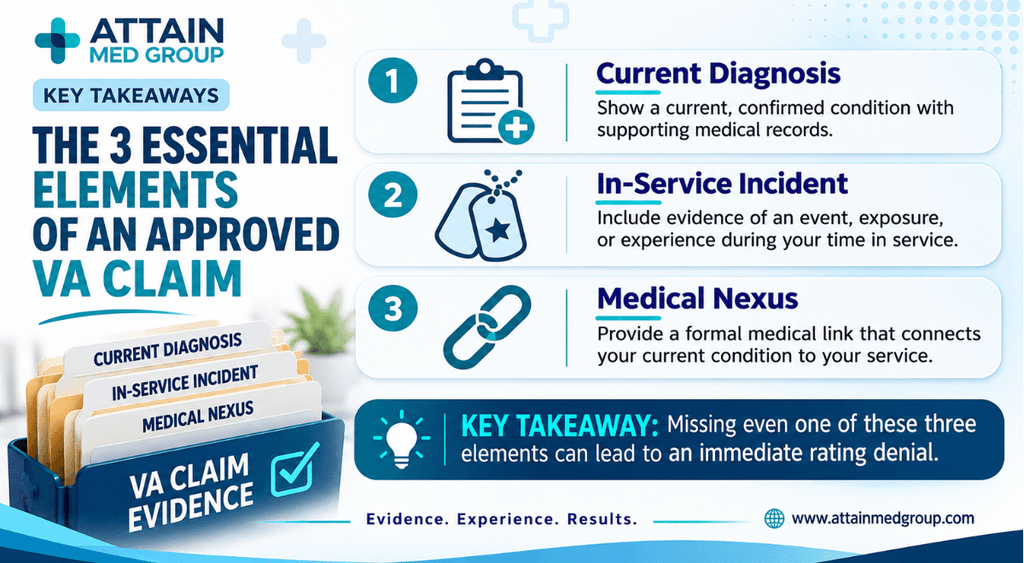
Federal law governs how disability compensation is granted under Title 38 of the Code of Federal Regulations. To establish a legitimate service-connected disability and secure your rightful VA disability benefits, an applicant must satisfy three legal prerequisites established by federal court precedents. If any single component is missing from your submitted file, the regional office will automatically issue a formal denial notice.
The first requirement is a current physical or mental diagnosis confirmed by an authorized medical provider. Symptoms alone without a formal diagnostic code rarely support a valid grant of benefits under current rating schedules. The second element is verifiable proof of an injury, disease, or traumatic event that occurred during your active duty service.
The third requirement connects the first two elements through what the agency formally terms a medical nexus. An official medical nexus establishes that your diagnosed condition is at least as likely as not related to your service. Providing this connection early on prevents adjudicators from relying on brief, unfavorable Compensation and Pension examinations to decide your fate.
Gathering Critical Records and Lay Statements
A primary cause of delayed claims involves incomplete documentation submitted during initial review stages. You should request your complete service personnel file alongside your official service medical records from the National Personnel Records Center. Civilian hospital documents and ongoing private care files must also be gathered to demonstrate an unbroken history of symptoms.
Adjudicators closely review civilian treatment records to see if your physical limitations have persisted continuously since discharge. When clinical files show chronological gaps, written statements in support of claim provide vital context regarding daily functional limitations. Buddy statements authored by fellow service members, spouses, or coworkers confirm observations of your pain, reduced mobility, or behavioral shifts.
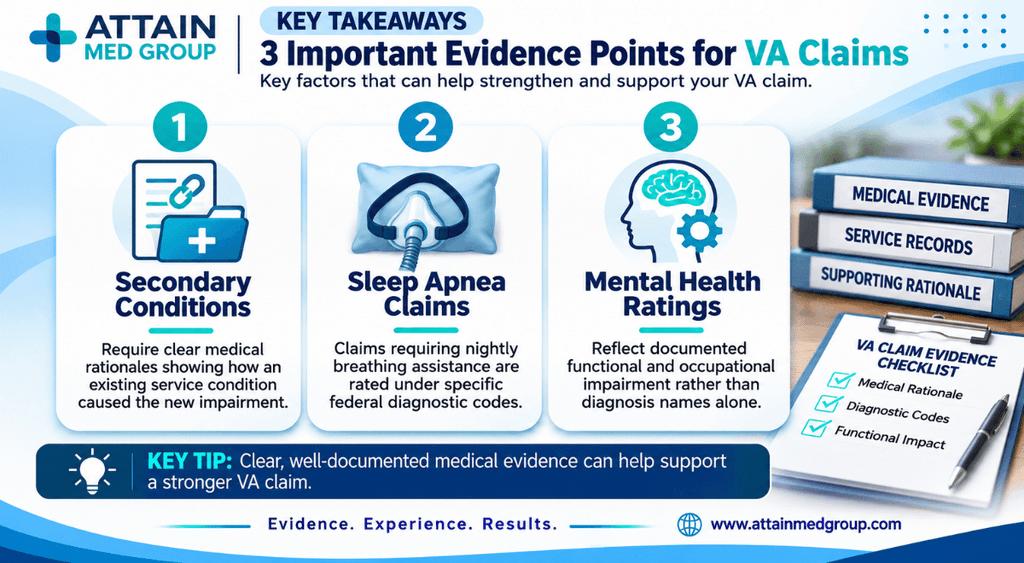
A strong statement explains specific events without hyperbole and clarifies how conditions affect daily occupational performance. When seeking compensation for a secondary service-connected disability, combining clinical history with witness testimony creates a robust record that holds weight during any formal rating audit. Private doctors who review your military record can supply objective documentation that reinforces your statements.
Pro Tip: Submit a formal Intent to File immediately to establish your effective date while you spend time collecting private records and buddy letters.
How Veterans Can Build a Strong VA Disability Claim From the Start
Executing an organized submission saves months of unnecessary waiting during your VA disability review process. Preparing your file systematically protects both your effective date and your evidentiary standing throughout the adjudication timeline. Following a structured procedure allows you to avoid common challenges that cause premature claim rejections.
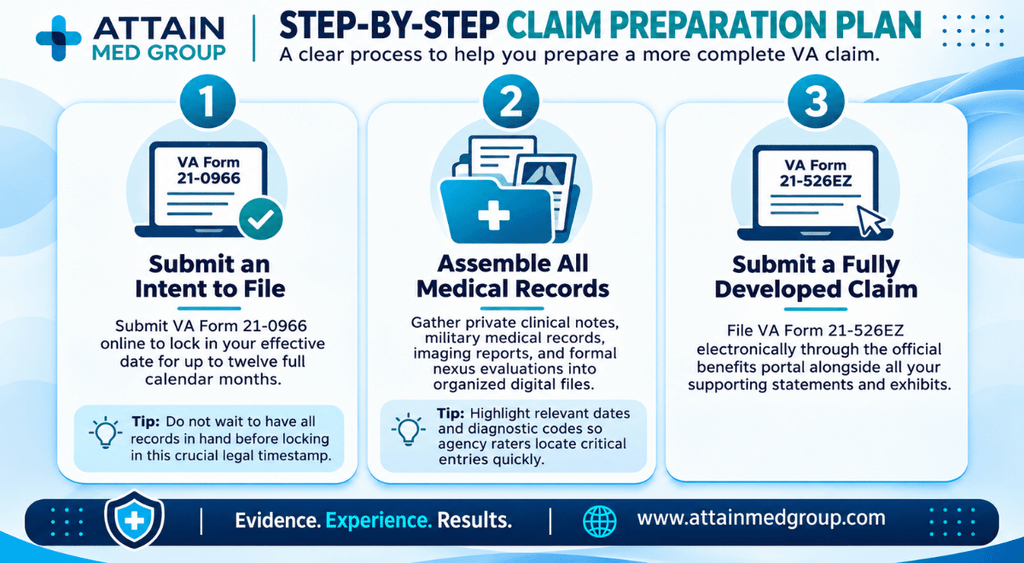
Completing this sequential order moves your file into the Fully Developed Claim program managed by the agency. This pathway speeds up the claims process by verifying that no additional clinical records need retrieval from outside facilities. Providing everything upfront leaves fewer reasons for agency staff to defer decisions or order unnecessary exploratory screenings.
After filing, track your claim progress on the central portal to respond rapidly to any development letters. Never ignore correspondence asking for clarification regarding service branches, deployment sites, or private healthcare facilities. Swift communication shortens review phases and helps raters finalize your packet without administrative hesitation.
Handling Specific High-Value and Secondary Claims
Many veterans suffer from secondary physical disabilities that develop as a direct consequence of an established direct impairment. Common examples include orthopedic alterations causing spinal degeneration or chronic depression stemming from severe mobility restrictions. Proving these secondary linkages requires clear physiological explanations from an accredited medical expert who reviews your file.
Secondary Conditions and Sleep Disorders: Sleep Apnea Claim Strategies
A frequent issue encountered by former service personnel involves sleep apnea / obstructive sleep apnea occurring secondary to post-traumatic stress or respiratory damage. Whether an applicant suffers from central apnea / obstructive sleep disturbances or upper airway / obstructive conditions, establishing medical causation remains essential. Preparing a comprehensive sleep apnea claim requires verifiable clinical evidence that connects breathing interruptions directly to service-connected pathology.
Diagnostic testing through overnight polysomnography is required before the agency can assign any sleep apnea VA rating. If your sleep study confirms sleep apnea and requires nightly continuous positive airway pressure support, federal guidelines assign a fifty percent rating. Submitting physician statements explaining how your primary condition caused your sleep apnea helps secure your rating without lengthy disputes when processing an apnea claim.
Mental Health and Military Sexual Trauma: Securing Your VA Rating
Psychological claims require special sensitivity and thorough verification of in-service stressor events. When emotional conditions result from military sexual trauma, standard unit logbooks rarely contain documented reports of the event. Federal rules instruct adjudicators to look for alternative behavioral markers like sudden disciplinary actions, performance drops, or clinic visits for sexual trauma.
Obtaining an appropriate ptsd va rating depends on detailing how trauma impairs social, professional, and emotional functioning. The rating schedule awards higher percentages when veterans show severe occupational impairment, memory difficulties, or chronic panic episodes. Submitting detailed personal statements alongside clinical notes ensures the assigned va disability rating reflects your true level of functional disability.
Evaluating Total Disability and Claim Outcomes: Maximizing Your VA Rating
Combined percentages can be calculated using specialized resources like a veterans disability calculator to understand how multiple ratings interact under non-additive federal math to determine your overall va rating. When service-connected impairments prevent you from maintaining substantially gainful employment, you may qualify for total disability individual unemployability. This benefit pays at the maximum one hundred percent compensation rate even if your combined rating is lower.
Winning complex tdiu cases depends on presenting vocational reports alongside your medical assessments. Vocational experts evaluate your work background and describe how physical restrictions prevent consistent physical or sedentary employment. Reviewing published administrative decisions and tdiu resources shows that vocational assessments often make the difference between an approval and a denial.
Have you assessed whether your service impairments eliminate your ability to maintain steady desk work? Establishing unemployability status provides substantial financial stability for families affected by chronic physical or psychiatric conditions. Presenting employment records that document lost productivity or frequent workplace absences strongly reinforces your claim package.
️ Warning: Never attend a Compensation and Pension exam without reviewing your initial medical evidence and personal notes beforehand.
Working With Qualified Representatives and Advocates

Working with an accredited veterans disability lawyer or accredited service officer helps prevent procedural missteps. Experienced representatives understand rating manual rules and can interpret clinical guidelines for complex physical conditions. Looking at real-world case studies highlights how professional advocacy frequently clarifies obscure service connections that unrepresented claimants overlook.
Many organizations offer free resources to educate claimants on rating criteria before they submit paperwork. Reputable firms define clear areas served and maintain an unwavering client service commitment when handling claimant files. Quality representation guarantees your paperwork complies with formal evidentiary burdens established by the Board of Veterans’ Appeals.
Before selecting representation, inquire about their history with complex physical or secondary conditions. Choosing a dedicated advocate provides reassurance that your documentation will be reviewed thoroughly before submission. Thorough legal preparation from the beginning saves valuable time and positions your file for an early favorable determination.
Conclusion: Protecting Your Long-Term Benefits
Building a successful va disability claim requires diligence, patience, and complete medical substantiation from the very beginning. By establishing all three pillars of service connection early, you prevent common administrative delays and streamline agency adjudication. Treat the application process as an evidence-based legal presentation rather than an informal clerical task.
Maintain complete copies of every piece of documentation you provide to the government for your personal archives. Review rating criteria in official regulations to verify your records reflect the specific level of functional limitation required. With organized proof and persistent advocacy, you can secure the va disability compensation you earned during your service.