


Securing compensation from the Department of Veterans Affairs requires a clear understanding of federal regulations and administrative evidentiary rules. Many former service members receive lower evaluations or immediate denials simply because they submit incomplete files. Understanding these 12 facts veterans should know to strengthen a VA disability claim can fundamentally change how adjudicators process your claim.
The Department processes hundreds of thousands of files each calendar year, relying strictly on verifiable documentation rather than assumptions. When you understand statutory standards, you can present an airtight record that establishes direct service connection. These twelve fundamental facts will help you protect your rights and obtain the compensation you earned.
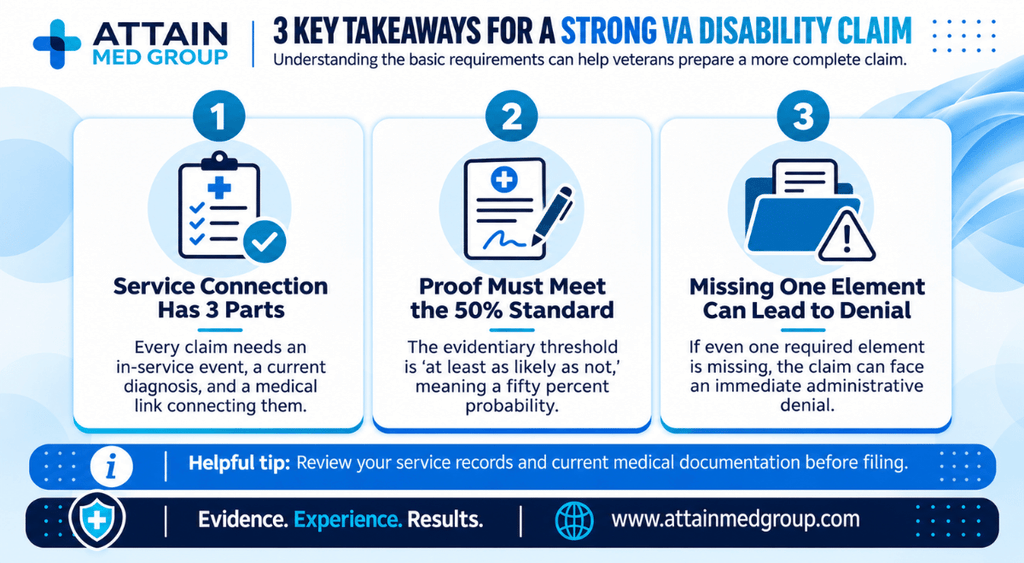
Every successful va disability claim rests upon three distinct legal components established under federal law. First, you must show an in-service injury, illness, or event that occurred during your military service. Second, you must possess a current clinical diagnosis of a physical or psychological impairment. Third, you need a medical link connecting the two events together.
Adjudicators evaluate thousands of va disability claims each year and will promptly reject an initial filing if even one of these three prongs is missing. Many veterans assume their service records speak for themselves without realizing examiners need clear medical logic. Demonstrating direct service connection requires consistent proof that directly bridges your military duty service with your modern symptoms.
You can review federal qualification rules directly on the VA disability eligibility page to review specific standards. The standard of proof is the “at least as likely as not” standard, meaning a fifty percent probability. Meeting this evidentiary threshold establishes legal entitlement to monthly disability compensation.
2. A Current Diagnosis Is Mandatory
You cannot secure va disability benefits based solely on pain or self-reported physical limitations. Under precedent set in Saunders v. Wilkie, pain alone can serve as a disability, but establishing an impairment requires verifiable symptoms. A qualified clinician must confirm a current diagnosis before the agency assigns an initial disability rating.
Relying on old active duty treatment logs without modern documentation creates immediate hurdles for approval. Private doctors or government providers can generate the clinical records necessary to substantiate your ongoing condition. Medical evidence must show that the ailment continues to impair your daily life right now.
Do you regularly schedule routine medical examinations to track your functional limitations? Frequent checkups create contemporaneous proof that prevents adjudicators from arguing your condition has completely resolved. Submitting clinical documentation with your benefits claim prevents unnecessary delays during regional office reviews.
3. Continuous Medical Records Establish Symptom Chronicity
Gaps in treatment create substantial doubt in the minds of agency rating specialists. If your military files document a severe back strain, but you went fifteen years without care, examiners question the etiology. Maintaining consistent medical records bridges that gap and proves your current symptoms stem from your military service.
When professional clinical documentation is sparse, buddy statements from peers or family can establish continuity. These lay statements explain how your service-connected disability persisted throughout the years following your discharge. While lay testimony cannot provide complex medical evidence, it can legally corroborate observable physical restrictions.
Such documentation provides critical context for recurring health conditions that fluctuate in intensity over time. For example, episodic joint flares or recurring respiratory problems require an established pattern of occurrence. Consistent health care visits build an irrefutable timeline that supports your pursuit of disability benefits.
Pro Tip: Request your complete military personal file and service treatment records before filing. Reviewing these papers helps you spot undocumented injuries that can support additional service connection requests.
4. Effective Dates Rely on Early Submissions

The date the agency receives your formal application directly governs your financial effective date. Submitting VA form 21-0966 establishes an official intent to file, preserving your back pay timeline for up to twelve months. This procedural step allows you to gather records without forfeiting potential retroactive payments.
If you take eight months to gather private clinic files, your compensation still dates back to that initial receipt. When veterans bypass this preliminary step, they lose hundreds or thousands of dollars in earned back pay. Every formal disability claim benefits immensely from locking in that statutory start date immediately.
After filing your intent notice, use that protected window to assemble strong supporting materials. Acquire private doctor letters, complete necessary evaluations, and obtain official command statements. Once your package is complete, you submit your formal va disability application on the proper official forms.
5. Presumptive Rules Eliminate the In-Service Event Requirement
Federal statutes contain presumptive categories that remove the burden of proving a specific in-service incident. If you served in designated regions, the law assumes your diagnosis directly relates to your operational deployment. For instance, exposure to burn pits in Southwest Asia grants presumptive service connection for numerous chronic respiratory conditions.
Veterans of the gulf war benefit from simplified adjudication pathways for undiagnosed systemic illnesses and functional gastrointestinal disorders. Active duty service during the gulf war grants broad statutory protections for deployed personnel. Similarly, Vietnam veterans exposed to agent orange receive expedited recognition for diabetes, heart disease, and specific cancers. You merely prove your boots-on-the-ground presence in qualifying locations alongside an official diagnosis of a covered presumptive condition.
Recent federal legislation under the PACT Act significantly enlarged the list of covered deployment zones and toxic exposures. Review the formal statutory listing at the Electronic Code of Federal Regulations Title 38 to verify if your assignment qualifies. Leveraging these rules speeds up the adjudication process and substantially raises your odds of an approval.
6. Secondary Service Connection Expands VA Benefit Scope
A primary service-connected condition often causes or aggravates additional medical problems across your lifetime. The legal mechanism known as secondary service connection allows you to claim compensation for these downstream consequences. This method offers an effective avenue to increase your overall monthly va disability rating.
Consider an orthopedic knee injury that forces you to walk with an abnormal, compensatory gait. Over time, that unnatural walking mechanic can cause degenerative disc disease or hip arthritis. Under secondary service guidelines, that newly developed back condition becomes compensable because the primary knee injury caused it.
Another frequent example involves physical pain triggering mental health problems, or medications causing gastrointestinal complications. Secondary conditions can also encompass respiratory problems; for instance, service-connected sinus problems frequently contribute directly to severe sleep apnea. Establishing this secondary service connection requires a physician to outline the physiological relationship connecting both ailments.
7. Independent Medical Opinions Clarify Etiology for a VA Claim
When military records fail to show an unbroken chain of treatment, an independent nexus letter becomes indispensable. This formal statement from a licensed physician provides the rationale connecting your modern illness to historical military service. Adjudicators give substantial weight to well-reasoned medical opinions based on complete reviews of your files.
A legally sufficient opinion must contain clear phraseology indicating the condition is “at least as likely as not” connected. Doctors must cite published medical research, physical examinations, and service treatment logs to justify their conclusion. Without clear clinical reasoning, a vague letter will be disregarded by agency rating specialists during evaluation.

8. Combined Disability Rating Calculations Follow Non-Linear Math
Many veterans incorrectly assume that their individual disability ratings simply add together using ordinary arithmetic. Instead, the government calculates your overall disability rating using a descending percentage of efficiency called the “whole person” theory. Each rating applies only to the remaining non-disabled percentage of your body.
For example, if you receive a fifty percent va rating, your body is considered fifty percent whole. A subsequent thirty percent rating applies only to that remaining fifty percent, adding fifteen percent rather than thirty. Receiving an updated va rating requires meeting precise clinical criteria under Title 38. This calculation produces an unrounded sum of sixty-five percent, which rounds up to a final seventy percent va disability rating.
This compounding process makes achieving a maximum evaluation progressively harder as your combined percentage rises. To calculate your precise numbers, consult the official VA disability ratings calculation tables for regulatory guidance. Knowing these rules helps you determine whether pursuing a higher rating for an existing condition makes mathematical sense.
9. Mental Health Disability Rating Rules Focus on Occupational Impairment
The rating schedule evaluates nearly all mental health conditions under a unified General Rating Formula. Whether you suffer from posttraumatic stress, major depression, or generalized anxiety, the diagnostic label does not govern your percentage. Instead, your va rating depends entirely on the level of social and occupational impairment you demonstrate.
A veteran experiencing posttraumatic stress disorder will be measured against the exact same behavioral criteria as one with adjustment disorder. Evaluating criteria include panic attacks, memory loss, impaired judgment, sleep disturbances, and suicidal ideation. Under this unified framework, the agency will assign a single combined evaluation to avoid illegal pyramiding of mental health symptoms.
Veterans claiming conditions related to military sexual trauma or severe combat often hesitate to discuss their worst days. However, understating your symptoms during examinations will result in a lower evaluation than your daily struggle warrants. When describing mental health conditions, explain your most severe functional problems rather than your temporary periods of stability.
10. C&P Examinations Demand Direct Symptom Descriptions
The Compensation and Pension (C&P) examination represents the most consequential appointment in your entire benefits journey. Contracted physicians use standardized Disability Benefits Questionnaires to assess the exact severity of your service-connected condition. How clearly you articulate your limitations to this examiner will directly dictate your awarded va disability compensation.
Have you documented your range of motion limitations during joint and spine evaluations? Examiners must record where pain begins, not simply your absolute physical threshold of maximum movement. For conditions like sleep apnea, provide your diagnostic sleep study and document daytime hypersomnolence clearly to substantiate functional loss. A verified diagnosis of sleep apnea accompanied by CPAP documentation substantiates clear functional limitations.
Special rules apply when physical symptoms stem from specific trauma experiences, including sexual trauma or severe battlefield stress disorder. In those situations, examiners watch for behavioral markers, interpersonal issues, and physical reactions to specific psychological triggers. Be honest, bring symptom journals, and never downplay chronic physical or mental pain during these critical evaluations.
11. Total Disability via Individual Unemployability
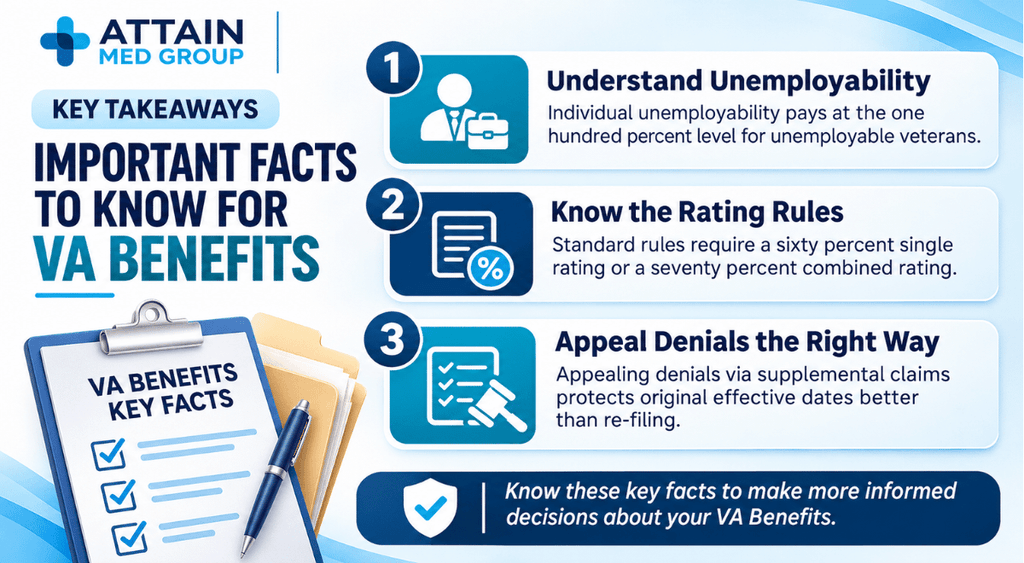
When severe service-connected disabilities prevent you from keeping gainful employment, you may qualify for total disability through individual unemployability. Proving that an established service-connected disability precludes substantial gainful activity remains the central requirement. This specialized benefit pays at the one hundred percent compensation tier even if your schedular evaluation falls below that mark. It provides vital financial relief to veterans whose health conditions destroy their professional earning capacity.
To qualify under standard rules, you generally need one service-connected condition rated at sixty percent or higher. Alternatively, a combined rating of seventy percent with at least one condition rated at forty percent will qualify. You must formally submit VA form 21-8940 to document your employment history and demonstrate your work restrictions.
The agency evaluates your vocational limitations rather than your age or local job availability when deciding these claims. Marginal work, such as protected family business employment earning below the federal poverty line, does not disqualify you. Securing this va benefit can stabilize your household finances when working becomes medically impossible.
12. Disability Claim Denials Require Strategic Appeals, Not Starting Over
When an unfavorable decision letter arrives, many claimants submit a brand new application instead of appealing the denial. This mistake forfeits your earlier effective date and erases potential retroactive va disability benefits. Under the Appeals Modernization Act, you hold three distinct paths to challenge a disputed rating decision.
You can file a supplemental claim using va form 20-0995 by introducing new and relevant evidence. Alternatively, you can request a Higher-Level Review on va form 20-0996 to have a senior adjudicator review the exact same record. The third pathway allows you to appeal directly to the Board of Veterans’ Appeals using va form 10182.
Working alongside accredited veterans service organizations provides valuable claim assistance during complex appeal proceedings. Accredited representatives review your rating sheet, spot clear administrative errors, and help you request a higher rating efficiently. Managing your appeals strategically keeps your original file active and preserves your right to full compensation.
12 Facts Veterans Should Know to Strengthen a VA Disability Claim: Strategic Preparation
Successfully navigating disability claims requires methodical legal preparation, consistent clinical evidence, and strict adherence to administrative filing deadlines. Understanding how the regional office evaluates your health condition prevents common mistakes that lead to protracted disputes. Every piece of documentation you provide should directly advance the legal elements of service connection.
Take charge of your records by securing copies of your medical files and verifying presumptive coverage options. If your condition worsens over time, pursue an evaluation increase or seek qualified assistance to present your case. Your military service entitled you to these federal va benefits, and systematic preparation guarantees you receive the exact rating you deserve.