


You served your country and earned your benefits, but you may wonder: How Strong Is Your VA Disability Claim? 7 Areas to Review Before You File provides the strategic framework needed to evaluate your case. That critical question matters immensely because approval often hinges on thorough preparation rather than basic eligibility. Taking time to assess your documentation now ensures a significantly smoother adjudication process with the regional office.
The Department of Veterans Affairs decides millions of claims each year, and small mistakes can delay your va disability rating for months. Before you file, take an honest look at the seven areas below. A few hours of review right now can save you a year of appeals later.
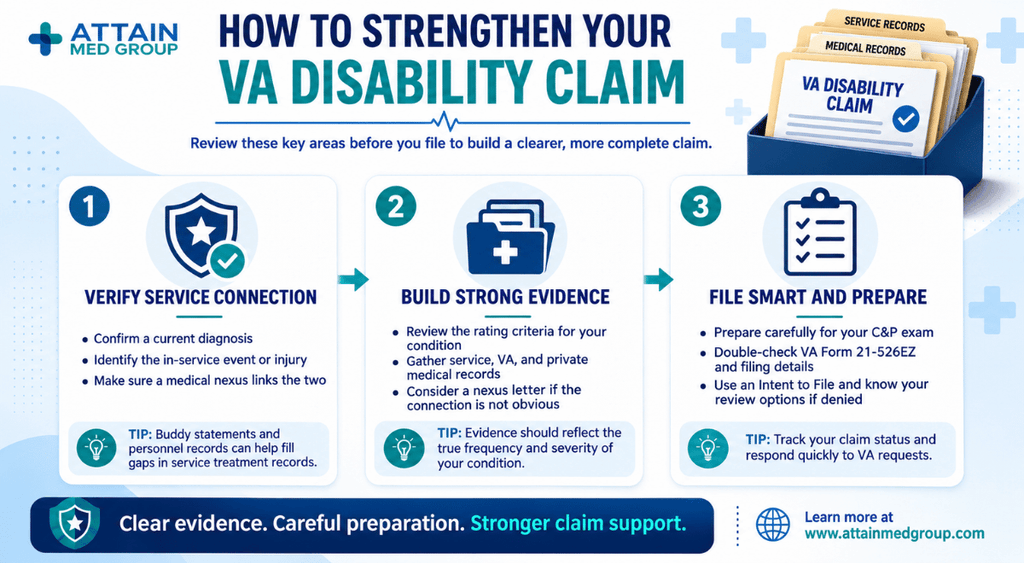
Every strong va disability claim rests on three pillars: a current diagnosis, an in-service event or injury, and a medical link connecting the two. Miss one pillar, and the Department of Veterans Affairs will deny the claim no matter how severe your symptoms feel.
The three pillars, checked one by one
Start by confirming your diagnosis appears in recent treatment records. A condition like sleep apnea, for example, requires a formal sleep study on file. A mental health condition such as PTSD needs a diagnosis from a qualified provider, not just a description of symptoms.
Next, pin down the in-service piece of the puzzle. Service treatment records, personnel files, and buddy statements can all prove the event happened. If you received health care through the military or VA shortly after discharge, those records often bridge the gap between then and now.
Ask yourself one hard question: could a stranger reading your file connect the dots without guessing? If the answer is no, your service connection needs more work before you file anything.
2. Rating Criteria: Know What Your Disability Rating Should Be
Your disability rating determines your monthly disability compensation, so you should understand the math before you file. The VA rates most conditions from 0 to 100 percent in 10-percent increments, using criteria published in the Schedule for Rating Disabilities.
So how does the VA actually combine multiple percentages? Here is where many veterans get surprised, because combined disability ratings are not simple addition. A 50 percent rating plus a 30 percent rating equals 65 percent, which rounds to 70, and our VA disability calculator can show you the math for your situation.
Read the rating criteria for your specific condition before filing. If your symptoms match the 30 percent level but your records only document the 10 percent level, the VA will pay at 10 percent. Your va disability outcome depends on what the evidence shows, not how you feel on your worst days.
Pay close attention to how the criteria describe frequency and severity of symptoms. Phrases like “occasional” versus “constant” carry real legal weight in a rating decision. Your treatment notes should reflect the true pattern of your condition, including flare-ups and bad stretches.
3. Medical Records and Evidence Gathering

Strong medical records win claims, and weak ones get denied. Your evidence gathering should cover three sources: service treatment records, VA treatment records, and private records from outside doctors.
Evidence that carries the most weight
The VA has a legal duty to help you gather evidence, but that duty has limits. Record requests take time, and files sometimes arrive incomplete or unreadable. If you submit evidence yourself alongside your application, you control exactly what the rater sees on day one.
Consider a nexus letter from a private physician if your condition is not obvious. A well-written letter explains, in medical terms, why your condition is at least as likely as not connected to service. Our guide on getting a nexus letter walks through what a persuasive one includes.
According to the VA’s evidence guidance, you can also support your disability claim with lay statements from family, friends, or fellow service members. These statements describe how your condition affects daily life, and they often fill gaps that clinical notes miss. Better evidence means better odds for the disability benefits you deserve.
Pro Tip: Request your complete VA treatment file through My HealtheVet or a records request before filing. Reading your own records helps you spot missing documents and correct errors before a rater ever sees them.
4. Preparing for VA Claim Exams
Most claims trigger a Compensation and Pension exam, commonly called a claim exam. A VA provider or contracted examiner evaluates you and reports on the severity of your condition. That report frequently becomes the most influential document in your entire file.
Treat va claim exams with the seriousness they deserve. Show up on time, answer honestly, and describe your worst typical day rather than your best one. Many veterans downplay symptoms out of habit or pride, and the examiner writes down exactly what you say.
You cannot introduce brand-new conditions at the exam, but you can bring notes. Write down your symptoms, flare-up frequency, and how the condition limits work and daily activities. Veterans who prepare for claim exams tend to receive more accurate evaluations, and accuracy is what drives a fair va disability rating.
If your exam feels rushed or the examiner ignores key symptoms, note the date and details afterward. An inadequate exam can be challenged later, and that challenge becomes valuable if you need to appeal.
️ Warning: Missing a scheduled exam can sink your claim. The VA may decide your case on existing evidence alone, which usually means a denial or a lower rating. Call the exam contractor immediately if you need to reschedule.
5. Forms, Filing Details, and Small Errors That Cause Big Delays
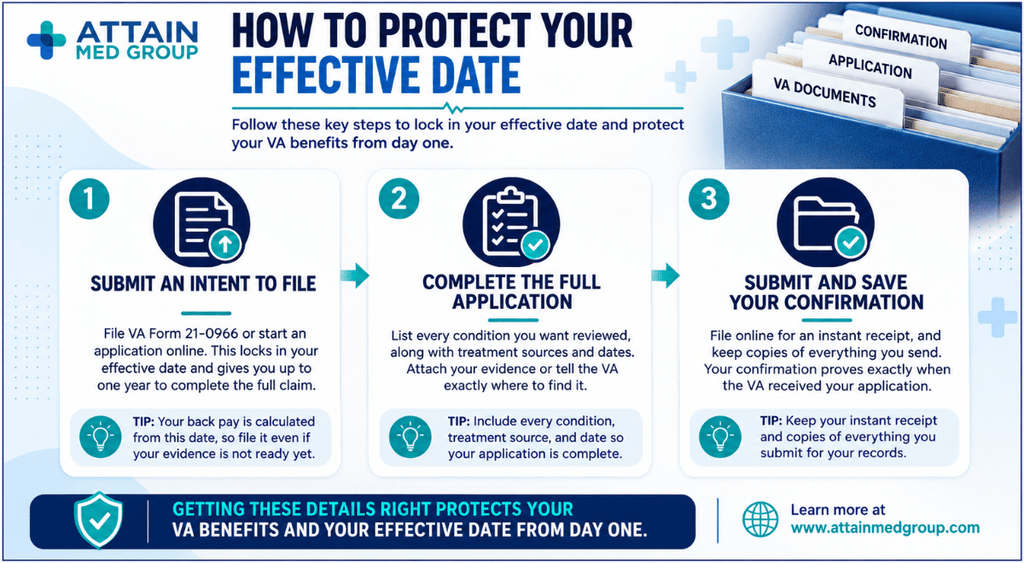
Paperwork errors cause some of the most frustrating delays in the entire system. The main application, VA Form 21-526EZ, asks for your conditions, service history, and treatment sources. Double-check every entry against your records before submitting anything.
Small details matter more than you might expect. A wrong social security number can stall processing for weeks while the VA verifies your identity. Missing dependency information can shortchange your monthly payment if your combined rating reaches 30 percent or higher.
Set up direct deposit correctly from the start, since that is how the VA pays retroactive benefits. Most veterans now file their claim online through VA.gov, which creates an instant timestamp and allows direct document uploads. Filing a va claim electronically also reduces the risk of lost paperwork.
6. Understanding the VA Claim Process Timeline
Knowing the va claim process helps you stay patient while you wait. The VA breaks the claim process into eight steps, and your claim status on VA.gov shows which step you are in at any given moment.
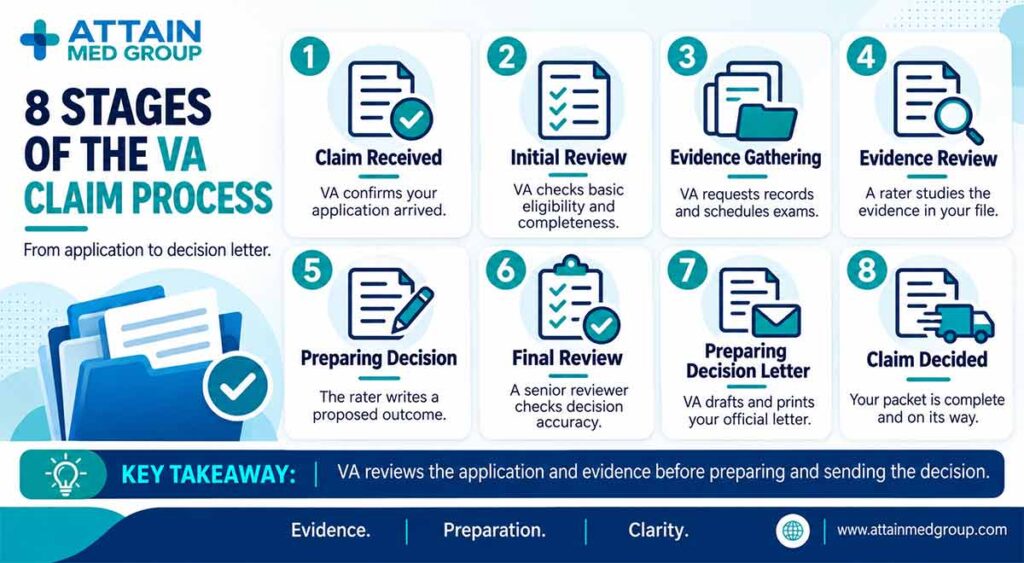
The early steps move quickly, often within the first few weeks. The middle steps take the longest, because raters must review every record and exam report carefully. A well-prepared va disability claim moves through these stages with fewer delays, since raters spend less time chasing missing documents.
Note: Statuses can move backward. A claim that jumps from evidence review back to evidence gathering usually means the VA ordered another exam or record. It feels frustrating, but it often signals the VA is building a fuller file.
Once the tracker shows your claim decided, the decision letter follows by mail and appears online within days. That letter explains the claim decision in plain terms: what the VA granted, what it denied, and why. It also states your combined rating and your monthly payment amount.
Throughout the process, the VA’s standard message says, in effect, we’ll review your file and we’ll contact you if anything is missing. Do not wait passively for updates. Check your status weekly, respond to requests fast, and read our VA claim timeline guide for realistic expectations at each step.
7. Your Backup Plan If the VA Decision Goes Against You
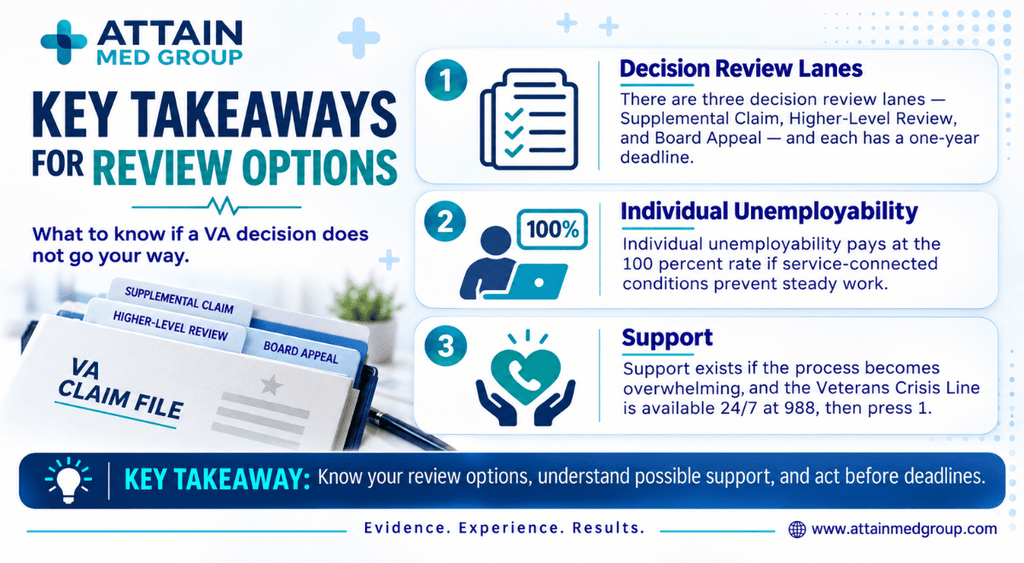
Even strong claims get denied sometimes, so plan for that possibility now. If your va decision disappoints you, the decision review system gives you three lanes: a Supplemental Claim with new evidence, a Higher-Level Review or a Board Appeal. You generally have one year from the decision date to choose a lane.
Do not overlook individual unemployability if service-connected conditions keep you from holding steady work. This va benefit pays at the 100 percent rate even when your combined rating falls short of that level. Many veterans disability advocates call it the most underused benefit in the entire system.
Certain groups face extra hurdles worth noting here. Women veterans, for instance, sometimes find their military occupational duties underdocumented, which makes service connection harder to prove. If the process wears on you, the Veterans Crisis Line is available around the clock by dialing 988 and then pressing 1.
Treat every disability claim as a long game rather than a single shot. Plenty of disability claims that fail initially succeed on appeal with better evidence and strategy. A denial is a detour, not a dead end, and the right review lane can recover months or even years of back pay.
How Strong Is Your VA Disability Claim? 7 Areas to Review Before You File: The Bottom Line: Review Now, Not Later
A strong disability claim is built, not born. The veterans who win fair ratings usually did the unglamorous work upfront: gathering records, studying criteria, preparing for exams, and checking paperwork twice.
Before you file, run through the seven areas above one more time. Confirm your service connection, match your symptoms to the rating criteria, and organize your evidence into a clean package. Then file with confidence, track your status, and respond quickly to anything the VA requests.
Your va disability benefits represent a promise the country made to you. A careful review today is how you collect on that promise tomorrow, at the full va benefit amount your service and sacrifice deserve.