


You served your country, and now you deserve a fair review of the VA benefits you earned. Yet many VA disability claims struggle because the supporting medical evidence is incomplete or unclear. The Department of Veterans Affairs reviews the evidence in your file when deciding your claim. Important details can be missed if they are not clearly documented. These medical evidence tips can help you build stronger support for your VA disability claim.
The following tips address common evidence gaps that can affect VA benefits decisions. They cover nexus letters, treatment records, lay evidence, and Compensation and Pension (C&P) exams. Each can help document a current condition, explain its connection to military service, or describe its impact. Understanding these steps can help you prepare evidence for a thorough VA review.
Strong documentation matters whether you file an initial claim, request a higher rating, or submit a supplemental claim. Relevant service records, private medical records, and supporting opinions can help VA reviewers understand your case. Organizing this information can support a clearer evaluation of your eligibility for VA disability benefits.
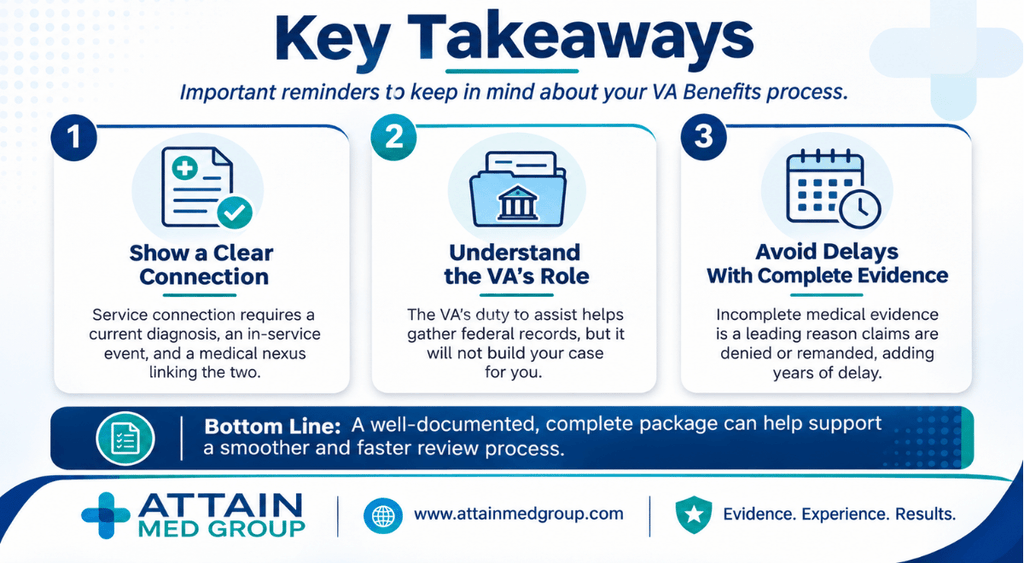
To establish service connection, veterans generally need three key elements: a current disability, an in-service event, injury, or illness, and a medical link known as a nexus. These elements help determine eligibility for VA disability benefits. A well-supported medical opinion can explain how the diagnosed condition relates to military service.
Under 38 CFR § 3.159, the VA has a duty to assist veterans in gathering relevant evidence, including federal medical and personnel records. However, veterans can also submit medical evidence, including private medical records, to help complete their documentation and support the claims process.
During the appeals process, the Board of Veterans’ Appeals may remand disability cases when additional evidence or examinations are needed. A remand returns the case for further development, potentially delaying a final VA decision. Providing organized records and supporting opinions early may help prevent avoidable evidence gaps.
The VA also applies the benefit of the doubt rule under 38 CFR § 3.102. When positive and negative evidence is approximately balanced on a material issue, the VA generally resolves reasonable doubt in the veteran’s favor. This principle plays an important role in evaluating veterans disability benefits.
For secondary medical conditions, such as depression associated with service-connected tinnitus or complications from an existing orthopedic condition, additional medical evidence may help explain causation or aggravation. A qualified provider’s opinion explaining the relationship can support a benefits claim, particularly when the onset of symptoms occurs years after discharge.
4 Medical Evidence Tips for a Stronger VA Disability Claim
Navigating the complex bureaucratic requirements of the claims adjudication process demands a methodical strategy. Below are the core evidence strategies designed to directly satisfy the evidentiary requirements set forth by VA rating officials. By focusing your efforts on these critical areas, you directly address the primary legal and clinical reasons claims encounter delays or unfavorable ratings.
Veterans often assume that submitting hundreds of disorganized pages will convince an adjudicator of their disability. In practice, raters work under severe time limits and need clear, easily referenced medical documentation to grant benefits. Learning how to properly format, obtain, and present clinical information transforms your submission into an actionable, high-probability claim.
Tip 1: Get a Persuasive Nexus Letter From a Qualified Doctor
A nexus letter is a written medical opinion connecting your current condition to your military service. The VA does not require one, but a strong letter can rescue a claim where service records are thin or the in-service event was never documented. Think of it as the bridge between your diagnosis and your time in uniform.
Choosing the right medical professional
Specialty matters more than most veterans realize. An orthopedic surgeon’s opinion on a degenerative knee condition carries far more weight than a short note from a general practitioner. For mental health claims, a psychiatrist or psychologist who has reviewed your service history will produce a more credible opinion than a counselor who met you once.
Private nexus letters typically cost between $500 and $2,500, depending on the provider and how involved your case is. Before paying, ask whether the physician has written opinions for VA claims before, and request a redacted sample. A letter that ignores your service records or offers no reasoning is money wasted.
Always verify that your doctor reviews your entire claims folder, commonly referred to as your c-file. When an independent medical provider explicitly states that they examined your service personnel file, entrance examination, and post-service treatment records, the VA cannot easily dismiss their clinical judgment. This thorough review establishes the physician as a fully informed expert witness in the eyes of the law.
Tip 2: Build a Consistent Treatment History Without Gaps
Continuity of symptomatology is one of the most heavily scrutinized areas in any VA disability claim. Under federal regulations outlined in 38 CFR § 3.303(b), chronic diseases must show persistent symptoms from discharge to the present day. When your medical record contains multi-year gaps with zero documented care, raters often conclude that your condition resolved or resulted from non-military factors.
Veterans often avoid doctor visits due to financial stress, busy schedules, or simple military stoicism. Unfortunately, silence in your clinical chart works against you. If you suffer from recurring physical pain or psychological distress, documenting that reality through regular checkups provides the continuous trail of clinical evidence that raters look for.
Maintaining a dedicated symptom journal serves as exceptional supplementary evidence alongside regular appointments. Logging the frequency of flare-ups, pain intensity, medication side effects, and missed workdays demonstrates persistent impairment. When cross-referenced with your official medical appointments, symptom logs demonstrate that your chronic condition never truly ceased.
Managing and explaining historical gaps in care
If you already have significant treatment gaps, you must proactively explain them rather than hoping the rater overlooks the missing years. Common explanations include lack of health insurance, relying on over-the-counter medications, or using home remedies to manage chronic discomfort. Submitting a detailed personal statement explaining these circumstances helps preserve your credibility.
In addition, gather records from alternative medical sources that you might have previously discounted. Urgent care visits, chiropractic treatments, physical therapy notes, and pharmacy refill histories all serve as legitimate medical evidence. These non-traditional clinical interactions can effectively bridge historical gaps in your formal medical record.
Prescription refill histories from civilian pharmacies provide an undeniable, objective paper trail during prolonged gaps in physician visits. Continuous refills for pain relievers, anti-inflammatories, or sleep medications prove continuous symptom management over extended periods. Presenting pharmacy ledgers shows adjudicators that chronic ailments required active medical intervention despite sparse clinical consultations.
Utilizing private and community medical records

Many veterans receive substantial treatment outside the Veterans Health Administration. If you receive healthcare through private health insurance or community providers, do not assume the VA will automatically retrieve those files. Under 38 CFR § 3.159, the VA makes reasonable attempts to request private records, but providers often fail to respond in time.
Take charge of your claim by requesting complete records directly from your private physicians. Submit these documents alongside a completed VA Form 21-4142 authorization form to avoid processing bottlenecks. Presenting an organized, chronological file directly to the rating team eliminates guesswork and prevents avoidable procedural denials.
When compiling private treatment documents, request the actual clinician progress notes rather than superficial billing summaries. Billing sheets merely document appointment codes, whereas narrative clinical notes record physical range of motion, subjective pain, and diagnostic test findings. Raters require granular clinical descriptions to establish an accurate percentage rating under the diagnostic code schedule.
Tip 3: Add Buddy Statements and Lay Evidence to Your File
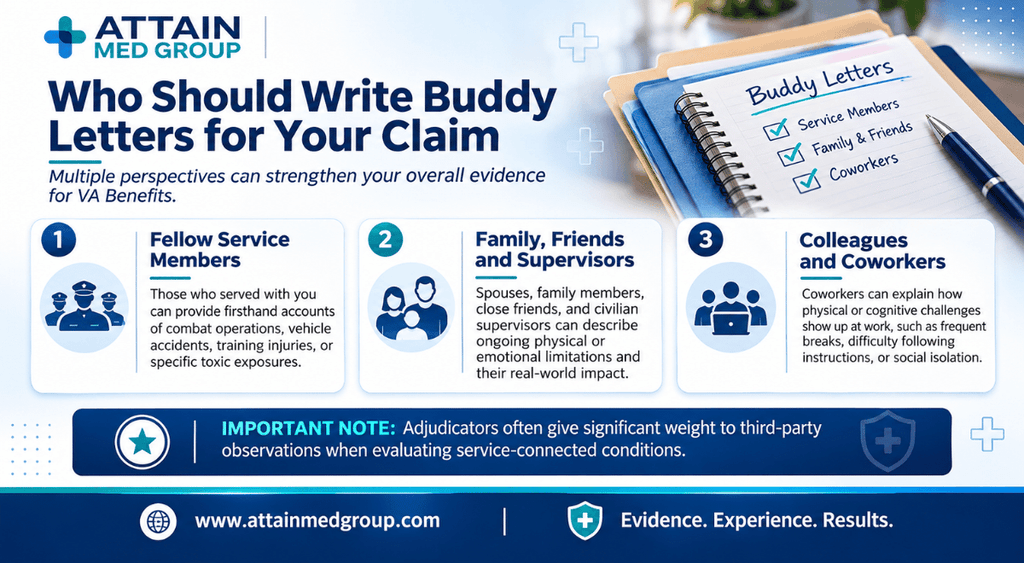
Medical records represent clinical facts, but lay evidence describes how an injury impacts your daily life. Lay statements, commonly referred to as buddy letters, provide firsthand observations from people who witnessed your in-service incident or observe your current limitations. When clinical records are sparse, credible lay testimony frequently turns the tide in a veteran’s favor.
Federal case law, notably the landmark ruling in Jandreau v. Nicholson, established that competent lay persons can attest to observable symptoms. While a layperson cannot diagnose an internal medical disease, they can describe limping, ringing in the ears, joint swelling, panic attacks, or sleep disruptions. This makes lay statements powerful corroborating tools.
Lay testimony is especially vital for combat veterans and operational personnel whose field medical records were lost or never generated. During high-tempo training or active combat deployments, soldiers rarely report to sick call for minor concussions, twisted joints, or blast exposures. Sworn buddy statements from fellow squad members establish the factual occurrence of these unrecorded incidents.
Crafting an effective statement in support of claim
When drafting your own statement or assisting a witness, utilize official forms such as VA Form 21-4138 (Statement in Support of Claim). Ensure the author includes their relationship to you, their contact details, and their direct observations. Specific dates, operational environments, and observable behavioral changes carry immense legal weight.
Avoid medical terminology and subjective speculation in buddy letters. A statement asserting that a veteran has “severe radiculopathy” carries little weight, but a statement noting that a veteran “drops coffee cups and cannot grip tools due to hand numbness” provides vital observable evidence. Factual, descriptive observations directly help the rater determine functional impairment.
Ensure the author signs the document under penalty of perjury to maximize its formal probative standing. Witness statements should specify their opportunity to observe you over time, detailing before-and-after behavioral changes following military service. A focused chronological account showing functional decline provides raters with clear qualitative context that raw medical measurements cannot convey.
Tip 4: Prepare for Your C&P Exam Like It Matters
The Compensation and Pension (C&P) examination is often the single most influential piece of evidence in your entire claims folder. Contract examiners or VA staff physicians evaluate your symptoms, measure range of motion, and offer definitive medical opinions on causation. Walking into this appointment unprepared can undermine months of careful claim development.
Treat this examination with the seriousness of a legal deposition. Review your medical history, military milestones, and symptom timeline before you arrive at the clinic. Arriving with a clear understanding of your medical file prevents contradictory statements that examiners might record as inconsistencies in your claim.
Never rely on the examiner to have thoroughly studied your extensive c-file prior to your arrival. Many contract evaluators are allocated limited time per veteran and may review your documents hastily before walking into the examination room. Bringing copies of your key diagnostic tests, nexus letters, and personal statements ensures vital evidence remains directly in front of the clinician.
Understanding the Disability Benefits Questionnaire (DBQ)
Examiners evaluate your disabling conditions using standardized forms called Disability Benefits Questionnaires. These documents follow the diagnostic criteria outlined in 38 CFR Part 4 (Schedule for Rating Disabilities). Familiarizing yourself with the relevant DBQ beforehand lets you understand precisely what functional criteria the examiner must assess.
During physical exams, ensure the clinician uses a goniometer to accurately measure your range of motion. Federal court precedents mandate that examiners evaluate your joint limitations during flare-ups and repetitive motion. Do not attempt to push through the pain; stop moving the moment discomfort begins so the recorded measurements accurately reflect your functional loss.
Reviewing the diagnostic criteria beforehand also prevents examiners from omitting required tests during your appointment. If you are claiming a mental health disorder, understanding the occupational and social impairment scale helps you speak clearly about panic attacks, suicidal ideation, or memory loss. Being educated on the DBQ keeps the evaluation focused entirely on the regulatory criteria that govern your rating.
Accurately describing your worst symptom days

Veterans are conditioned to minimize discomfort and maintain a resilient posture when speaking with clinical providers. When the examiner asks how you are doing, answering “I am fine” can inadvertently result in a lower disability rating. Instead, accurately describe how your condition presents on your absolute worst days.
Explain the frequency, severity, and duration of your flare-ups in concrete, objective terms. Describe how your symptoms interfere with your ability to maintain substantial gainful employment and perform routine activities of daily living. If your migraines cause incapacitation that leaves you bedridden in a darkened room, detail exactly how many days per month those episodes occur.
Following your examination, request a copy of the completed exam report through your regional office or your accredited representative. Review the examiner’s notes and clinical findings immediately for factual errors or incomplete measurements. Identifying mistakes early allows you to submit a formal rebuttal or request a new examination before a final rating decision is rendered.
If the examiner fails to use proper diagnostic tools or displays clear bias, draft a memorandum for the record immediately upon returning home. Detail the exact time the exam started and stopped, which tests were skipped, and any dismissive statements made by the provider. Submitting this sworn statement to your claims file creates an indisputable basis for requesting a new, competent examination.
Final Thoughts on Building a Stronger Claim
Achieving the disability compensation rating you deserve requires treatable evidence, patience, and unwavering attention to procedural detail. The Department of Veterans Affairs operates within strict legal and clinical frameworks, making objective medical documentation your most powerful asset. By securing a compelling nexus letter, establishing consistent treatment, submitting credible lay testimony, and thoroughly preparing for your examination, you establish an ironclad case.
Do not let administrative hurdles or an initial unfavorable decision discourage you from pursuing the benefits you earned through honorable military service. Claims with well-developed records succeed at significantly higher rates upon initial submission and through higher-level review. Apply these evidence-building principles systematically, and you will position your claim for the best possible outcome.
Remember that the disability claims journey is an ongoing legal process that rewards thoroughness, consistency, and clinical proof. Should you receive an unsatisfactory rating decision, your strong evidentiary record will serve as the foundation for a successful supplemental claim or appeal. Stay vigilant, preserve your treatment records, and continue advocating for the medical recognition you have rightfully earned.