


Every year, the Department of Veterans Affairs decides well over a million disability compensation claims, and a large share of them end in denial. Weak or missing clinical documentation sits near the top of the list of reasons why claims fail. Learning how to win a VA disability claim with strong medical evidence is essential, because the VA can only approve what your official records establish.
The encouraging part is that you control more of this claim process than you might think. So what does winning medical evidence actually look like in your claim file? This guide breaks down the exact documentation the VA looks for, where to find it, and how to present it in a way that holds up under rating review.
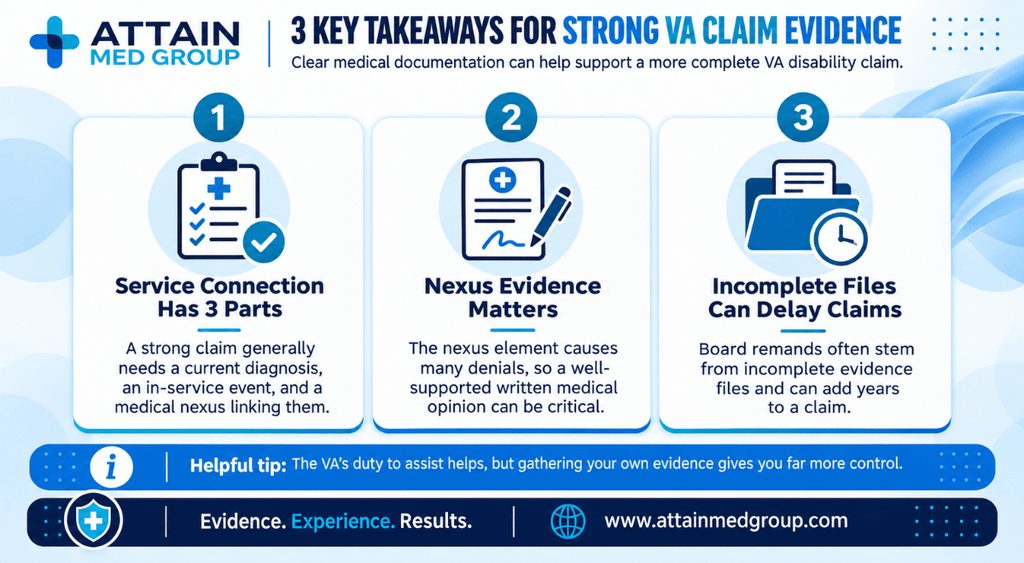
The Department of Veterans Affairs evaluates disability compensation claims based on evidence establishing eligibility for VA disability benefits, not sympathy or visible hardship alone. Under 38 CFR § 3.303, direct service connection generally requires three key elements. Understanding these requirements can help veterans build a strong initial application, avoid common mistakes in the disability claims process, and improve the quality of evidence submitted for review.
These three elements typically include a current medical condition, an in-service injury, illness, or event, and a connection between the two. Medical records, military service documentation, and qualified medical opinions can help establish this relationship. However, not every case requires a separate nexus letter, especially when sufficient evidence already establishes service connection or the veteran qualifies under rules for presumptive conditions. For example, certain Vietnam vets exposed to Agent Orange may qualify for presumptive service connection for specific conditions, while veterans seeking benefits for post-traumatic stress disorder may need evidence addressing additional requirements.
Medical evidence also plays an important role during the appeals process. The Board of Veterans’ Appeals may remand cases when additional evidence, medical examinations, or procedural corrections are necessary. Incomplete treatment records, unsupported medical conclusions, and missing documentation can complicate claims appeals and extend the time veterans wait for a decision. Organizing relevant medical evidence early can help support a more complete review, although it does not guarantee approval or faster processing.
The VA has a statutory duty to assist eligible veterans in obtaining certain records, including service treatment records and relevant federal medical documentation. However, veterans can also strengthen their applications by identifying private treatment records, submitting supporting medical opinions when appropriate, and verifying that important evidence is included in their files. Taking an active role in gathering documentation can make the disability claims process easier to navigate and help veterans pursue the disability benefits and financial support for which they may qualify.
VA Disability Claim Documentation: The Medical Evidence That Carries the Most Weight
Not all medical evidence carries the same weight when the Department of Veterans Affairs evaluates VA disability benefits. Strong medical records, service records, and well-supported medical opinions can help establish service connection and support a veteran’s eligibility for disability compensation. Understanding which documents matter most can help veterans navigate the disability claims process, prepare a strong initial application, and avoid evidence gaps that could delay access to disability benefits and financial support.
The following evidence categories explain what VA rating specialists review when evaluating service-connected conditions, including claims involving presumptive conditions, and how proper documentation can strengthen a veteran’s case.
Service Treatment Records (STRs) for Direct Service Connection
Your military service treatment records document medical visits, injuries, illnesses, and diagnoses recorded during active duty. These official records can provide important evidence of an in-service event or condition when establishing direct service connection. Veterans preparing disability claims can request available military records through the National Archives using Standard Form 180 when necessary documents are missing from their claims folder.
For veterans whose records were destroyed in the 1973 National Personnel Records Center fire, alternative evidence may help establish events during military service. The VA may consider unit morning reports, historical military documents, buddy statements, and personal accounts when evaluating missing service records. In cases involving lost or destroyed government records, the VA has a heightened obligation to assist veterans and explain its findings, although the standard for establishing service connection remains unchanged.
Some veterans, including Vietnam vets exposed to Agent Orange, may also qualify under special rules for presumptive conditions. These provisions can help establish service connection for certain recognized illnesses without requiring the same individualized medical nexus evidence typically needed for direct service connection. Understanding these distinctions can help veterans identify the records needed to support their eligibility for VA disability benefits.
Current Diagnosis and Ongoing Treatment Records for VA Disability
A compensable VA disability claim requires an active medical diagnosis confirmed by current clinical findings. Consistent treatment notes from private physicians or VA medical centers prove that your condition remains persistent and disabling. Long treatment gaps allow raters to question diagnostic continuity or conclude that symptoms have resolved.
Treating medical providers can also complete an official Disability Benefits Questionnaire (DBQ). A completed DBQ follows the identical diagnostic rubrics utilized by VA examiners, giving private medical evaluations substantial credibility during adjudication. Once you establish your diagnosis and disabling effects, a VA disability calculator can help you estimate your potential monthly benefit compensation.
Medical Nexus Letters and Independent Medical Opinions (IMOs)
A medical nexus letter serves as an expert clinical opinion linking your current medical condition to active duty. The strongest independent medical opinions use formal VA evidentiary language, concluding that your condition is “at least as likely as not” incurred during service. That phrasing satisfies the 50 percent certainty standard, invoking the benefit-of-the-doubt rule under 38 U.S.C. § 5107(b).
Evidentiary substance matters considerably more than length when raters review medical opinions. An effective nexus letter analyzes your complete service record, references peer-reviewed medical literature, and details thorough clinical rationale. A brief letter without supporting medical reasoning will fail to counter an unfavorable Compensation and Pension examination.
Pro Tip: Ask your treating physician for a nexus opinion first, since they already know your history. If they decline, an independent medical opinion from a specialist who reviews your complete file often carries even more weight with raters.
Buddy Statements and Competent Lay Evidence for VA Claims

Sworn statements from spouses, fellow service members, and employers supply vital lay evidence that medical paperwork cannot cover. In Jandreau v. Nicholson, federal precedent established that lay testimony constitutes competent evidence regarding observable physical symptoms like limping or distress. Detailed statements from fellow veterans can verify specific combat incidents or in-service injuries when official records remain incomplete.
Veterans can formally submit third-party statements on personal letters or by completing VA Form 21-4138. Statements should emphasize observable facts, dates, duty stations, and functional limitations rather than unsupported medical diagnoses. Your own personal statement should clearly outline functional impairment affecting your daily life and earning capacity.
How to Win a VA Disability Claim With Strong Medical Evidence Step by Step
Following a systematic file assembly process ensures your disability package addresses every statutory requirement raters inspect. Each developmental phase supports subsequent documentation, so execute these steps thoroughly before filing your initial claim or supplemental appeal.
Your Five-Step Evidence Checklist
- Request Your Complete Records and C-File
Submit requests for your service treatment records, personnel files, and your VA claims folder (C-file). Your C-file reveals the exact clinical evidence and prior ratings the VA possesses, eliminating unexpected surprises during adjudication.
- Lock In a Current Diagnosis With Active Treatment
Schedule comprehensive clinical visits with your private physician or VA medical provider to record functional limitations. Regular clinical encounters provide continuous medical records demonstrating ongoing impairment severity.
Tip: Keep a brief symptom journal between appointments so your descriptions stay accurate and consistent.
- Obtain a Competent Medical Nexus Letter
Retain a medical expert to review your complete military health records and draft a formal nexus letter. The physician must state clear medical rationale connecting your diagnosed disability directly to active military service.
- Gather Supporting Lay Evidence and Buddy Statements
Collect buddy letters and draft your personal statement on VA Form 21-4138. Emphasize factual observations, documenting how daily flare-ups disrupt employment tasks, family duties, and physical mobility.
Tip: Give statement writers a short prompt list so they include dates, locations, and specific events.
- Audit the Entire Medical Evidence File Before Submission
Review your documentation against the statutory elements of service connection. Resolving medical documentation gaps prior to submission accelerates the rating decision and avoids prolonged appeals.
VA Disability Claim Errors: Common VA Claim Mistakes That Lead to Denials
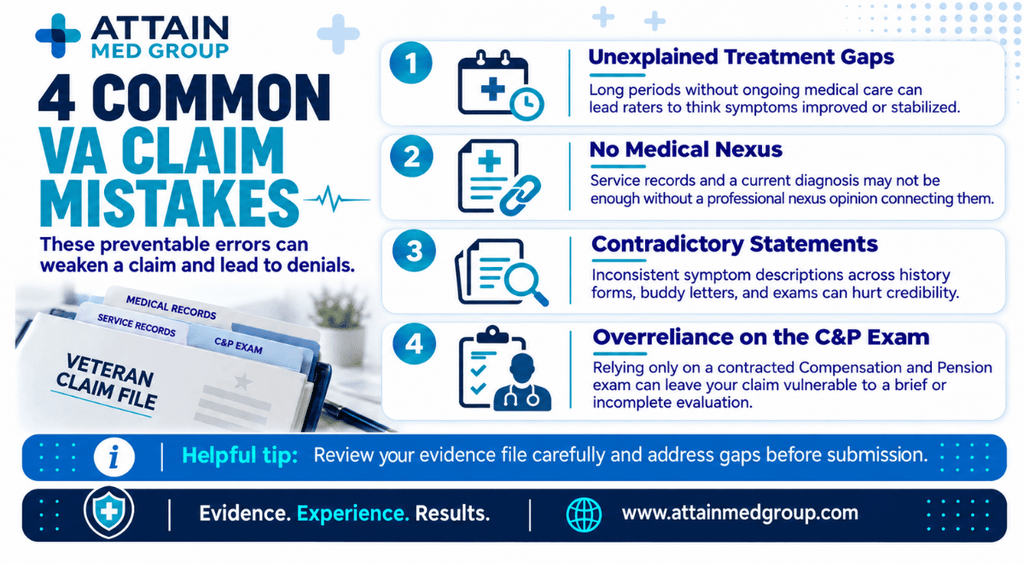
The C&P exam warrants thorough preparation because its conclusions carry immense weight in rating determinations. Examiners provide opinions that adjudicators often adopt outright, meaning an incomplete report can derail an otherwise well-documented claim. Treat this appointment with priority, and review an authoritative C&P exam preparation guide before your scheduled evaluation.
Warning: Never downplay your symptoms at the C&P exam out of pride or habit. Describe your worst days rather than your best, because the examiner’s report becomes the medical evidence of record for your claim.
Appealing Denied VA Claims: What to Do If the VA Already Denied Your Disability Claim
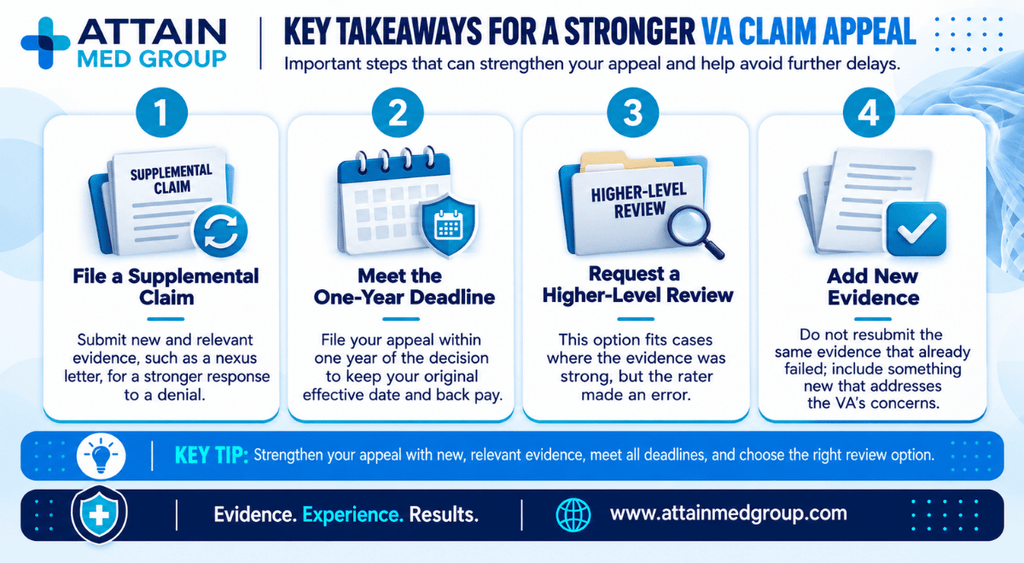
Receiving an adverse rating decision does not conclude your pursuit of compensation. The VA Appeals Modernization Act provides three separate review paths, and strong medical evidence represents the foundation of a successful challenge.
A Supplemental Claim filed on VA Form 20-0995 permits veterans to introduce new and relevant clinical records. Introducing an independent medical nexus letter or newly uncovered service records fits this appeal framework directly. Filing within one year of your rating decision preserves your original effective date, protecting earned retroactive back pay.
Higher-Level Review applies when the existing record was legally complete but adjudicators committed clear administrative or procedural errors. Alternatively, a Board Appeal directs your file to a Veterans Law Judge in Washington, D.C., with opportunities for personal hearings. For strategic guidance on choosing appropriate appeal routes, review this breakdown of VA appeal options and timelines.
Final Thoughts on Winning Your VA Disability Claim
Prevailing in a VA disability claim requires establishing legal service connection with objective medical records. A verified current diagnosis, an in-service injury, and an authoritative medical nexus form the core pillars of approval. Claimants who approach their disability filings with rigorous medical evidence consistently achieve higher success rates than those who rely solely on agency development.
Begin by requesting your complete service treatment records, then assemble the necessary clinical evidence methodically. If the appeals process proves challenging, accredited Veterans Service Organizations offer free representation, while VA-accredited attorneys handle complex appeals. Your military service earned these disability compensation benefits, and authoritative medical evidence ensures you secure them.