


Many veterans face a complex VA benefits system after returning home from active duty. You may already have a service-connected condition from your military service. Over time, that condition may cause or worsen another health issue. This new issue may qualify as a secondary service-connected condition. A secondary VA claim still requires evidence connecting the two conditions. However, some relationships may be easier to document when the medical connection is well established.
Understanding these requirements can help you prepare stronger supporting evidence. This guide explains how secondary claims work and what evidence may support the connection. Filing a secondary VA claim may provide compensation for a condition linked to an existing service-connected disability. The VA generally looks for evidence showing that the primary condition caused or aggravated the secondary condition.
Medical records can play an important role in establishing that relationship. Other supporting documentation may also help explain how the conditions are connected. For example, a service-connected knee condition may contribute to problems in another joint. A chronic physical condition may also affect other areas of a veteran’s health. Each claim depends on the individual evidence and circumstances.
Some veterans assume every secondary claim requires the same level of proof as an initial claim. In practice, the evidence needed can vary depending on the conditions involved.

Certain medical relationships may already be well recognized. Even then, veterans should provide evidence that supports the connection in their specific case. A well-developed record can help the VA understand the full impact of related conditions. The body does not function as a group of completely separate systems. An injury or health condition can sometimes affect other parts of the body.
Recognizing these connections early can help veterans organize relevant medical records and supporting evidence. A clear record can better show how service-connected conditions may affect overall health. To understand VA secondary claims, veterans first need to understand secondary conditions. A secondary condition develops because of an existing service-connected disability.
For example, a service-connected knee injury may cause an altered gait. Over time, that altered gait may contribute to a back condition. In this example, the knee is the primary service-connected disability. The back condition is the secondary condition. Federal regulation 38 CFR § 3.310 addresses secondary service connection. It allows VA to recognize certain conditions that result from a service-connected disease or injury.
This rule reflects an important reality. One health condition can sometimes affect another part of the body. A secondary claim does not require the new condition to have started during military service. Instead, the evidence must connect it to an existing service-connected disability. That distinction changes the type of evidence VA reviews. Veterans generally need evidence showing that the primary disability caused or aggravated the secondary condition.
Medical records can help document this relationship. VA may also review medical opinions and other relevant evidence. A medical connection between the conditions is often called a nexus. If VA has already established the primary condition as service connected, veterans do not need to prove that issue again. Instead, the secondary claim focuses on the relationship between the primary and secondary conditions.
Aggravation can also support secondary service connection. This occurs when a service-connected disability worsens another condition beyond its natural progression. Evidence should clearly document that worsening when aggravation is the basis of the claim. Medical records that describe changes in symptoms, severity, or functioning can help show how the condition progressed over time.
Secondary claims you don’t have to prove. evidence needed for secondary claim for a va secondary condition
Some secondary conditions have medical relationships that are well understood. That can make the evidence easier to explain and document. However, veterans still need evidence to support a secondary VA claim. The record generally needs to show an existing service-connected condition and a current secondary condition. It should also explain how the two are connected.
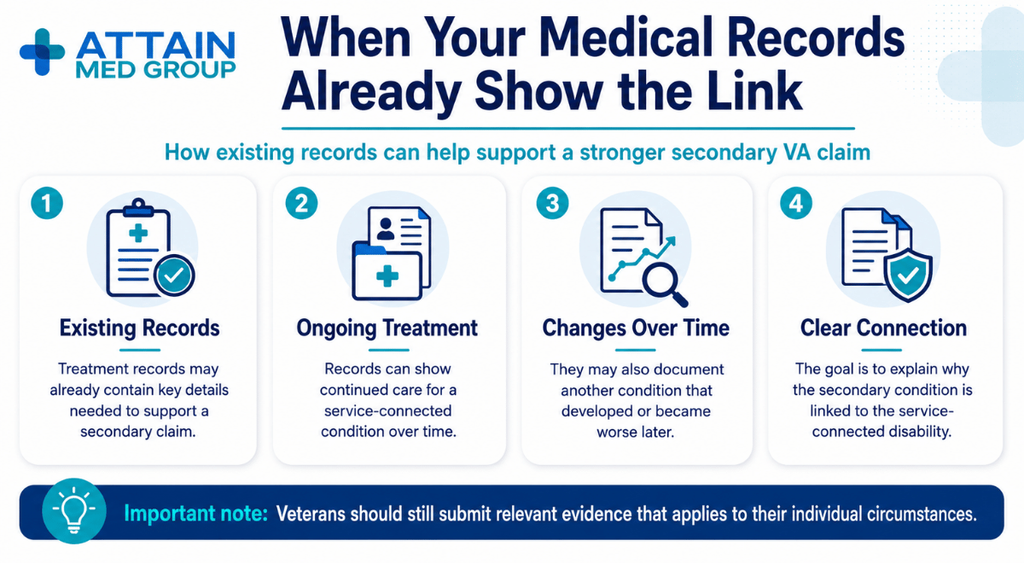
In some cases, treatment records may already contain useful evidence. A doctor may have documented that one condition caused or worsened another. Records like these can help VA understand the relationship.
Secondary Service Connection Through Aggravation
A secondary claim may also involve aggravation. This means a service-connected condition made another condition worse. The second condition does not have to begin during military service. Instead, the evidence must support that the service-connected disability increased its severity.
Medical records can help show changes over time. Treatment notes, test results, and medical opinions may help document that worsening. Under 38 CFR § 3.310, VA may grant secondary service connection when a service-connected condition causes or aggravates another disability.
Do Common Medical Relationships Guarantee Approval?
No medical relationship guarantees approval of a secondary VA claim. VA reviews the evidence in each veteran’s case. Some conditions may appear together often, but that alone does not prove service connection. A veteran may still need medical evidence explaining why one condition caused or aggravated the other.
For that reason, veterans should focus on evidence specific to their own history. Strong records can help show when symptoms began, how they changed, and how the conditions may be related. Recognizing a possible secondary condition is only the first step. The next step is building clear evidence that supports the connection.
The Medical Evidence Needed for a Secondary Claim
To win a secondary va claim, you need three specific elements of medical evidence. First, you need a current medical diagnosis of the secondary condition from a licensed professional. You cannot claim “back pain” without a formal diagnosis from a healthcare provider that identifies the specific underlying pathology. Second, you must have evidence of a primary service-connected disability that is currently rated by the VA. Third, and most importantly, you need a nexus letter that explicitly links your secondary condition to your primary disability.
The quality of your medical records is paramount to the success of your application. The VA will scrutinize your treatment records to see if you have consistently reported the symptoms of the secondary condition over time. If you claim a secondary condition of sleep apnea due to a service-connected neck injury, but your records never mention sleep issues until the day you filed the claim, the VA may be skeptical. Consistent reporting in your medical records creates a “paper trail” that supports your claim you’re making to the veterans service officers.
In addition to professional medical evidence, you can also submit lay evidence, which provides a personal perspective on your health. Lay evidence includes statements from you, your family, or your fellow service members describing how the secondary condition affects your daily life and functional abilities. While lay evidence cannot provide a medical diagnosis, it can provide a vivid picture of the functional limitations caused by the secondary condition. When combined with a strong nexus letter, lay evidence makes for a “fully developed” claim that is much harder for the VA to deny.
It is also beneficial to include any private medical records that the VA might not have access to. While the VA has a duty to assist in gathering records, providing them yourself ensures that nothing is missed during the review process. Detailed imaging results, such as MRIs or CT scans, can provide objective proof of a secondary physical ailment. The more objective data you provide, the less room there is for a VA rater to question the validity of your secondary claim.
The Critical Role of a Nexus Letter in Your VA Claim
A nexus letter is perhaps the most important piece of evidence in any secondary va claim. This letter must be written by a qualified medical professional who has reviewed your entire medical file, including your military service-connected disability records. The doctor must state that it is “at least as likely as not” (a 50% probability or greater) that your secondary condition was caused or aggravated by your primary condition. Without a nexus letter, many secondary conditions are summarily denied because the VA claims there is no proven link.
When requesting a nexus letter for a secondary condition, ensure the doctor uses the specific language the VA looks for. Phrases like “is due to” or “is the result of” are essential for meeting the legal requirements of the claim. For example, if you are filing for a mental health condition secondary to chronic pain, the nexus letter should explain the physiological and psychological mechanisms by which the pain leads to the mental health issue. A generic letter saying “the veteran has depression” is not enough; it must be a nexus letter that bridges the gap between the two conditions.
You may need multiple nexus letters if you are filing for multiple secondary conditions across different medical specialties. For instance, if you have a knee injury leading to both a hip secondary condition and a secondary condition of depression, you might need a nexus letter from an orthopedic specialist and another from a mental health professional. Each nexus letter serves as a standalone piece of medical evidence that strengthens your overall va disability claim. Do not underestimate the power of a well-crafted nexus letter in securing a higher disability rating and ensuring your voice is heard.
A strong nexus letter should also include a detailed “rationale” section where the doctor explains the medical reasoning behind their conclusion. This rationale should cite peer-reviewed medical literature or clinical studies that support the link between the primary and secondary conditions. By providing this scientific backing, the doctor makes it much more difficult for a VA C&P examiner to offer a contradictory opinion. A well-reasoned nexus letter is often the deciding factor in complex cases where the connection is not immediately obvious.
Common Examples of a Secondary Condition: Mental Health and Sleep Apnea
One of the most frequent secondary conditions seen in va disability claims is a mental health condition. Veterans suffering from chronic pain due to a service-connected disability often develop secondary depression, anxiety, or somatic symptom disorder. The constant physical toll of a knee injury or back strain can lead to significant mental health struggles that impact every aspect of life. Because the link between chronic pain and mental health is so well-documented, these are often the “secondary claims you don’t have to prove” with extreme difficulty, provided you have a diagnosis and a nexus letter.
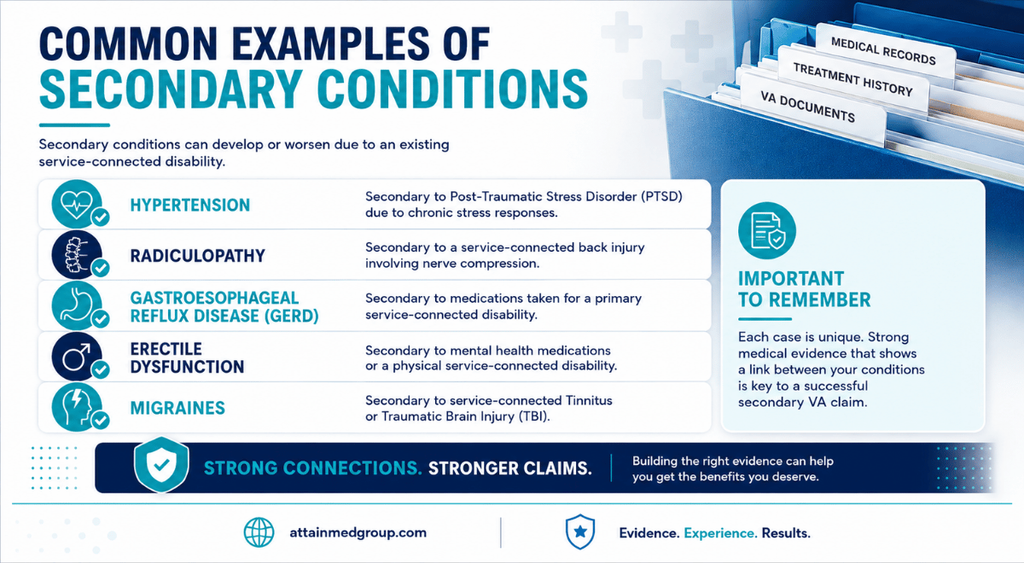
Each of these examples requires a specific nexus letter and supporting medical records to be successful. Whether it is a mental health condition or a physical ailment like sleep apnea, the key is showing the “chain of causation” from the primary disability to the secondary condition. This is the heart of a successful va claim for secondary issues, ensuring that every related health problem is properly compensated. By documenting these links, you create a more accurate representation of your total health status.
Why Secondary Conditions Matter for Your Disability Rating
The primary reason to pursue a secondary va claim is to increase your overall disability rating. The VA uses a “combined rating” system, often referred to as “VA Math,” which can be confusing for many veterans. When you add a secondary condition, it can push your total rating from 50% to 70%, or from 90% to 100%. This increase in your disability rating leads to significantly higher monthly disability benefits and access to additional healthcare and vocational resources for your family.
Furthermore, a secondary condition can sometimes be the key to reaching Total Disability based on Individual Unemployability (TDIU). If your service-connected disabilities, including your secondary conditions, prevent you from maintaining “substantially gainful employment,” you may be eligible for the 100% pay rate even if your combined rating is lower. Understanding secondary conditions is therefore not just about medical accuracy; it is about financial security and long-term stability for you and your family. Every percentage point matters when it comes to the support you receive.
By filing for every secondary condition you legitimately have, you ensure that the VA recognizes the full impact of your service on your life. A single knee injury might only be rated at 10%, but if that injury leads to a secondary condition in the other knee, a back problem, and a mental health condition, your total disability rating will be much higher. This is why gathering medical evidence and a nexus letter for every secondary va claim is so critical. It is about receiving the full measure of justice for the sacrifices you made during your military service.
Steps to Build a Strong Secondary VA Claim
Building a strong va disability claim for a secondary condition requires a methodical and patient approach. First, you should submit an Intent to File to preserve your effective date while you gather evidence. Once that is done, identify all the health problems you currently face that you believe are linked to your primary service-connected disability. Seek a formal diagnosis for each secondary condition from a healthcare provider to ensure they are clearly documented in your medical documentation and treatment records.
Next, obtain a nexus letter for each secondary condition from a doctor who understands the VA’s evidentiary standards. As discussed, this nexus letter must clearly state the link between the primary and secondary issues using the correct legal terminology. After you have your medical evidence ready, you will need to fill out the appropriate va form, typically VA Form 21-526EZ. When completing the va form, be sure to explicitly state that you are filing for the condition as “secondary to” your existing service-connected disability.
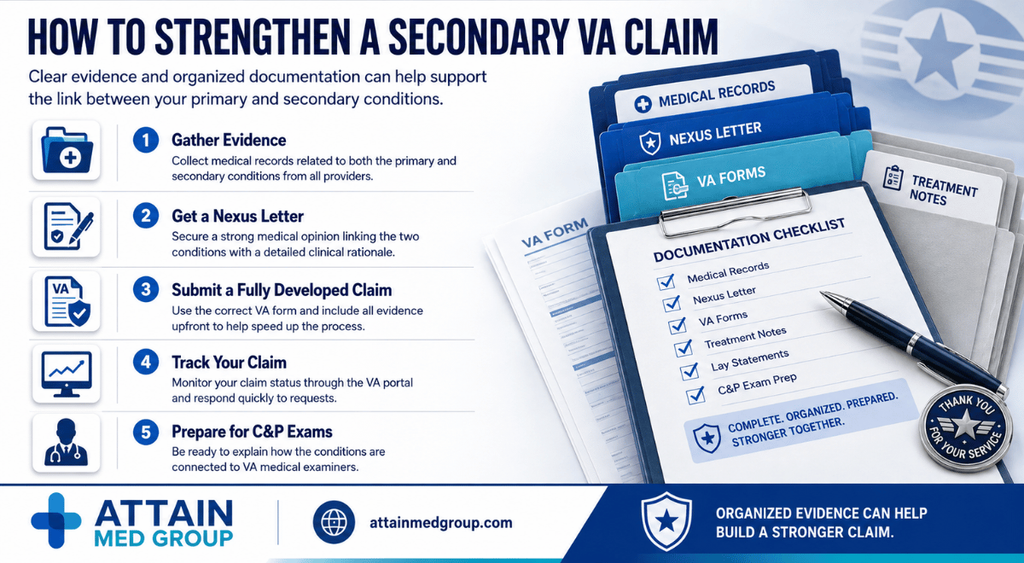
The goal is to submit a “fully developed” claim, which reduces the time the VA spends searching for information. This means you provide all the medical evidence, nexus letters, and lay statements at the time of filing. A fully developed claim for a secondary condition is often processed faster and has a higher likelihood of approval on the first try, avoiding the need for a lengthy supplemental claim or appeal. Taking the time to be thorough at the beginning saves months of frustration later.
Common Mistakes in Disability Claims for Secondary Issues
One of the most common mistakes veterans make in a va disability claim is failing to provide a nexus letter. Many assume that because the link seems obvious to them, it will be obvious to the VA’s rating specialists. However, the VA is not required to make medical inferences; they require a medical professional to do so explicitly. Another mistake is not being specific about which primary condition is causing the secondary issue, leading to confusion during the review process.
Another frequent error is neglecting the impact of the secondary condition on daily life and work performance. While medical evidence is king, the VA also considers how the condition limits your ability to work and perform daily tasks. Failing to include lay evidence or detailed descriptions of your symptoms can result in a lower disability rating than you deserve. Always ensure your medical records reflect the frequency, duration, and severity of your secondary condition symptoms to provide a complete picture.
Finally, many veterans fall into the trap of “pyramiding,” which is prohibited under 38 CFR § 4.14. Pyramiding occurs when a veteran tries to get multiple ratings for the same symptom under different diagnostic codes. For example, you cannot get two separate ratings for the same limitation of motion in a single joint. Understanding these rules helps you focus your claim on distinct symptoms and conditions, ensuring that your application is legally sound and more likely to be approved without complications.
What to Do When the VA Denies Your Secondary Condition
If the VA denies your secondary condition, do not lose hope, as many successful claims are won on appeal. The first step is to carefully read the “Reasons for Decision” in your denial letter to understand where the evidence was lacking. Often, the VA denies a secondary va claim because the nexus letter was insufficient or because they didn’t believe the medical evidence was strong enough. This is where a supplemental claim or a Higher-Level Review comes into play.
A supplemental claim allows you to submit “new and relevant” evidence to the VA to address the reasons for denial. If your original nexus letter was weak, you can obtain a new, more detailed nexus letter from a different specialist. If the VA claimed there was no diagnosis, you can provide updated medical records showing a clear and current diagnosis. The supplemental claim process is a powerful way to address the specific reasons for denial and eventually win your va disability claim through persistence.
In some cases, you may want to seek help from a veterans service organization or a qualified attorney who specializes in VA law. They can help you identify the gaps in your medical evidence and ensure your next filing is as strong as possible. Remember, the journey to a fair disability rating for a secondary condition is often a marathon, not a sprint. With the right medical evidence, a solid nexus letter, and a clear understanding of secondary conditions, you can successfully navigate the system and secure the benefits you earned through your service.