


What is a Non-Service-Connected Disability? Many veterans leave active duty with physical or mental health conditions directly linked to their military service. However, life continues after discharge, and new medical issues often arise years later. A non-service-connected disability is a specific health condition that did not originate from your time in uniform and does not have a direct service connection to your duties. While these conditions are not tied to your time in the military, they can still significantly impact your quality of life and financial stability as you age. Understanding the nuances of these disability benefits is essential for every veteran planning for their long-term care and financial security.
The Department of Veterans Affairs recognizes that aging veterans still need significant support for these later-in-life challenges. While a standard service-connected disability provides specific compensation based on a VA rating, other conditions follow a different path. Veterans might qualify for a specialized VA pension if they meet strict financial criteria and have served during a recognized period of wartime. This va pension serves as a safety net for those who are permanently and totally disabled from non-service-connected disabilities. This program ensures that those who served during our nation’s most trying times are not left behind due to health issues that developed after their service ended.
Understanding how the federal system treats these conditions helps you access appropriate health care and financial support. You must know the distinctions before filing a VA claim to secure the correct VA benefits for your situation. This guide explains the rules, the application process, and the specific programs available for veterans facing health challenges. By gathering the right medical evidence, you can ensure your non-service-connected disability is properly documented for the VA. Navigating the bureaucracy can be difficult, but having a clear roadmap makes the journey toward securing your rightful benefits much more manageable.
To grasp the concept fully, you must first understand the baseline of a service-connected disability. This status requires clear medical evidence showing your condition started or worsened during your military service. In contrast, a non-service connected disability develops after discharge without any direct link to your time in uniform. These non-service-connected disabilities are often the result of natural aging, post-service accidents, or illnesses that manifest long after your active duty ended. The VA distinguishes between these two categories to determine which pot of funding your benefits will come from.
For example, a soldier who injures their knee during a combat deployment has a valid service connection. If that same veteran develops arthritis in their hands twenty years after leaving the military, it is likely a non-service-connected disability. While the VA does not pay monthly compensation for these conditions like they do for a service-connected disability, they do offer a disability pension for those who qualify. This distinction is vital when you are preparing your va disability claim and organizing your records. It is important to remember that a single veteran can have both service-connected and non-service-connected conditions simultaneously.

The VA looks for three things to establish a service-connected va rating: an in-service event, a current diagnosis, and a medical nexus. Without these, your condition will be classified as a non-service-connected disability. However, having non-service-connected disabilities does not mean you are without options for support. Many veterans rely on the non-service-connected va pension to cover basic living expenses when they can no longer work due to their health. This program acts as a supplemental income for those whose net worth and income fall below specific thresholds set by law.
Eligibility for Non-Service-Connected VA Pension and Pension Benefits
The non-service-connected va pension is a needs-based VA benefit designed to help veterans with limited income. To qualify for this connected pension, you must have served at least 90 days of active duty, with at least one day during a period of war. Additionally, your net worth and annual income must fall below limits set by Congress. This disability pension is specifically for those who are age 65 or older, or those who are permanently and totally disabled. Permanent and total disability means the VA has determined your condition is unlikely to improve and prevents you from working.
When the VA evaluates your application for pension benefits, they look closely at your household’s total net worth. This includes your income and the value of your assets, though some exclusions like your primary home and car may apply. If your income exceeds the limit, you might still qualify if you have high unreimbursed medical expenses. These expenses can be deducted from your gross income to reach what the VA calls “countable income.” This non-service-connected pension can be a lifeline for veterans who did not sustain injuries during their military service but now face significant health hurdles.
It is important to note that you cannot receive both a service-connected disability payment and a non-service connected disability pension at the same time. The VA will typically pay you whichever amount is higher, ensuring you receive the maximum VA benefits available. For many, the non-service connected pension provides the necessary financial stability to manage chronic illnesses that are not related to their time in the military. Understanding the non-service connected disability pension requirements is the first step toward securing this aid. You should also explore Aid and Attendance benefits if you require help with daily activities.
Wartime Service Requirements for Non-Service-Connected Pensions
One of the most important factors in determining eligibility for a non-service-connected pension is when a veteran entered active duty and the total length of that service. Unlike VA disability benefits paid through service-connected compensation, the Veterans Pension is a needs-based benefit for qualifying wartime veterans. For these types of VA claims, eligible veterans must generally have qualifying active-duty service, at least one day during a recognized wartime period, an acceptable discharge, and income and net worth within VA limits.
Veterans who started active duty before September 8, 1980, generally must have served at least 90 days, including at least one day during wartime. Enlisted veterans who started after September 7, 1980, generally must have served at least 24 months or completed the full period for which they were called or ordered to active duty, with certain exceptions. In some cases, completing the entire tour or obligated period may satisfy the requirement even when it lasted less than 24 months. Different requirements may apply to officers who began active duty after October 16, 1981.
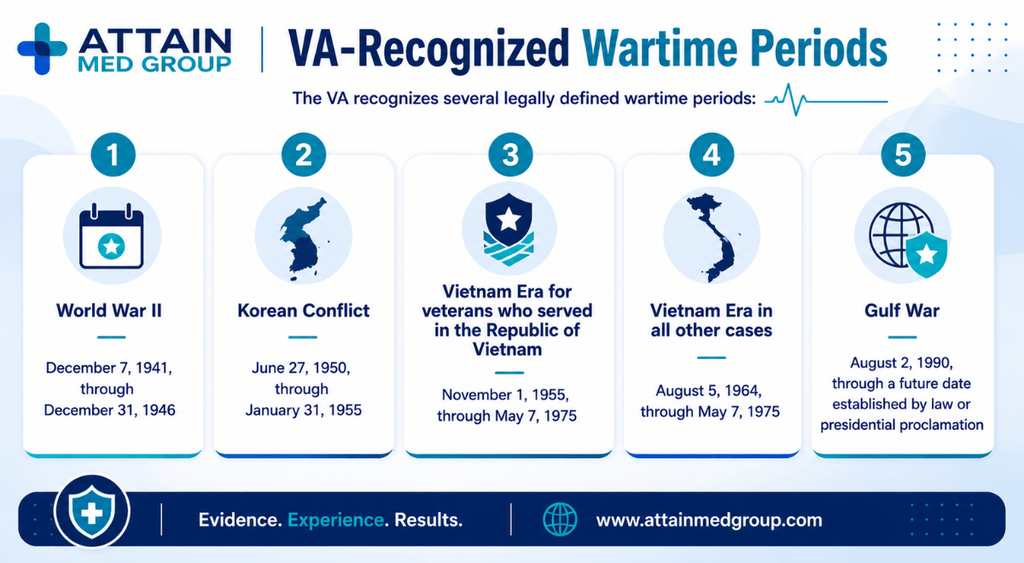
The location where veterans served matters when determining which Vietnam Era dates apply. However, veterans do not need to have served in combat or entered a combat zone to meet the wartime-service requirement.
Eligibility note: Veterans whose service occurred entirely during peacetime generally do not qualify for the Veterans Pension, even when they have serious non-service-connected health conditions or financial hardship. The pension is specifically available to qualifying veterans with wartime service who also meet the applicable age, disability, income, and net-worth requirements.
When veterans apply, they should submit their DD214 or other separation documents showing their service dates, length of service, and character of discharge. Veterans may apply using VA Form 21P-527EZ and must report income, assets, dependents, and certain medical expenses so the VA can determine financial eligibility. This information helps applicants prove financial need under the pension program’s income and net-worth rules.
In some situations, the VA may request an additional verification report, income-and-asset statement, or Eligibility Verification Report to confirm or update financial information. Applicants should complete only the forms requested for their specific circumstances and promptly report significant changes in income or net worth.
Reviewing these requirements before filing can reduce delays and help ensure that the application contains the service and financial evidence the VA needs to make a decision.
How to File Your VA Disability Claim and VA Claim
Filing a VA claim for a non-service-connected disability requires a different approach than a standard claim for service connection. You must provide comprehensive medical evidence that proves you are permanently and totally disabled. This evidence should include doctor’s reports, hospital records, and any other documentation of your health status. When submitting your va disability claim, accuracy is paramount to avoid delays in the processing of your application. You will likely use VA Form 21P-527EZ, which is the application for a veterans pension.
As noted by VA expert Brian Reese, the quality of your medical evidence often determines the success of your VA claim. You should ensure that your healthcare providers clearly state the severity of your non-service-connected disabilities and how they prevent you from maintaining gainful employment. The VA will review this information alongside your financial records to determine your eligibility for the non-service-connected va pension. Be prepared to provide detailed information about your income and assets during this stage, including bank statements and investment records.
Once your application is submitted, the VA will begin a formal review process to verify your military service and medical status. You may be asked to attend a Compensation and Pension (C&P) exam, even for a non-service-connected disability, to confirm the extent of your limitations. After the review is complete, you will receive a VA decision letter outlining the agency’s findings. This va decision letter will explain whether your claim was approved and the amount of pension benefits you are entitled to receive. If you are found eligible, payments are usually retroactive to the date you filed your claim or submitted an intent to file.
Essential Health Care, Medical Appointments, and Travel Allowance
Even if you do not qualify for a monthly pension, having a non-service-connected disability can still impact your health care enrollment. The VA uses a priority group system to manage care enrollment, and your disability status plays a major role in your placement. Veterans with non-service-connected disabilities may still access high-quality health care through the VA, though they might be required to pay small copayments for certain services. This ensures that all veterans have a path to medical support regardless of their service-connection status. Most non-service-connected veterans fall into Priority Group 5 if they meet income requirements.
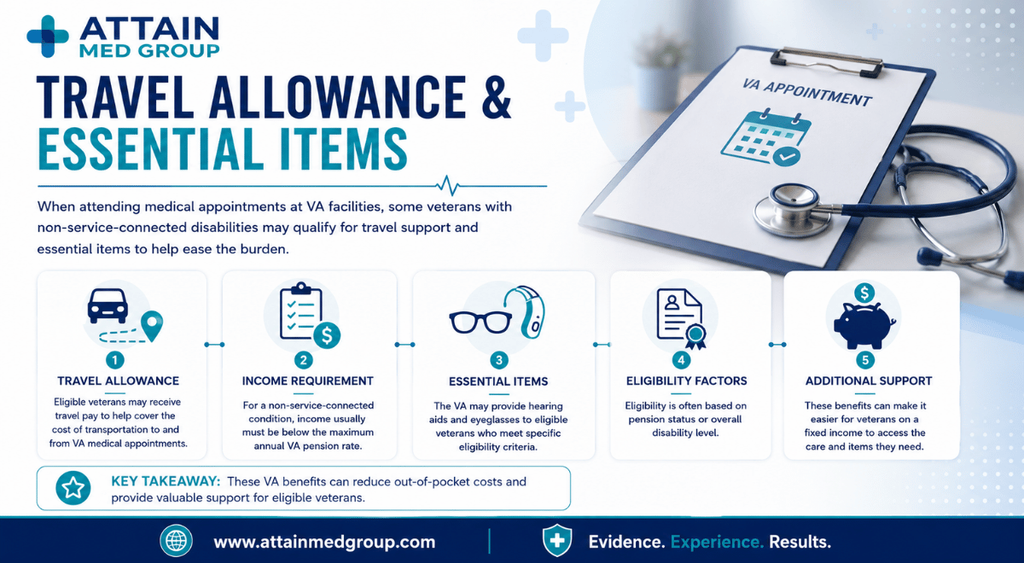
Maintaining regular medical appointments is crucial for documenting the progression of your non-service-connected disability. This ongoing medical evidence is vital if you ever need to increase your pension benefits or apply for additional aid, such as Housebound or Aid and Attendance benefits. The VA health care system is a comprehensive resource that supports veterans through every stage of their post-service life. By staying proactive with your care enrollment, you can ensure you have access to the specialists and treatments you need to manage your long-term health effectively.
Veteran Preference and Federal Hiring Advantages
Beyond financial and medical support, veterans with disabilities often receive a veteran preference when applying for government jobs. In the realm of federal hiring, this preference can give you a significant edge over other candidates. Specifically, a 10-point veteran preference is often awarded to veterans who have a disability, regardless of whether it is service-connected or non-service-connected in some specific programs. This point veteran preference recognizes the sacrifices made by those who served and helps them transition into meaningful civilian careers. It is a powerful tool for those looking to continue their service in a civilian capacity.
Being a 10-point veteran can move your application to the top of the list for many federal positions. This advantage is a key component of the government’s commitment to hiring those who have worn the uniform. While the rules for veteran preference can be complex, they generally aim to provide a fair shot at employment for those with non-service-connected disabilities. Understanding how to leverage this preference is essential for any veteran looking to enter the federal workforce. You should ensure your resume clearly states your eligibility for these points when applying through USAJOBS.
Federal hiring managers are often looking for the unique skills and discipline that veterans bring to the table. By highlighting your veteran status and any applicable disability ratings, you can maximize your chances of success. Whether your condition is a service-connected disability or a non-service-connected one, your status as a veteran remains a powerful asset in the job market. Take the time to research the specific requirements for the 10-point veteran preference to ensure you are getting the full benefit of your service. This preference can be the deciding factor in landing a stable, well-paying federal career.
Reviewing Your VA Decision Letter and Appeal Option

After the VA processes your claim, you will receive a formal VA decision letter in the mail. This document is the official record of the VA decision regarding your eligibility for benefits. It is critical to read this letter carefully, as it contains the reasoning behind the VA’s choice. If your claim for a non-service-connected va pension is denied, the letter will explain which requirements were not met, such as income limits or medical evidence gaps. Understanding these reasons is the first step in deciding whether to accept the decision or fight it.
If you disagree with the outcome, you have the right to pursue an appeal option. The VA offers several ways to challenge a decision, including a Higher-Level Review, a Supplemental Claim, or an appeal to the Board of Veterans’ Appeals. Using an appeal option allows you to submit new medical evidence or argue that the VA made an error in its initial assessment. Many veterans find success in the appeals process by providing more detailed documentation of their non-service-connected disabilities. The Appeals Modernization Act has made this process more streamlined, offering different “lanes” for your appeal.
The timeline for an appeal can vary, so it is important to act quickly once you receive your decision letter. Seeking assistance from a Veterans Service Officer (VSO) or a qualified attorney can help you navigate the complexities of the system. They can help you understand the nuances of your va decision and develop a strategy for your appeal. Remember, a denial is not necessarily the end of the road; it is often just a request for more information to support your va disability claim. Persistence is often the key to successfully navigating the VA’s complex adjudication process.
Additional Perks: Plot Allowance and Burial Benefits
The support for veterans with non-service-connected disabilities extends even to end-of-life planning. The VA provides a plot allowance to help cover the costs of burial in a private or state veterans’ cemetery. This VA benefit is available to veterans who were receiving a VA pension or disability compensation at the time of their passing. It is a final gesture of respect for your military service and provides financial relief to your loved ones during a difficult time. These benefits ensure that every veteran can be laid to rest with the dignity they deserve.
In addition to the plot allowance, the VA may provide a headstone, marker, or medallion for the grave of any eligible veteran. These benefits ensure that every veteran is honored appropriately, regardless of whether their death was related to a service-connected disability. Families should be aware of these options and keep copies of the veteran’s discharge papers (DD214) to facilitate the application process. Planning ahead can ensure that these non-service-connected va benefits are utilized fully, reducing the burden on grieving family members. The VA also offers a Presidential Memorial Certificate to the next of kin.
Understanding the full scope of what is available for non-service-connected disabilities allows you to live with greater peace of mind. From health care and monthly pensions to employment preferences and burial honors, the system is designed to support you. While the process of filing a va claim can be daunting, the rewards are well worth the effort. Stay informed, keep thorough records, and don’t hesitate to seek help when navigating the world of VA benefits. Your service to the country has earned you these protections, and you should take full advantage of the resources available to you.