


Veterans often face frustrating hurdles when pursuing the VA disability benefits they earned through service. The Department of Veterans Affairs requires strong medical evidence, clear medical records, and a well-supported connection between a veteran’s condition and military service before approving many compensation claims. This is why understanding what to expect during a VA disability Independent Medical Examination and how much it costs can help veterans prepare for the claims process with more confidence.
An Independent Medical Examination, often called an independent medical exam, gives veterans the opportunity to have their condition evaluated by a qualified private medical professional outside the VA system. During this medical exam, the provider may review your service records, treatment history, current diagnosis, symptoms, and functional limitations. The goal is to create a detailed medical opinion that explains the severity of your condition and how it may relate to service connection.

For many veterans, an independent medical examination can be especially helpful after a denied or underrated VA disability claim. A private doctor may identify missing evidence, explain overlooked symptoms, or prepare an exam letter or claim exam letter that helps clarify your condition. This type of report can strengthen a VA claim, especially when the original claim exam did not fully capture the impact of your disability.
An independent medical provider may also prepare an independent medical opinion or nexus-style report. This can help bridge the gap between your military service, current diagnosis, and ongoing physical or mental health limitations. Strong medical opinions may be useful in both initial disability claims and appeals when the VA needs more evidence to understand your case.
Taking control of your medical evidence gives veterans an advantage during a complex VA claim exam or appeal. A thorough private evaluation can help support your VA disability claim, explain your symptoms in detail, and show why you may qualify for a higher disability benefit or additional VA benefits. This guide explains what happens during independent medical exams, what documents to bring, how much these evaluations may cost, and how a strong report can support your path toward fair compensation.
Many veterans confuse an Independent Medical Examination with a standard VA claim exam or Compensation and Pension exam. The government usually schedules a standard claim exam through a VA contractor or third-party examiner. This exam may take place at a VA medical center, a contracted clinic, or another approved location during the official scheduling process.

An Independent Medical Examination, sometimes called an IME, is different because the veteran hires a private, unaffiliated IME doctor to review their full medical history. This private provider conducts an objective evaluation of the veteran’s physical health condition, mental health, or other service-related disability. Unlike a VA-scheduled exam, an independent evaluation gives veterans more control over the type of specialist reviewing their case.
This can be especially important for complex claims involving toxic exposure, Agent Orange, Gulf War Syndrome, traumatic brain injury, military sexual trauma, reproductive health issues, chronic conditions, or other difficult-to-prove disabilities. A specialist who understands the veteran’s condition can provide a more detailed VA medical opinion than a rushed or incomplete exam.
A strong independent report may explain the severity of the veteran’s symptoms, whether the condition is connected to service, and how it affects daily life or employment. For example, an IME may support a claim involving individual unemployability, a higher disability rate, or a denied condition that needs stronger medical evidence. The report may also help clarify whether the veteran’s condition is related to service, secondary to another disability, or aggravated by military experiences.

The resulting medical report often serves as the missing link for veterans fighting an initial denial. Judges at the Board of Veterans’ Appeals may consider outside medical opinions when reviewing conflicting evidence. Veterans can submit this documentation as new and relevant evidence during the formal appeals process or when reopening a previously denied claim.
Before attending any exam, veterans should make sure the VA has their up-to-date address, phone number, and email address so they do not miss important appointment notices. Missing a scheduled VA exam can delay the claim or lead to denial. Keeping communication clear with the VA, the person you are working with, and any local VA office or local VA medical center can help the process move more smoothly.
Key Takeaways
- An IME is a private evaluation conducted by a doctor unaffiliated with the government.
- Veterans have complete freedom to choose their own board-certified medical specialist.
- The final report serves as critical new evidence for appealing a denied disability claim.
VA Disability Claim Evidence: Why You Should Consider a Private Evaluation for Your VA Claim

Veterans pursue private medical exams for several important reasons related to their pending VA disability claim. One of the most common reasons is receiving an unfavorable result from a standard VA claim exam or Compensation and Pension exam. If a VA contractor dismisses your symptoms, overlooks key records, or fails to explain your condition accurately, a private doctor can provide a stronger medical opinion to challenge the findings.
An independent provider often spends more time reviewing your medical records, service treatment records, and long-term treatment history than a standard examiner. This deeper review allows the doctor to evaluate your full health condition, identify missing evidence, and explain how your symptoms affect daily life. For many veterans, this careful review helps establish the service connection needed for a successful disability claim.
A strong private evaluation can also provide a clear medical nexus. A medical nexus links your current diagnosed physical health condition or mental health condition directly to your military service, a service-connected condition, or a specific exposure or event. This can be especially helpful for complex claims involving toxic exposure, Agent Orange, Gulf War Syndrome, traumatic brain injury, military sexual trauma, chronic conditions, or reproductive health concerns.
Veterans may also use an Independent Medical Examination to pursue an increased disability rating. If your service-connected condition worsens over time, you may qualify for a higher level of monthly compensation. A private physician can document your current symptoms, physical limitations, functional loss, and work-related restrictions using the proper medical language and, when appropriate, VA disability forms.
Private evaluations may also help veterans seeking individual unemployability. If your service-connected condition prevents you from maintaining steady employment, a detailed medical report can explain why your symptoms interfere with work. This evidence may help show the VA how your condition affects reliability, stamina, concentration, mobility, or the ability to perform job duties.
A private evaluation does not replace every VA requirement, but it can strengthen your evidence package. When used correctly, an independent medical report can help clarify your diagnosis, support your nexus, challenge a weak claim exam, and improve the overall strength of your VA claim.
What to expect during a VA disability Independent Medical Examination and how much it cost.

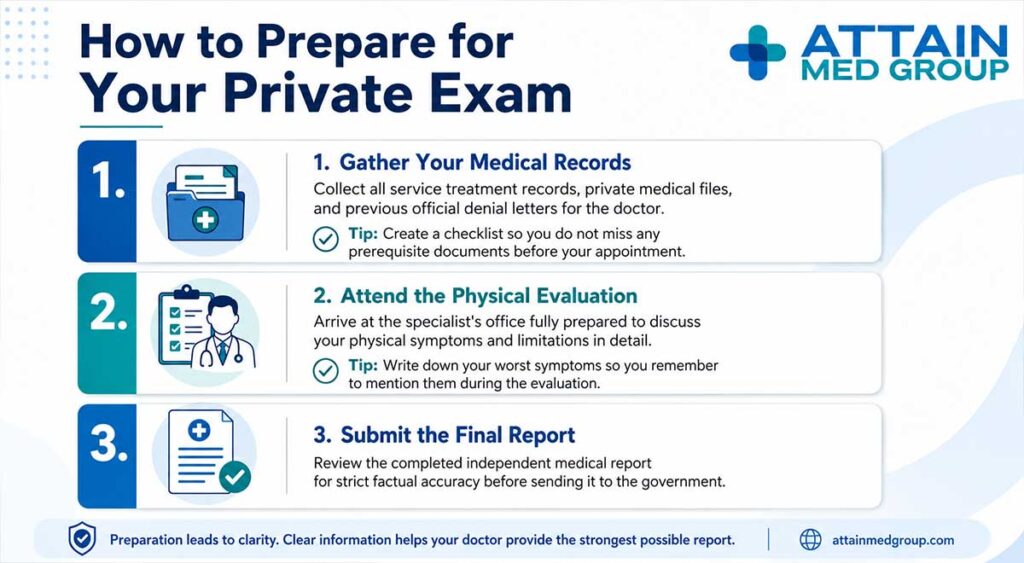
Preparing for a VA disability Independent Medical Examination requires gathering strong documentation, detailed medical records, and historical evidence related to your condition. Before the appointment, your chosen physician should review your service treatment records, private treatment notes, VA records, prior claim exam results, imaging reports, medication history, and any evidence related to service connection.
A private medical exam often feels similar to a specialist visit, but the focus is more detailed and claim-specific. The doctor is not only looking at your diagnosis. They are also evaluating your symptoms, functional limitations, daily struggles, and how your condition affects work, movement, sleep, mobility, or mental health.
During the appointment, the physician may ask specific questions about your daily symptoms and physical limitations. Depending on your condition, they may measure active range of motion, test reflexes, review pain levels, evaluate strength, observe mobility, or assess how your disability affects ordinary activities. For mental health or complex claims, the provider may also ask about concentration, mood, memory, anxiety, trauma history, or how your condition affects relationships and employment.
Veterans should answer every question honestly. Do not exaggerate symptoms, but do not minimize them either. Explain what your condition is like on a normal day and during flare-ups. If pain, fatigue, weakness, anxiety, or other symptoms limit your ability to work or complete daily tasks, those details should be clearly discussed during the independent medical exam.

After the evaluation, the doctor prepares a detailed medical report or independent medical opinion. This report may include your diagnosis, medical history, current symptoms, physical findings, functional limitations, and the doctor’s professional opinion about whether your condition is connected to military service. In many VA claims, the most important language is whether the condition is “at least as likely as not” caused or aggravated by service.
A strong report can help support a VA disability claim, challenge a weak VA claim exam, or strengthen an appeal. The final opinion should explain the medical reasoning clearly, cite relevant records, and connect your current disability to your service, exposure history, injury, or another service-connected condition. This is why choosing a qualified provider who understands VA disability standards can make a major difference in the strength of your claim.
The Financial Cost of an Independent Medical Examination for Veterans
Veterans must pay entirely out of pocket for an Independent Medical Examination and the resulting documentation. The government does not reimburse former service members for the costs associated with hiring private medical experts. The total price varies significantly based on the complexity of your case and the doctor’s specific specialty.
What exactly are you paying for when you hire a private physician for your disability claim? A standard independent medical exam typically costs between $1,000 and $2,500 for most common physical conditions. This fee generally covers the in-person evaluation, the extensive medical records review, and the final written report.
Highly specialized fields like neurology or complex psychiatric evaluations often push the final cost above $3,000. Some medical professionals charge a flat fee, while others bill by the hour for extensive document review. A veteran with thousands of pages of medical records will naturally pay more for the doctor’s valuable time.
️ Warning: Never sign a contract that promises a private doctor a percentage of your future back pay. Ethical medical professionals charge a flat fee or standard hourly rate, regardless of your claim’s final outcome.

Finding the Right Medical Professional
Selecting an appropriate medical provider heavily dictates the ultimate success of your independent medical evaluation. The government prefers opinions from board-certified specialists rather than standard family medicine general practitioners. An opinion from an orthopedic surgeon carries far more legal weight than one from a standard clinic doctor.
Your chosen physician must possess a deep, practical understanding of the federal disability rating system. A brilliant doctor who writes a poorly formatted report will not help your pending disability claim. The provider must know how to properly complete a Disability Benefit Questionnaire.
How do you know if a doctor is qualified to write a legally sound nexus letter? Veterans can search for qualified experts through national medical directories like the American Board of Medical Specialties. You should interview potential doctors about their previous, documented experience with military disability claims.

Legal Weight and Government Evidence Rules
The federal government must evaluate all submitted medical evidence according to highly specific federal regulations. Under 38 CFR 3.328, adjudicators must consider independent medical opinions alongside their own government examinations. If the private and government exams carry equal evidentiary weight, the “benefit of the doubt” rule applies.
This legal doctrine means that ties in medical evidence must be resolved in favor of the veteran. However, claims adjudicators often attempt to assign less probative value to private medical reports. They might argue the independent doctor did not review your complete military service records before writing the report.
To prevent this negative outcome, your doctor must explicitly state they reviewed your entire claims file. The written report should directly address and medically refute the negative findings from your previous government exams. A thoroughly researched rebuttal makes it exceedingly difficult for the government to dismiss the private doctor’s conclusions.

The Difference Between a Nexus Letter and an IME
Many people use the terms nexus letter and Independent Medical Examination interchangeably, but they represent different concepts. An independent medical exam is the actual physical or psychological evaluation conducted by the private physician. A nexus letter is the written document produced after the doctor completes their thorough medical review.
You can obtain a nexus letter without an in-person examination if the doctor only reviews your records. However, a records-only review carries less weight than a full physical examination combined with a medical records review. Adjudicators prefer to see that a doctor physically examined you before offering a definitive medical opinion.
Investing in the full examination provides a much stronger foundation for your pending disability appeal. The doctor can personally document your current range of motion, pain levels, and physical limitations during the visit. This firsthand clinical observation validates the arguments made within the final written nexus letter.
Pro Tip: Always provide your private doctor with your complete C-File before the actual examination takes place. The doctor must state they reviewed this specific file for the resulting nexus letter to hold legal weight.
Common Mistakes to Avoid During Your Exam
Veterans sometimes unintentionally sabotage their own independent medical exams through poor preparation or miscommunication. One major error involves hiding the true severity of your physical symptoms due to stubborn pride or general embarrassment. The private doctor cannot accurately document physical limitations they do not observe, so you must communicate your daily struggles honestly.
Another frequent mistake is failing to provide the doctor with complete military service treatment records. If your chosen physician bases their medical opinion on incomplete information, the government adjudicators will easily discredit their final report. You must gather every relevant medical document before the doctor begins writing your nexus letter.
Finally, veterans often assume the doctor will automatically know how to format the required legal documents. You must proactively confirm that your chosen physician understands the specific language required for disability claims. A simple medical diagnosis is entirely insufficient without the proper supporting rationale and legally binding terminology.
Final Thoughts on Independent Medical Exams
Investing in a private medical evaluation represents a significant financial and emotional commitment for most veterans. For many former service members, this strategic decision ultimately reverses years of frustrating claim denials. A well-crafted medical opinion bridges the legal gap between your military service and your current physical suffering.
Do you feel the government has unfairly evaluated your service-connected disabilities during previous examinations? Taking active control of your medical evidence empowers you to demand the financial compensation you rightfully earned. While the upfront costs seem high, a lifetime of proper disability benefits easily justifies the initial expense.
Always work with reputable, board-certified medical specialists who completely understand the federal benefit system. Gather your complete medical history, communicate your physical symptoms clearly, and review the final report carefully. Proper preparation transforms an independent medical exam into a highly effective winning strategy for your claim.
Key Takeaways
- Expect to pay between $1,000 and $3,000 for a comprehensive independent medical examination.
- Always hire a board-certified specialist who understands how to write a legally binding nexus letter.
- Provide your doctor with your complete military medical file to validate their final written opinion.