

If you are reading this, there is a good chance the VA told you no on a claim you felt sure about. Maybe you have fresh doctor reports in hand now, or you finally got a diagnosis that connects everything together. That is where a clear Step‑by‑step guide to reopening a denied VA claim with new medical evidence. really matters.
Having your claim denied can feel like getting punched in the gut. But a denial is not the end of the story. With the right strategy and the right proof, you can go back, reopen the claim, and fight for the benefits you earned.
The claims process can seem long and difficult. However, many veterans face these same hurdles every day. This Step‑by‑step guide to reopening a denied VA claim with new medical evidence. will walk you through what to do next in plain language.

Why VA Denials Happen And Why They Are Not Always Final
Before you fix a problem, you have to see what went wrong. The VA usually explains why it denied your claim in the rating decision letter. It might be lack of a current diagnosis, no proof of a service link, or not enough medical proof of how bad your condition is.
Sometimes the regional office simply did not have enough information to approve the request. Veterans disability laws require specific elements to be present in the file. If one piece is missing, the whole claim stops.
So if your claim was turned down, you are not alone at all. Many veterans face this exact situation after their military service ends. The system is built to process mass amounts of data, and sometimes the human element gets lost.
The good news is that a denial usually does not close the door for good. Under VA rules, if you bring in what they call “new and relevant” evidence, you can reopen or add a review to that earlier claim instead of starting over from scratch. This helps you keep your original decision date relevant for potential back pay.

What “New And Relevant” Evidence Really Means
The VA has a very specific idea of what counts as helpful new proof. The legal rule at 38 CFR 3.2501 explains that evidence determines whether a case can be looked at again. Relevant evidence is information that tends to prove or disprove something that matters in the claim.
New means the VA did not have it the first time it made a decision. It must be information that was not in the folder when the rater looked at it. Relevant means it speaks to the reason the VA denied you.
It also includes proof that raises a new theory the VA never looked at before. This distinction is critical when filing claim appeals. If you submit the same records again, the VA will likely refuse to reopen the case.
Here are a few examples of what that might look like:
- A new PTSD diagnosis linked to service, when the first decision said you did not have a diagnosis.
- A doctor letter saying your back condition is “at least as likely as not” related to airborne jumps.
- Recent treatment records that show your condition got worse and now meets a higher rating level.
- Updated medical records that clarify a timeline of symptoms during service.
The quality of the medical opinion matters. Compare a weak line like “Veteran likely experienced PTSD symptoms” with a stronger one. A better example fits the criteria found in this clinical style note that states the evaluation “meets DSM 5 criteria based on service related trauma” documented in service treatment records.
The second kind of language fits much better with how VA raters think. It addresses the va requirements directly. When the evidence addresses the specific gap in the file, your chances of success improve.
Step‑by‑step guide to reopening a denied VA claim with new medical evidence.
Let’s break the whole process down into clear steps you can actually follow. You do not need a law degree. You just need to understand the choices the VA gives you and match those with the right evidence.
Step 1: Read Your Old Rating Decision Line By Line
Pull out your VA decision letter on the denied VA claim. If you do not have a paper copy, you can usually get it through your VA.gov account or by calling the VA. This document is the map for your next move.
Read the section labeled “Reasons for Decision.” Look for language like “Service connection is denied because” or “An evaluation higher than X percent is denied because.” The words after that tell you what kind of material evidence you now need.
You must understand exactly why the va denied the first attempt. For example:
- If it says there is “no current diagnosed disability,” you need new medical evidence of a diagnosis.
- If it says there is “no nexus,” you need a doctor to connect your condition to your service.
- If it says your symptoms “do not meet the criteria” for a higher rating, you need records that clearly show worse symptoms.
Step 2: Decide Whether You Are Reopening Or Filing A Review
Under the current appeals system, you usually are not literally “reopening” the old claim the way the old rules did it. Instead, you are filing a “Supplemental Claim” with new and relevant evidence for that same issue. This is distinct from a Higher-Level Review, which does not allow new evidence.
This is still often called reopening a denied claim in day to day speech. But the actual form and lane you choose matter. That is what we cover next.
Choosing the wrong lane can delay your VA disability claim by months. Make sure you have new evidence ready before choosing the Supplemental Claim lane. If you have no new evidence, this is not the right path.
Step 3: Use VA Form 20 0995 For A Supplemental Claim
To file a Supplemental Claim, the VA tells you to use VA Form 20-0995. This form is how you officially ask the VA to look again at a previously decided issue, using your new and relevant proof. It is the cover sheet for your new evidence.
Here is how to approach that form:
- Print it or fill it out on your computer so your answers are clear.
- Check the right benefit type at the top, such as “Compensation.”
- List the specific issues you want the VA to review again.
- Explain that you are submitting new and relevant VA medical evidence and list what it is.
Attach copies of every new document. Do not just say “VA can get these records.” Whenever you can, you should send them in yourself so they are right in front of the rater. This helps you reopen claim files faster.
Step 4: Send The Form And Evidence To The Right Place
Once your packet is ready, you have two main ways to send it in. You can mail your completed VA Form 20 0995 and your new evidence to the central intake center at PO Box 4444, Janesville, WI 53547 4444. Mailing provides a paper trail if you use certified mail.
Or, you can bring it in person to your closest VA Regional Office, which you can find through the VA location finder here: closest Regional Office. Many veterans prefer to walk it in, get a date stamp, and keep a copy of everything for their own records.
Either way, make sure every page shows your name and claim number. If pages get separated inside VA systems, that information helps the staff keep everything together. This attention to detail guides veterans toward better outcomes.
Step 5: Collect The Right Kind Of New Medical Evidence
Now let’s talk about the type of medical proof that tends to move the needle. Think about your condition from the VA’s point of view. They care about three big questions for service connection and then how severe it is for rating.
To reopen claims successfully, you need proof that covers these pieces:
- You have a current disability or diagnosis.
- An event, injury, or illness happened in service.
- A medical link exists between that service event and your current condition.
- Clear signs that describe how your symptoms affect your daily life and work.
Useful medical evidence might include recent VA or private treatment notes, specialist opinions, mental health evaluations, or test results. For conditions like sleep apnea, a new sleep study is often the “new and relevant” evidence needed. If you suffer from a stress disorder, updated therapy notes can be vital.
You can also use buddy statements to support the medical evidence. While these are lay statements, they provide context to the medical reports. They help paint a picture of how the disability affects you daily.
As medicine improves, there may be fresh tools to measure or treat your condition. Articles like WebMD’s overview of new medical breakthroughs for COPD patients show how treatment and proof for certain illnesses keep changing. New science often gives stronger support to older claims.
Step 6: Get Strong Medical Nexus Statements
For many denied claims, the missing piece is a nexus, that link between what happened in service and what you are living with today. The VA likes clear medical language. Doctors who treat veterans a lot understand that.
Nexus letters are documents written by medical professionals that explicitly link your condition to service. Without this link, a service-connected disability is hard to prove. A helpful doctor letter will do three main things:
- State your current diagnosis using accepted medical terms.
- Describe the key facts of your service history, like deployments or specific injuries.
- Give a clear opinion that it is “at least as likely as not” that your disability is related to service.
They should give reasons for their view and, if possible, mention specific records. The stronger and more detailed their reasoning, the harder it is for the VA to say it is not relevant. This is where a private medical opinion can outweigh a negative VA exam from the past.
Step 7: Make Sure Your Evidence Is Truly New And Relevant
Before you hit send, ask yourself a few straight questions about every piece of evidence. You want to make sure the evidence relevant to the specific denial is present. This step requires careful review.
- Was this document already in the VA file before they denied me?
- Does it speak to the reasons for denial, like diagnosis, service link, or severity?
- Does it bring up a theory or angle that the VA did not address before?
If you are reopening disability, dependency indemnity compensation, or even burial benefits, resources like this guide from Nolo lay out when claims can be reopened with new and relevant evidence: reopening earlier VA disability claims.
Also, keep in mind that your evidence does not need to prove your case beyond doubt. It just needs to make your claim reasonably stronger in a way the VA cannot ignore under the standard at 38 CFR 3.2501. The goal is to get the claim reopened so it can be fully reviewed.

How Effective Dates Work When You Reopen A Claim
Many veterans care, with good reason, about the back pay date if the claim is finally granted. Effective date rules live in the regulations at 38 CFR 3.400. Inside VA, rating staff use tools like the VBMS Rating Effective Date Builder to apply those rules in a standard way.
There is a specific time limit involved in keeping your original date. If you file a Supplemental Claim within one year of the vaâs decision, you can potentially keep the original effective date. This is why acting quickly is important.
Guidance for staff goes even deeper in internal manuals. For example, there are sections for disability compensation effective dates in M21 1, Part V, Subpart ii, Chapter 4, and more detailed instructions for informal claims and other older rules in M21 1, Part II, Subpart iii.
If there was clear error in the old decision, different effective date rules can kick in. For example, corrections based on what VA calls clear and unmistakable error follow 38 CFR 3.400(k). That path is harder, but it shows how deep these date rules can go.
The table below breaks down how the type of claim you file impacts your effective date:
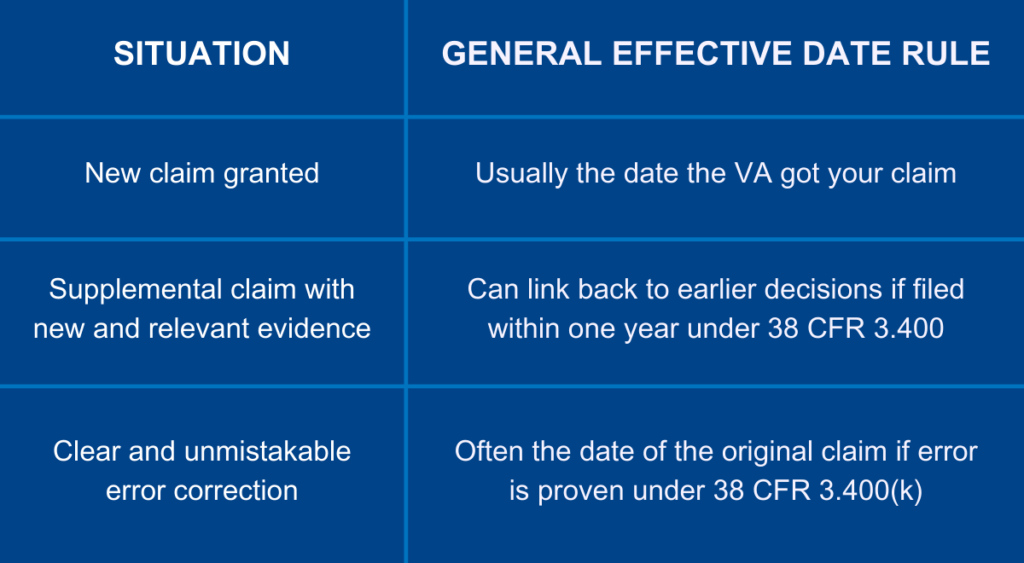
Because effective dates can mean years of back pay, this is one part where it helps to slow down and match your filing lane and timing to your long term goals. Reopening va claims correctly ensures you don’t leave money on the table.
What Happens If Your Case Goes To The Board
Sometimes, even after a Supplemental Claim, you may decide to go up to the Board of Veterans Appeals. The Board can review evidence, remand issues back for more work, or agree with the original rating decision. This is a major part of veteransâ claims strategy.
Veterans appeals at the Board level take longer but offer a review by a Veterans Law Judge. Referrals by the Board, where it sends matters back to the Regional Office, follow the rules described in 38 CFR 19.9(b). This often happens when the VA medical exam was inadequate.
When the Board affirms a rating decision that denies an issue, the rule at 38 CFR 20.1104 explains how that earlier VA determination gets folded into the Board’s final decision. If you get a denial here, you still have options, but they become more legal in nature.
If you believe the Board made a serious legal or factual error, there are also limited tools like a motion to vacate under 38 CFR 20.1000 or a motion to revise a Board decision based on clear and unmistakable error under 38 CFR 20.1404.
Those are advanced paths, though, and many veterans first gain traction simply by strengthening the medical side and using the Supplemental Claim lane the right way. Proper reopening denied claims at the lower level is usually faster.
Independent Medical Opinions And Special Examinations
Some cases rest on tricky medical questions. Think about rare conditions, overlapping diagnoses, or disagreements between VA and private doctors. For that type of file, the VA may ask for independent medical opinions in certain situations.
Doctors can assist veterans by providing these detailed opinions. A strong independent opinion can be the difference between a denied service connection and an approval. Guidance to VA staff on examinations in special situations and on when to request such opinions can be found in resources like M21 1, Part IV, Subpart i, Chapter 2, Section E, as well as regulations like 38 CFR 3.328.
You do not need to cite those numbers in your forms, but it helps to know there are built in tools to deal with harder medical cases. Asking your representative or doctor whether an independent opinion makes sense can sometimes give your claim that missing edge. It forces the VA to weigh conflicting evidence.
Often, a prior va exam might have been rushed. An independent expert can spend more time with you. This additional evidence can clarify symptoms that the VA doctor missed.
What Counts As “Medical Evidence” Today
Medical proof is not stuck in the past. Technology and treatment options grow all the time, which means you may have more ways now to document your condition than when you first filed. Updated medical science is a powerful ally.
New imaging tests, better breathing studies, sleep monitors, and mental health tools can all help show what you deal with day to day. Organizations and groups like warrior allegiance often emphasize the importance of using modern medical evidence to support your service connection.
Just as public health articles walked through reopening plans across the country in guides like The Insider’s Guide To Reopening America and A State By State Guide To Reopening America, you are building your own guide to reopening your denied VA claim. You do that by gathering every piece of new medical information that shows the current state of your health.
Over time, “new medical” tools and breakthroughs change how strong a veteran’s case can look. The better the health care community gets at documenting conditions, the easier it becomes for you to bring in clear proof for your VA file. Strong evidence is the key to winning.

Handling Other Types Of VA Denials
Your denial might not be only about basic disability compensation. You could be dealing with reduced ratings, cuts in benefits, or related health denials. It is important to know that the process for reopening va disability applies broadly, but specific rules may vary.
For example, reductions in compensation fall under rules at 38 CFR 3.105(e), and internal guides like M21 1, Part X, Subpart ii, Chapter 4 help raters carry those out. If the VA tries to reduce your rating, you can submit medical evidence showing your condition has not improved.
If a Veterans Health Administration benefit is denied, like certain medical cost coverages, some of those denials can be appealed under rules such as 38 CFR 17.506, which covers appeals to the Office of General Counsel within 60 days. The va denies these benefits for different administrative reasons.
The thread through all these paths is simple. Solid, clear, new evidence, especially from the medical side, makes it easier to challenge or reopen a bad decision. Whether it is service medical records or private opinions, the proof matters most.
Staying On Top Of Communication And Feedback
Inside VA, staff have internal tools to deal with questions about ratings and quality, including things like the VBA feedback process hosted through SharePoint resources for their teams, such as the VBA Feedback Loop for their internal reviews. This system allows them to correct errors internally.
You may never see that side, but it is worth knowing that the people handling your file have systems to question and double check tricky cases. Clear, well organized evidence from you makes it easier for quality reviewers inside VA to spot where something went wrong. You want to help them help you.
That is one reason it is helpful to keep your submissions simple to read. Group medical records, use cover letters, and match each document to a reason the VA gave in your earlier denial. This requires careful organization on your part.

Conclusion
Having a VA claim denied hurts, especially when you feel like your health and your story were not heard. But the law gives you real tools to push back through the Supplemental Claim lane, new medical records, and stronger opinions from doctors who know what they are doing. A solid Step‑by‑step guide to reopening a denied VA claim with new medical evidence. gives you the road map, but your persistence and proof fill in the details.
You have the right to gather evidence that is new and relevant, send it with VA Form 20-0995, and ask VA to look again. With better medical support, clearer nexus letters, and an eye on effective dates under 38 CFR 3.400, reopening that denied claim can lead to the outcome you should have had in the first place.
Use this Step‑by‑step guide to reopening a denied VA claim with new medical evidence. as a checklist, not a one time read. Each time you touch your file, come back to the basics. Why was I denied, what new medical evidence do I have now, and how do I present it so the VA has to pay attention. By following this process including all the right steps, you can secure the benefits you deserve.