


You are in pain and something is clearly wrong. But the VA has not put a name to it yet, and you are stuck wondering how to move forward. If you are asking yourself how to build a VA claim when the VA hasn’t diagnosed you yet, you are not alone.
Many veterans wait months or even years for clear answers regarding their health. During that time, symptoms keep piling up, bills grow, and the stress can feel crushing. So learning how to build a VA claim when the VA hasn’t diagnosed you yet becomes the difference between staying stuck and finally making progress.

Why lack of a diagnosis stalls so many VA claims
Here is the tough part. The VA pays disability benefits for diagnosed conditions, not just symptoms. That can sound unfair when you know your body better than anyone and you live with this stuff every single day. VA law talks about three core pieces for most claims. You need a current disability, an in-service event, and a link between the two. That first piece, the current disability, usually shows up as a medical evidence diagnosis from a qualified provider.
Without it, many veterans get early denials that feel like a slap in the face. It is not always because the VA thinks you are making it up. Often the file just does not have the medical language their rules require. However, a lack of a label does not mean a lack of a problem. You can still succeed if you approach the process correctly. It requires gathering the right documents before you file.
What the VA actually needs to see in your file
The VA does not expect you to show up as your own doctor. You do not need to know all the Latin terms or have a medical degree. But you do need the right mix of documents in the right place. That mix usually includes your service records, your medical records, personal statements, and any supporting documents like buddy letters. If you already follow VA news or VA press releases, you know that they often update processes and forms.
These updates can affect how claims move through the regional office. It is your job to pull the story of your condition together. The rater reading your file must follow it clearly from service to today. The goal is to make it easy for the rater to see the connection. If they have to guess, they often deny the claim. Clarity is your best friend in this process.

Step 1: Get seen and get your symptoms documented
Before you think about how to write the perfect statement or what box to check, you need one thing. Medical evidence. Even if you do not have a diagnosis, you can still build a solid trail of care. You can start with your nearest VA clinic or a private provider if that is easier. Either way, go in ready to talk about symptoms in detail. Explain the frequency, duration, and impact on work and daily life.
Make sure your complaints end up in writing in your chart. The VA later uses those records when they review your claim for VA disability benefits. No documentation means the problem might as well not exist in their system. If you have access to health care through the VA, use it. Regular visits create a timeline of your suffering. This timeline is harder to ignore than a one-time complaint.
What to say at the appointment if you have no diagnosis
Doctors hear general statements all day long. To help them, skip phrases like “I hurt all over” and go specific. Tell them exactly what hurts, when it started, and what makes it worse or better. Describe how the pain, anxiety, breathing problems, or sleep issues limit you. Tell them what you cannot do now that you could do before service. These details push a provider to look deeper instead of giving you a quick brush off.
This also makes your notes far stronger as evidence, even before any official label shows up. Specific notes help the veterans affairs raters understand the severity. General notes often lead to low ratings or denials.
Step 2: Learn which VA forms start your claim
The VA likes structure. Forms are how they keep that structure and track your file. So the form you file to start is not always the application for benefits. You usually start by submitting a Veterans Application for Compensation and or Pension. This is VA Form 21-526EZ. This form opens your claim for disability compensation and creates your filing date.
That date can mean a lot of back pay later. Do not wait years just because you do not yet have a firm diagnosis. Getting the date locked in is vital. Sometimes you might not be ready to file the full claim yet. In that case, you can submit an “Intent to File” first. This holds your place in line for one year while you gather evidence.
Using statements to fill in the gaps
Maybe your treatment notes are thin or your doctor has not made the link to service. That is where a statement from you comes in. The VA even has a standard way to send it in. You can write your story on VA Form 21-4138, Statement in Support of Claim. This is where you walk through the details of how and when symptoms began. You connect them back to events while you served.
You can also ask a spouse, friend, or battle buddy to write their own statements describing what they see in your day-to-day life. These letters from family members or friends are powerful. They serve as eyewitness testimony to your disability.
Tips for filing online and technical requirements
When you are ready to file, you have options. You can mail documents or you’ll submit your claim online. The digital route is generally faster and allows for better tracking. The va.gov portal is a federal government site. This means it is secure for sharing sensitive information. However, you must be careful to use the correct portal.
For touch device users, the site is responsive. You can use swipe gestures on your phone or tablet to move through sections. If you are one of the many device users who prefer mobile, the experience is smooth. Always review autocomplete information carefully. Browsers often fill in the wrong address or date. Double-check every field before you hit submit.
If you encounter trouble signing in, verify your credentials with ID.me or Login.gov. The VA often posts notices saying “we’re working to resolve technical issues” during maintenance. Simply wait a few hours and try again.
Where to mail paper claims
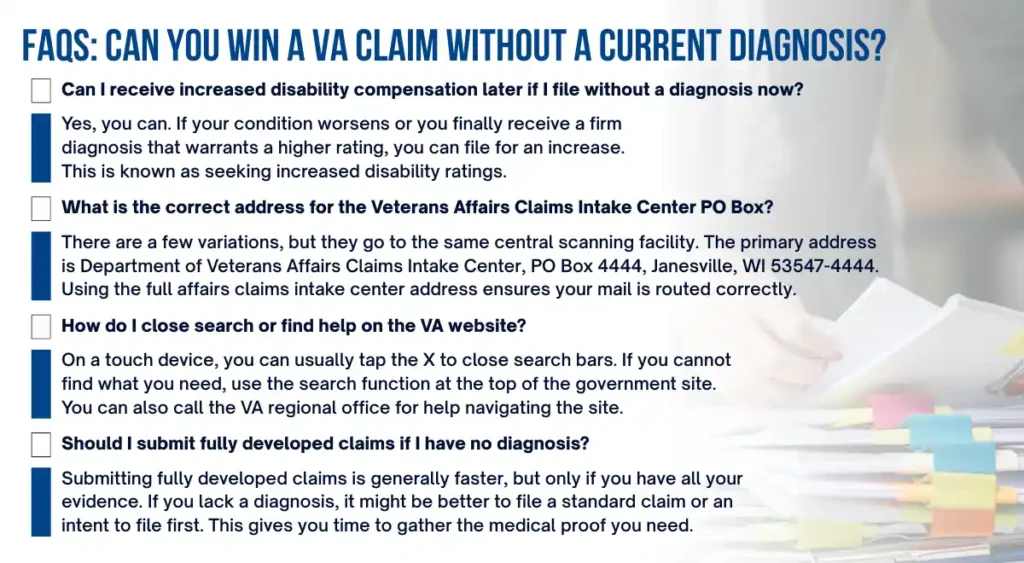
If you prefer paper, you must send your forms to the right place. You cannot just send them to a local hospital. You need to mail them to the centralized intake center. The specific address often confuses people because of the long title. You generally mail documents to the Veterans Affairs Claims Intake Center PO Box 4444 in Janesville, WI. The claims intake center scans everything into the digital system.
Getting the address right is critical. If you leave off intake center po or the box number, mail gets lost. The affairs claims intake center po box destination is the primary hub for all paper evidence. To ensure speed, many veterans skip the mail. But if you must mail, use the full claims intake center po box address. The intake center staff processes thousands of documents daily.

Step 3: Understand “current disability” without a formal name yet
The phrase “current disability” trips up a lot of veterans. You might think it has to mean a final, locked-in diagnosis that never changes. That is not how the VA always views it. In many cases, consistent and documented symptoms, combined with exam findings, can meet the bar. Later, the VA examiner at your compensation and pension exam might put an official name to it. This connects your symptoms to a ratable condition.
That exam still ties back to the period after you filed your 21-526. So you do not lose your place in line just because the label came later. Your VA disability claim remains valid from the start date.
What if you had a condition before service
Some people enter service with asthma, knee problems, migraines, or mental health conditions. These issues might already be part of their life story. If service made that earlier problem worse, the VA has rules for that. Under 38 CFR 3.306, a pre-existing condition is considered aggravated if there is a clear increase in severity during service. You do not need a new diagnosis to prove this.
So even without a fresh diagnosis, records showing more flares count. Stronger symptoms or added limits during or after service can carry serious weight. This leads to service-connected disability status based on aggravation.
Step 4: Build a timeline that makes sense on paper
You have lived this health journey from the inside. The VA rater has not. They only see what is written in your file. So sit down and map out a simple timeline. Start with your entry date. List key injuries or stressors while on active duty.
Include your duty stations and then when symptoms first appeared or worsened. This personal timeline will guide what you say in your statement. It also dictates which records you request to back each event up.
Matching events to evidence
After you outline your timeline, connect each turning point to a record type. A field injury might link to line of duty notes. You might find emergency room visits or sick call slips. A trauma exposure might tie to unit reports, awards, or other deployment papers. Mental health symptoms can connect to records at your VA clinic. Even private therapy notes count.
By the time you file, every major event should have support. You want at least one document or witness who can confirm it. This makes your VA claim hard to dispute.

Step 5: Gather service and medical records that match your story
The VA often already holds your service treatment records and personnel file. But that does not mean every private record made its way there. It also does not mean the rater will read your story the way you see it. You can pull extra records through USA.gov resources or ask private doctors directly. Organize copies for your own files so you know exactly what evidence backs you up. Never assume the VA has everything.
If you need community-based resources while you do this work, look around. The National Resource Directory can be a good place to look for veteran services near you. These services can help you locate a VA location for assistance.
Key types of records that matter most
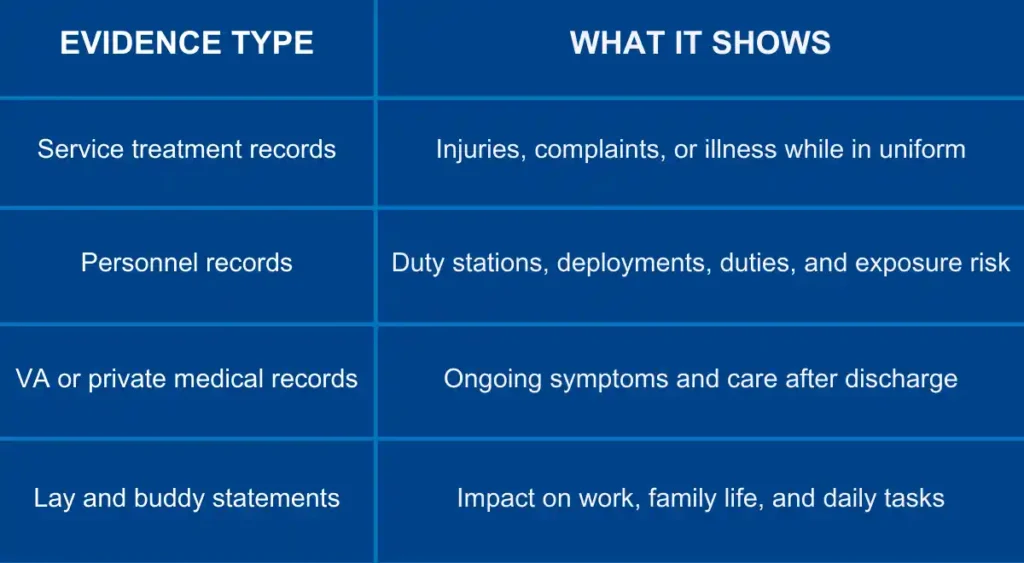
Think about four main buckets. Service records, medical records, lay statements, and program records. Program records include therapy notes or support group documentation. Service records help prove what happened while you wore the uniform. Medical records show how your body or mind reacted then and now. Lay statements give a real-world picture of your daily limits.
Program records can show your effort to get help. This is especially true through things like Homeless Veterans services. Women Veterans programs or Minority Veterans resources also generate valuable records.
How to talk about undiagnosed symptoms without guessing
A lot of veterans feel pushed to pick their own diagnosis. They think the VA will only take them seriously if they use medical terms. That can backfire. You are better off giving strong facts about symptoms than trying to pin a name on it yourself. Describe what you feel, see, hear, and live with. Do not state what you think the medical label is.
For example, say “sharp pain in lower back that shoots down the leg twice a week.” Do not just say “sciatica.” The doctor and the examiner can then use that rich description to do their part.
Using patterns, not just bad days
The VA wants to rate average levels of impairment. They do not just look at rare bad days. Track how often you miss work due to symptoms. Note if you cancel plans or lie down during the day. If sleep, anxiety, or flashbacks drive your struggles, document it. Programs under PTSD resources can also add treatment notes that confirm those patterns. Patterns across months or years can point clearly to a VA disability. This holds true even while the specific label evolves. Consistency is key for disability claims.
How the VA handles some undiagnosed issues
There are groups of symptoms where the VA already expects to see conditions. This happens even without a quick clear cause. Think of environmental exposure issues or certain clusters after combat. If you served during the post-9/11 era or in earlier conflict zones, rules change. Staying updated through VA email updates helps. Official VA social media can help you track new rules that may help your case. Changes often show first through VA news posts. They appear there before they filter down to individual claims. Always keep an eye on VA outreach materials.
The mental health piece: stigma, fear, and documentation
For mental health especially, many people live with symptoms for years. They do this before anyone writes down an actual diagnosis. You may worry about stigma or what people will think. The hard truth is that what is not on paper often gets missed. Decisions on VA benefits rely on written proof. Resources through VA mental health services can help you take that first step.
If thoughts turn dark and you need crisis-level support, do not wait. You can start a confidential chat and find more resources at VeteransCrisisLine.net. This connects you to the veterans crisis team immediately.

What a good personal statement looks like
Your personal statement is where the rater hears from you. It provides a voice beyond the medical jargon in your chart. Think of it as a focused letter, not a rant. On your Statement in Support of Claim, walk the reader through three main parts. Cover service events first. Then cover the onset or worsening of symptoms. Finally, explain the impact on your life today. Stay honest, clear, and specific. Leave out guesswork and stick with what you live through each day.
Questions to answer in your statement
Try writing a draft that answers questions like these. When did you first notice the symptoms? What were you doing in service around that time? How did the symptoms change during deployments or training cycles? Did they change after specific incidents? How have work, school, or family life changed because of your condition now?
If your claim is based on aggravation of a prior condition, describe it plainly. Tell them how much worse things are today than before you served. This helps justify increased disability compensation later.
How to build a VA claim when the VA hasn’t diagnosed you yet without feeling lost
You might feel like you are building a house without blueprints. No one handed you a clear roadmap the day you left the service. It can be confusing. Think of the steps this way. First, you get consistent medical documentation. Then, you file the correct claim form.
This starts the clock and creates your place in line. After that, you build out the story with your own statement. You add buddy letters and carefully chosen records that line up with each key point.
Using other claim worlds as a mindset guide
This whole process might remind you of other insurance processes. Insurance companies handle injury claims after an accident similarly. They also look for medical proof, timelines, and cause. Guides that explain steps to filing a claim after a car accident follow this pattern. Document early, report clearly, then back up every piece with records. The logic is universal. Your VA claim may be federal and military linked. But it still rests on that same solid proof-based way of thinking. Do not overcomplicate the logic.
Staying informed while your claim moves
VA policies and special programs shift over time. That can work for you if you know what is changing. New presumptions and new toxic exposure rules show up throughout the year. Updated additional forms also appear regularly. Staying tuned into official channels prevents mistakes. Check VA news, press releases, and social accounts like VA Facebook or X.
You can even sign up for email updates. This ensures important changes reach you without extra searching. Being proactive prevents you from relying on outdated advice.

What to do if your claim gets denied the first time
Even with strong effort, a first denial happens a lot. That does not mean you were wrong to file. It does not mean your condition is in your head. A denial often signals one of three things. You might have missing evidence. There might be a weak or unclear medical link. Sometimes a rater simply did not see what you see in the file. This is where appeals or supplemental claims come in. You can add fresh records or stronger medical opinions.
Why an early diagnosis later still matters
Sometimes a diagnosis finally appears after you push through more appointments. You might get a second opinion months later. Even if that label is late, it still ties back to your earlier symptoms. That later diagnosis can be added to your record. You can use it in a supplemental claim. You do not go back to square one. You use what you already filed and build from it. The key is to stay on top of follow-up care. Keep each new piece of information flowing into the VA file.
Programs that can support you while you fight for benefits
Your claim journey does not happen in a vacuum. Life keeps moving. Work, housing, and family stress stack on top of health issues. The VA and partner agencies run many targeted programs. These include Homeless Veterans services and Women Veterans support. You can also find adaptive sports and special events. You can look for a full spread of these in the National Resource Directory. You can also look on platforms like VA Instagram, Flickr, or YouTube. Utilizing these programs provides immediate support while you wait for VA disability compensation.
Why clear records beat technical tricks
Some people talk about tricks to get an easy win. They discuss tech topics or shortcuts. With VA disability, your strongest asset is not a trick. It is clear, steady evidence collected over time. It must be linked to real-life impact. The more honest your records are, the better. Consistent records leave less room for doubt. A rater cannot easily miss the picture if the evidence is overwhelming. Build a case that speaks for itself.
When you need hands-on guidance for your claim
You might read all of this and still feel overwhelmed. You might want a teammate in your corner. That makes sense as the stakes feel high. You can work with accredited representatives or county service officers. Legal help is also available. You can also reach out directly to teams who focus on building claims.
Conclusion
Filing a disability claim without a clear diagnosis can feel like stepping into a maze in the dark. But once you know how to build a VA claim when the VA hasn’t diagnosed you yet, that maze turns into a clear path with real steps.
You focus first on documented symptoms and steady care. Then, you anchor those symptoms to service with records, timelines, and your own statement. You let future diagnoses add strength as they come, instead of waiting years to start the process.
Your service counted, and your health struggles now count too. If you stay consistent, keep learning, and use the tools and resources available to you, you can build a claim that finally tells your story in a way the VA cannot ignore.