

You probably never thought the hard part would be after you filed your VA disability claim. Yet here you are, reading a denial letter that feels cold, confusing, and honestly a bit insulting. You are not alone in this frustration.
In fact, the most common reasons the VA denies disability claims. How to fix a VA claim denial with medical care is shockingly similar from veteran to veteran. The good news is that the situation is often reversible. Most denials are fixable when you know what went wrong and how to correct it with solid medical evidence.
That is what we are going to walk through together here. We will look at the most common reasons the VA denies disability claims. How to fix a VA claim denial with medical using better records, stronger medical opinions, and a smarter strategy for appeal. If you have your denial letter near you, keep it close. You will probably spot yourself in several of these examples.

Why So Many VA Disability Claims Get Denied
First, let us talk about the big picture. Law firms that focus on veterans’ disability, like VetLaw, report that a huge number of initial VA disability claims are denied or underrated. Some firms estimate that nearly seven out of ten veterans run into a denial somewhere in the process. This lines up with what many advocates see every day regarding VA disability benefits. There are defined routes to challenge a bad rating decision. You just need medical proof that matches what the VA needs to see.
Most common reasons the VA denies disability claims. How to fix a VA claim denial with medical
Let us break this into two parts. First, we will look at the reasons you probably got denied. Second, we will explain exactly how stronger medical evidence can flip that result. You will see a pattern pretty fast.
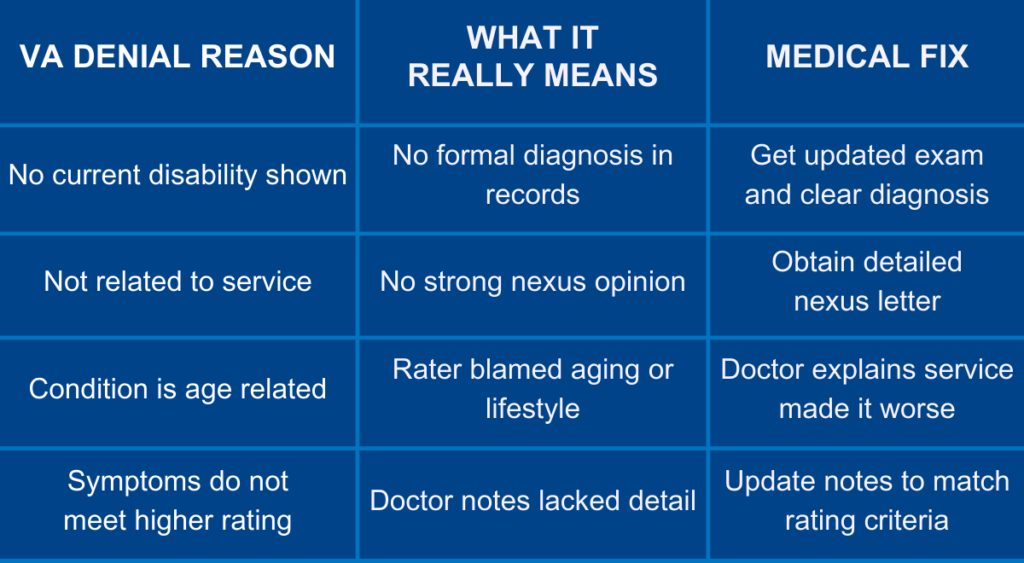
1. No current diagnosed disability on record
The VA will not grant service connection if they think you do not have a current condition. You may have daily pain, flashbacks, or sleep issues. However, if there is no formal medical diagnosis in your records, many raters stop right there. They may even write something like “no current chronic disability shown by evidence.” This often happens with complex conditions like a traumatic brain injury.
A veteran might complain of headaches, but without a specific diagnosis, the VA treats it as a symptom rather than a disability. Unlike Social Security Disability where total inability to work is required, the VA compensates for specific conditions. Therefore, naming the condition precisely is essential.
Medical fix:
- Get a current diagnosis from a qualified provider, not just symptoms written in a note.
- Ask your doctor to list the exact name of the condition and the diagnostic standard they used.
- For mental health, the doctor should tie their findings to DSM‑5 criteria.
Compare these two statements and notice the difference. “Veterans likely experienced PTSD symptoms during service” sounds soft and uncertain. “Clinical evaluation confirms PTSD, meeting DSM‑5 criteria based on service related trauma documented in service treatment records” is clear and grounded in the record.

2. VA says there is no nexus to service
You can have a rock solid diagnosis and still get denied if the VA does not see a link to your time in uniform. That link is called the medical nexus. It answers one core question. Is it at least as likely as not that your current disability was caused or aggravated by your service? Many denials state some version of “the condition is not related to military service.”
That often means no strong medical opinion was in the file connecting the two. This is critical for both a primary service-connected issue and a secondary condition. A secondary condition is a disability caused by another service-connected problem. For example, if your service-connected knee injury altered your gait and caused back pain, that back pain requires a nexus to the knee injury.
Medical fix:
- Ask a qualified doctor to write a clear nexus letter using the phrase “at least as likely as not.”
- The doctor should review your service records, past exams, and current treatment.
- They must explain the reasoning, not just give a short yes or no.
The Veterans Benefits Knowledge Base shows what strong independent medical opinions look like in VA claims. A short note that simply says “related to service” rarely moves the needle. Detailed, medically backed reasoning does.
3. Service records do not clearly show the event or injury
Many veterans were taught to tough it out and skip sick call. So your service treatment records might not show the blast, fall, accident, or assault that actually caused the issue. The VA may use this gap to deny your claim. You might see wording such as “no documented event in service” or “no in‑service incurrence found.” For Guard and Reserve, this is even more common.
A GAO study found that Army Reserve and National Guard veterans often face higher rejection rates, in part due to scattered records. The absence of formal incident reports can be a major hurdle. However, you can still provide evidence through other means.
Medical fix:
- Ask your doctor to give a timeline that matches your sworn statement about the in‑service event.
- Use buddy statements to help back up what happened and when.
- For things like hearing loss, tinnitus, or PTSD, ask the doctor to explain delayed onset if the symptoms got worse years later.
Think about how people talk about the most common airbag injuries in car crashes. The doctor might not see the crash in front of them, but they know how that type of impact usually harms the body. They can do the same with common military stressors.
4. C&P exam was rushed, unfair, or inaccurate.
Many veterans walk out of a compensation and pension exam feeling like they were not heard. The exam might have lasted ten minutes. The examiner might have skipped a range of motion checks or barely asked about mental health symptoms. Then the VA leans on that single exam to deny you.
It is vital that you attend scheduled exams, but you must also be ready to correct the record. The VA claims process relies heavily on these exams, sometimes to a fault. If the examiner did not review your relevant medical history, their opinion might be flawed.
Medical fix:
- Request a copy of your C & P exam notes and read what the examiner wrote.
- If the notes are wrong, get your treating provider to write a rebuttal.
- You can also bring a detailed independent medical opinion from outside the VA to challenge the exam findings.
This is like appealing any insurance claim denial. Sometimes the first person who reviewed the file just got it wrong. You fix that with stronger, clearer evidence and a second set of eyes.

5. VA lowballed your rating
Sometimes you are technically “granted,” but the rating is so low that it may as well be a denial. You might get 10% for a back injury that keeps you from working a full day. Or 30% for PTSD that blows up relationships and makes steady work a daily battle. The disability rating determines your monthly compensation.
Therefore, getting the correct percentage is just as important as getting the service connection. The VA schedule for rating disabilities is very specific. It lists exact symptoms required for each level, such as 30, 50, or 70%.
Medical fix:
- Study the rating criteria in the VA schedule for your specific condition.
- Ask your doctor to write notes that line up with those criteria.
- For example, have them spell out limits in work, social life, sleep, and self‑care with detail.
The VA is very checklist driven regarding disability ratings. If your doctor’s notes track each symptom that the higher rating mentions, you give the rater far less room to lowball you.
6. Gaps in treatment or long breaks in your records
Life happens. Maybe you lost insurance. Maybe you got tired of repeating your story to new doctors. The result is big gaps in treatment records, and the VA uses that to claim your disability is not “chronic.” They might argue the condition resolved itself.
Consistent treatment history is the best way to prove a condition is chronic. However, when gaps exist, you must explain them with evidence showing ongoing treatment was needed but not accessed. This is common in claims involving pain management or mental health.
Medical fix:
- Explain the gaps to your current doctor and ask them to document that your symptoms continued during that time.
- Bring in statements from family, coworkers, or friends about how you were struggling during the years without treatment.
- Have the doctor clearly say the condition did not resolve during the gap.
Doctors see this kind of pattern in many areas of health. The most common causes of memory loss, for example, may develop slowly and only show up in records once people finally get scared enough to seek help. The same slow burn often applies to depression, pain, or sleep disorders from service.
7. VA blames everything on age, weight, or lifestyle
This one frustrates a lot of veterans. Your knees are wrecked from years of ruck marches and jumps, yet the denial letter claims the damage is “degenerative” from normal aging. Or the VA says your back problems are just from being out of shape, even though you were already hurting during deployment. This differs from workers’ compensation, where work injuries are more immediately recognized.
The VA often looks for reasons to attribute conditions to post-service life. Even if a condition existed before service, if military duties made it worse, it is considered service aggravated. You can be compensated for that aggravation.
Medical fix:
- Ask your doctor to explain why your condition is more severe than expected for your age.
- Have them point out signs that suggest trauma rather than simple wear and tear.
- They can also say your time in service at least made your condition worse, which can still win service connection.
Doctors deal with cause and effect every day. Think of a dentist looking at the common reasons someone might need a tooth pulled. They look at timing, damage patterns, and risk factors. Your VA doctor or outside specialist can do the same for your injuries.

8. The VA misunderstands mental health conditions
Mental health claims have their own set of hurdles. Stigma, rushed exams, and confusing symptom lists often mix into weak decisions. You might be told that you have anxiety instead of PTSD, or that your condition is “mild,” even though it has crushed parts of your life. This is where understanding the difference between Social Security and VA standards is key.
For social security disability, you must prove you cannot work at all. For the VA, you must prove a service connection and a specific level of impairment. Confusion between these standards can lead to poor documentation.
Medical fix:
- See a psychologist or psychiatrist who understands trauma, combat stress, or military sexual trauma.
- Ask them to tie your diagnosis to DSM‑5 criteria and specific service events.
- Have them spell out how your condition affects work, family, and daily life.
We all get stuck in our heads. Mental health pros even write about our most common thought traps, and how we twist situations without meaning to. Your VA rater is human too and can fall into these traps when reading your file, which is why precise medical descriptions matter.
How to read your VA denial and build a plan
Your denial letter is painful to read, but it is also a roadmap. The VA usually tells you why they denied your claim in short bullet style sections. Those sections point straight at the medical evidence you need to fix next. They spell out the va standards used to judge your file.
Here is a simple way to use that letter.
- Highlight every reason the VA gave for denial or low rating.
- List what is missing for each reason. Is it diagnosis, nexus, severity, or timing.
- Match each missing item with a medical action you can take in the next 60 days.
Using the three main VA appeal lanes the smart way. Once you know what went wrong, you have three basic options under VA decision reviews. All are listed on the VA website, but let us put them in plain language with a medical focus.
Choosing the correct lane is vital for your VA appeal.
1. Higher Level Review with VA Form 20‑0996
A Higher Level Review is like asking for a supervisor to look again at the same evidence. You use VA Form 20‑0996 to start this path. This option works best if you believe the VA simply misread your records or the C & P exam, not if key medical documents were missing. This level review does not allow for new evidence. If you forgot to include medical records, this is not the right lane for you.
Medical angle:
- You usually cannot add new medical records here.
- So you focus on pointing out errors or missed facts already in the file.
- Sometimes a lawyer or accredited agent can argue that the existing evidence already met the standard.
2. Supplemental Claim with VA Form 20‑0995
A Supplemental Claim is where new and relevant evidence comes into play. You file this route with VA Form 20‑0995. This is the lane you use when you have fresh medical opinions, new test results, or missing records that fill the gaps. Supplemental claims are the most common way to fix a denial caused by a lack of evidence. You can file VA forms for this lane as soon as you have the new proof ready.
Medical angle:
- Bring in updated treatment notes that show your current diagnosis and severity.
- Add a strong independent medical opinion or nexus letter.
- If you found old service records or line of duty reports, include those as well.
The VA site for Supplemental Claims explains exactly how this works from their view. Your job is to match their rules with your medical evidence step by step.

3. Appeal directly to the Board with VA Form 10182
If you want a Veterans Law Judge to look at your case, you appeal to the Board. You use VA Form 10182 for that option. This path can be slower but may be the best move if the Regional Office keeps repeating the same mistakes. Veterans’ appeals at the Board level allow for a more thorough legal review. This is often where complex arguments about service connection are won.
Medical angle:
- Strong, clear medical evidence becomes even more important at this stage.
- Your representative might ask for a hearing and use your medical opinions to cross check the VA’s view.
- This is where a good expert report can tip the scales.
How to work with your doctor for a stronger claim
Most civilian doctors have never filled out a VA Disability Benefits Questionnaire or written a nexus letter. They might not understand how much detail the VA expects regarding VA disability compensation. So you need to be an active partner in that visit. You must ensure they include medical details that matter to a rater. Evidence showing the severity and origin of the condition is paramount.
Here are some steps that work well.
- Bring your denial letter to the appointment so the doctor sees the VA’s reasoning.
- Bring a copy of any past C & P exams and highlight parts that felt wrong or incomplete.
- Ask the doctor to review at least some of your service treatment records if possible.
- Request that they explain their opinion in normal language with medical facts behind it.
Doctors appreciate clarity too. You are not asking them to become a legal expert, just to give a full medical picture of what is going on and how it ties back to your service. The more they write down, the easier it is for a rater to grant what you are due. This detailed medical approach transforms a basic medical note into a powerful piece of evidence. Spotting and avoiding the VA’s thought traps
Just like you, VA raters can fall into patterns of thinking that are not fair or accurate. Some are unconscious biases, some are bad habits from rushing cases. If you spot them, you can call them out in your appeal. Understanding the reasons VA employees might deny a claim helps you fight back.
Here are some examples:
- Assuming no records means nothing happened.
- Blaming age or lifestyle by default for any degenerative change.
- Downplaying mental health issues because the veteran “looks fine” on paper.
- Overvaluing one short exam over years of treatment notes.
Writers who talk about mental patterns, like those describing our most common thought traps, show how easy it is to slip into shortcuts. The key is this. You and your doctor respond with detailed, calm evidence that pushes the rater out of those shortcuts and back to the facts.

Conclusion
If your VA decision letter is sitting on the table, it can feel like the system has decided your pain or trauma does not count. That is not the end of the story, though. Often it is just the start of the real work. By now you have seen that the Most common reasons the VA denies disability claims. How to fix a VA claim denial with medical evidence comes down to clear patterns and fixable gaps.
Lack of diagnosis, weak nexus, missing service records, unfair exams, or low ratings are all common problems. Each one has a matching medical answer. That might mean a stronger opinion from a specialist, better documented symptoms, or old records finally brought into the light. With the right medical backing and a clear strategy, you can turn a denial into an approval or a low rating into a fair one.
Your service already costs you enough. Getting the benefits you earned should not be another silent battle you face without support. If you are ready to take the next step, start with your denial letter and your doctor. From there, choose the best review lane, and if needed, pull in an experienced veterans law team to walk with you through the process.