

Feeling lost in the maze of VA paperwork for your disability benefits? You are not alone. Many veterans get tripped up by the terms the VA uses, and it is easy to see why you might be confused about nexus letters vs independent medical opinions for VA claims? Compare their purpose, depth and impact. These two documents sound similar, and people often use the names interchangeably. They have different jobs in your VA disability claim, and knowing that difference can be the one thing that gets your claim approved.

If you’ve ever felt confused about nexus letters vs independent medical opinions for VA claims? Compare their purpose, depth and impact, then you are in the right place to get some real answers. Understanding these tools can give you control over your claim and help you get the compensation you earned through your service. This is especially true for complex cases involving things like Agent Orange or Gulf War Syndrome.
Why Medical Opinions are the Heart of Your Claim
Before we break down the two types of medical evidence, let’s get on the same page about why they matter so much for all VA disability claims. To win VA disability benefits, you have to prove service connection. Think of it as a three-legged stool; if one leg is missing, the whole thing falls over.
Here are the three legs you absolutely need:
- A current, diagnosed disability from a healthcare provider.
- An event, injury, or illness that happened during your military service.
- A medical link, or medical nexus, that connects your current disability to that event in service.
That third leg, the medical nexus, is where most veterans get stuck in the claims process. You can have a mountain of evidence showing your bad back and point to the exact day you fell off a truck in service. But without a doctor officially linking the two, the VA will likely deny your disability claims.
This is where medical opinions become your most powerful tool. The VA needs to see a clear connection, whether your condition is from a direct injury, from environmental hazards like burn pits, or from exposure to things like the Camp Lejeune contaminated drinking water. A strong medical opinion provides the professional judgment the VA needs to approve your VA claim.
The Nexus Letter: Building the Bridge
A VA nexus letter is exactly what it sounds like. It is a focused document with one main goal. It’s built to be the bridge that connects your current medical condition to your time in the military.
What is a Nexus Letter, Really?
A nexus letter is a written medical nexus opinion from a medical professional. This letter clearly states that your disability is connected to your service. It directly addresses that crucial third leg of the service-connection stool for your service-connected disability.
This is not just a simple note from your doctor. A powerful VA nexus letter shows that the expert has looked over your records. They see the full picture of your health, both during and after your time in the service, to form their nexus opinion.
A strong nexus letter ends with a very specific phrase. The doctor will state that your condition is “at least as likely as not” caused by your military service. That phrase is gold to the VA because it meets their 50% probability standard of proof.
Who Can Write a Powerful Nexus Letter?
Technically, any qualified medical professional can write nexus letters. This includes your family doctor, a specialist, a physician assistant, or even a psychologist for mental health claims. Getting it from the right person makes a huge difference, though, especially if you want a strong nexus letter.
A letter from a specialist in the field related to your disability carries more weight. If you have a heart condition from exposure to particulate matter, a medical nexus letter from a cardiologist is more persuasive than one from a general practitioner. The VA gives more “probative value” to an expert’s opinion, so it is important to find someone qualified to write nexus letter documentation.
Your own treating VA doctor can also be a great choice to write nexus. They know your medical history better than anyone. They have seen how your condition, like sleep apnea or a traumatic brain injury, has progressed over time.

What Goes Into a Winning Nexus Letter?
A weak nexus letter is just a doctor’s signature on a piece of paper. A strong nexus is a detailed argument that leaves the VA with no doubts. It should always be clear that the medical expert has done their homework and is prepared to write nexus letters that hold up.
The doctor must state they have reviewed your complete file. This includes your service medical records, VA medical files, and any private treatment records. This full review gives their medical evidence its strength and credibility.
The letter also needs to explain the rationale. Why does the doctor believe your PTSD is from combat and not something else? A solid medical explanation is the backbone of the entire document and what makes it a strong nexus that can help you win your veterans claims.
The Independent Medical Opinion (IMO): The Full Story
Now let’s talk about the Independent Medical Opinion (IMO). While a nexus letter is a type of IMO, the term “IMO” usually refers to something much more thorough. Think of a VA nexus letter as a targeted strike and an IMO as a full-scale assault on the evidence.
How is an IMO More Than a Nexus Letter?
An Independent Medical Opinion is a comprehensive medical evaluation done by an expert who is not your regular treating doctor. The “independent” part is important. It means they are giving an unbiased opinion based only on the evidence presented in your VA claim file.
While an IMO will almost always include a nexus statement, it often goes much deeper. It does not just build the bridge to service connection. It can also build out the entire case around it, which is useful when appealing VA disability claims.
Many IMOs are written to challenge a conclusion the VA has already made. This is often in response to a negative finding from a Compensation & Pension (C&P) exam. An IMO provides a powerful counter-argument based on medical facts and can be crucial for supplemental claims or higher-level review requests.
What Else Can an IMO Do For Your Claim?
Because an IMO is more comprehensive, it can address several parts of your VA disability claims at once. An expert can use an IMO to argue against a bad C&P exam or previous BVA denials. They can point out errors the VA’s examiner made or provide a more detailed analysis.
An IMO can also help you get the right VA disability rating. A doctor can fill out a Disability Benefits Questionnaire (DBQ) as part of the IMO. This form details the severity of your symptoms, which the VA uses to assign disability ratings and can support a claim for individual unemployability.
Sometimes, an IMO even includes a direct examination of the veteran. This is different from a nexus letter, which is almost always just a review of your existing records. This hands-on evaluation adds a lot of credibility to the doctor’s findings and can be decisive when appealing VA decisions.
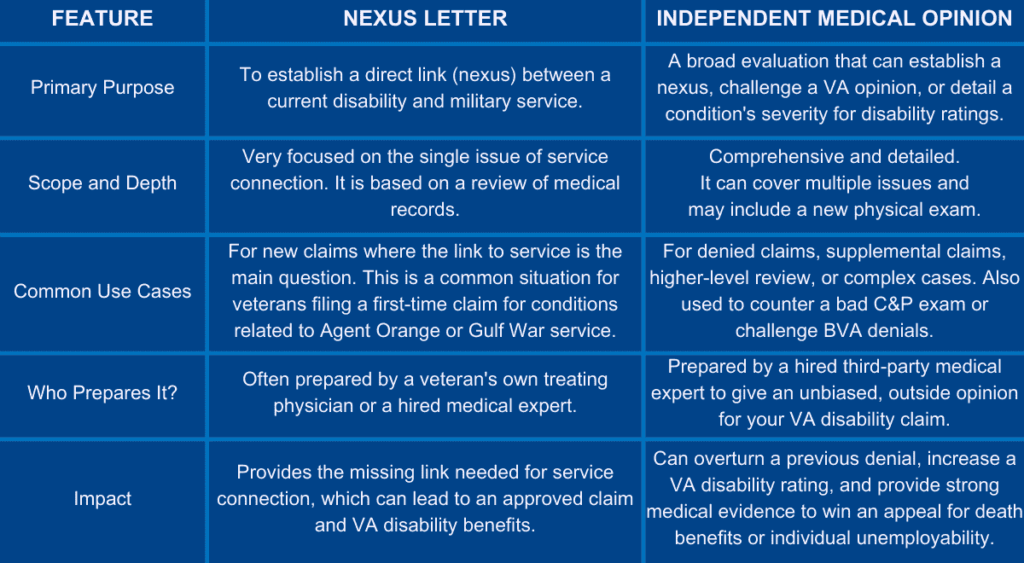
Still confused about Nexus Letters vs Independent Medical Opinions for VA Claims? Compare Their Purpose Depth and Impact Side-by-Side
Seeing things next to each other often makes the differences clear. Sometimes a simple table is all you need. This should clear up any remaining confusion.
What about the VA’s C&P Exam?
It is important to remember that the VA will almost always schedule its own medical exam. This is called a Compensation & Pension (C&P) exam. This exam is, in effect, the VA’s own IMO and is similar to other pension exams.
Unfortunately, these exams can be a problem. Many C&P examiners are contractors who rush through dozens of appointments a day. They might spend only a few minutes with you and miss key details in your file, from your brain injury to your exposure to the contaminated drinking water at Camp Lejeune.
If a C&P examiner writes a negative opinion, your claim is in serious trouble. This is why having your own evidence is so vital. A strong, well-reasoned nexus letter or IMO from a specialist in your corner can directly challenge and outweigh a weak opinion from a VA contractor.
The Board of Veterans’ Appeals frequently sees cases where a private medical opinion was the key piece of evidence that won the case. Submitting your own medical evidence gives you a say in the outcome. It prevents the VA from being the only one providing a medical opinion on your condition.
Which one is Right for Your Claim?
So, which document do you need for your veterans claims? There’s no single right answer, because it depends completely on your specific situation. You have to look at what you are trying to prove in your journey for VA disability benefits.
A clear and powerful nexus letter might be all you need for a straightforward claim. If you have a well-documented injury in service, like from a training accident, and just need a doctor to connect the dots, this is a great tool. It’s focused and gets the job done for your VA medical file.
But if your claim is more difficult, an IMO is probably the better weapon. If you’ve been denied before when appealing VA disability, an IMO can tear apart the VA’s reasons for denial. If you think your VA disability rating is too low, an IMO with a DBQ can show the true severity of your condition.
Think of it like fixing a car. Sometimes you just need a wrench to tighten one bolt. Other times, you need a full diagnostic machine to find a hidden problem. A nexus letter is the wrench, and the IMO is the diagnostic machine for your VA claims.

Conclusion
Hopefully, you are no longer so confused about nexus letters vs independent medical opinions for VA claims? Compare their purpose, depth and impact. While they are related, they serve different functions within the VA claims system. A nexus letter is a precise tool for building the bridge of service connection for a VA claim.
An IMO is a comprehensive tool for fighting and winning more complex battles with the VA, from initial disability claims to veterans’ appeals. Knowing which one you need puts you in control of your claim. It lets you give the VA the exact medical evidence they need to make the right decision.
This understanding helps you secure the VA disability benefits you have earned through your service and sacrifice. Whether you’re dealing with the effects of the Camp Lejeune contaminated drinking water or another service-related issue, the right medical opinion makes all the difference. You can move forward with confidence in your claim.